Coal, Metallurgical Coal
October 21, 2026
TRADE REVIEW: Asian met coal market enters Q4 seeking support beyond China's Q3 rally
By Sumita Layek and Samuel Chin
Editor:
HIGHLIGHTS
China's Q3 buying surge drives coal price rally
Indian restocking emerges as Q4 price factor
LVHCC relativity to PLV rises to 86.3%
This report is part of S&P Global Energy's Metals Trade Review series, where we dig through datasets and digest some of the key trends in iron ore, metallurgical coal, copper, alumina, cobalt, lithium, nickel and steel and scrap. We also explore what the next few months could bring, from supply and demand shifts to new arbitrages, and to quality spread fluctuations.
The Asian seaborne metallurgical coal market enters the fourth quarter after a China-led rally pushed prices to multiyear highs in Q3, as market participants are monitoring whether anticipated Indian restocking can offset recovering Chinese coal production and weak steel margins.
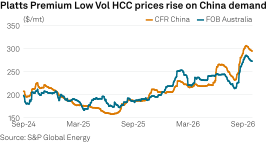
Platts, part of S&P Global Energy, assessed premium low-volume hard coking coal reached more than two-and-a-half-year highs Sept. 10, with FOB Australia at $284.90/metric ton and CFR China at $305.80/mt.
PLV HCC FOB Australia ended Q3 at $272.10/mt, up $28.60/mt from the start of the quarter, while CFR China rose $30.50/mt to $294/mt.
The rally extended gains from late Q2, after the May 22 Shanxi mine accident raised concerns about Chinese domestic coal supply and revived import demand. Supply constraints remained a key Q3 feature as production normalized more slowly than expected, while mine-safety inspections and tighter Mongolian coal flows supported demand for imported seaborne cargoes.
S&P Global Energy CERA analysts expect Shanxi mine restarts to accelerate in Q4, although significant capacity remains suspended or under safety inspection. The analysts project China's metallurgical coal production to decline by about 45 million mt in 2026 as Shanxi balances efforts to restore supply with mine-safety requirements.
China's supply challenges reshape Q3
China was the dominant driver of Q3 seaborne demand, reversing weak buying seen through much of the first half of the year.
As Chinese buying increased, liquidity improved markedly. Platts published 1,941 CFR China-related bids, offers, trades and notional indications in Q3, up 108.3% from Q2 and 137.3% from Q1.
Of the 22 PLV HCC trades published by Platts during the quarter, 17 were destined for China. Slower-than-expected recovery following the Shanxi mining accident, ongoing mine-safety inspections and reduced Mongolian inflows continued to tighten coal availability.
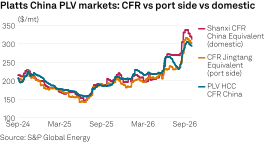
Additionally, as arbitrage opportunities opened between domestic and seaborne markets, Chinese buyers were increasingly willing to pay competitive levels for imported cargoes, supporting both CFR China and FOB Australia prices.
Can China keep supporting prices?
As Q4 begins, market participants are watching whether Chinese demand can continue supporting seaborne prices.
Chinese regulators have pushed for greater stability in domestic coal production while maintaining stringent mine safety standards, creating uncertainty about the pace of supply recovery.
Mongolian supply remains a focal point. Daily truck movements through the Ganqimaodu border crossing fell sharply in late August amid stricter inspections and have remained at about 500-700 trucks/day, from 1,300-1,400 trucks/day during May-July, according to market participants.
Market participants expect demand to remain firm in October after Golden Week, supported by restocking requirements and lingering domestic supply constraints.
However, participants increasingly anticipate prices to ease later in Q4 as domestic coal production recovers and weak steel margins reduce mills' appetite for higher-cost raw materials.
"Chinese demand has been very supportive, but if steel mill margins continue deteriorating, we could eventually see production cuts and lower coal consumption," a trader source said.
India to determine if rally extends
While China dominated seaborne headlines in Q3, attention has increasingly shifted to India, where any return of spot buying could tighten an already-supported market.
CFR India market activity remained largely stable in Q3, with Platts publishing 428 bids, offers and notional indications, up 7% from Q2, as many buyers continued relying on long-term contractual supplies.
"Spot PHCC demand is now very limited in India ... before April, at least 3-4 Panamaxes per month could go to India, but now only 1-2 Panamaxes can go [to India per month], and even those would struggle to find buyers," an international trader said.
The subdued pace of spot buying is precisely why India has become a key Q4 variable.
Market participants said any improvement in spot demand would coincide with relatively firm Chinese buying interest, potentially tightening the availability of premium Australian cargoes.
India's finished steel consumption increased 7.4% year over year to 70.5 million mt during April-August, with participants expecting stronger demand during the October-November festive season and into the traditional peak consumption period extending into Q1 2027.
Additional support may come from the coke market. Lower Indonesian coke deliveries resulting from drought-related disruptions in September-October are expected to tighten India's imported coke availability, potentially encouraging some steelmakers to increase coking coal purchases.
Indian buyers have also become increasingly comfortable diversifying away from Australian supply, with greater use of US-origin high-volatility coals alongside PCI and other low-volatility materials to optimize blend costs, trading sources said.
LVHCC relativities recover
The Platts low-volume hard coking coal relativity against PLV HCC FOB Australia strengthened through Q3, recovering from multimonth lows as Chinese buyers returned to the seaborne market.
Monthly average relativity rose from 75.6% in May to 82.3% in June and 87.4% in August, before easing to 86.3% in September.
The recovery contrasted with earlier conditions, when ample spot availability across multiple LVHCC brands and subdued end-user demand pressured prices relative to PHCC.
During Q3, stronger Chinese import demand, tighter Mongolian coal availability and domestic supply constraints lifted values across China's domestic and portside markets. Portside LVHCC prices rose to two-and-a-half-year highs, improving seaborne cargo competitiveness and increasing buying interest across a broader range of coal grades.
Platts weekly LVHCC Ex-Stock Jingtang climbed to 2,150 yuan/mt during Q3, up 640 yuan/mt from May 22, when the Shanxi mine accident triggered concerns over domestic coal availability.
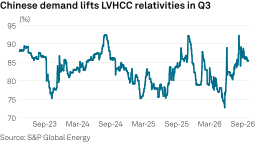
Market participants said buyers were increasingly willing to consider LVHCC cargoes as supply concerns persisted, allowing LVHCC to outperform PLV HCC on a relative basis.
Relativities eased slightly in September as concerns over immediate coal availability moderated and portside inventories strengthened. Nevertheless, values remained well above Q2 levels, with developments in China's domestic coal market and Mongolian export flows likely to remain key drivers in Q4.
