
1860
Henry Varnum Poor publishes “History of the Railroads and Canals of the United States,” the first attempt to arm investors with data on the growing U.S. railroad industry. It sparks an intelligence groundswell that continues today.
1862
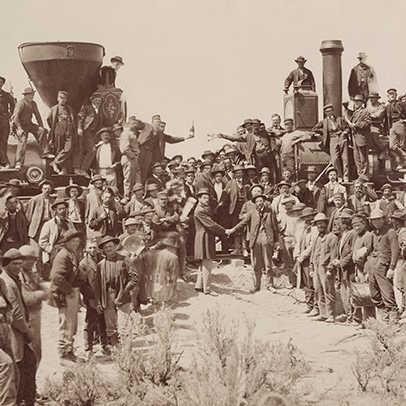
The U.S. government appoints Poor as a commissioner for the Union Pacific Railroad. Poor gains valuable insights, laying the groundwork for S&P Global’s industry-leading government and infrastructure solutions.

1868
Poor’s Publishing prints the “Manual of the Railroads of the United States,” giving investors current information on U.S. railroads. The guide helps readers make decisions by allowing them to monitor a railroad’s performance.

1884
Charles Dow invents the first stock index. The 11-stock index appears in a newsletter, carried by runners to subscribers on Wall Street.
1896
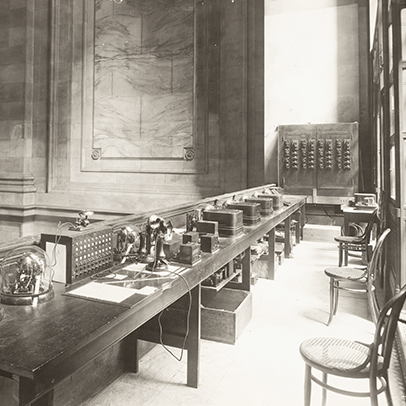
Charles Dow creates the Dow Jones Industrial Average, providing financial information with unprecedented speed. S&P Dow Jones Indices carries on Dow’s legacy in the global economy.
1906
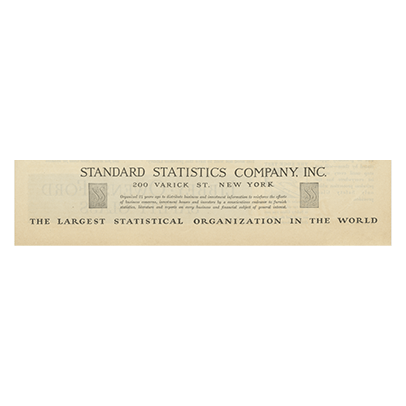
Luther Lee Blake founds the Standard Statistics Bureau to provide current information on non-railroad industrials. Standard Statistics delivers index cards, each containing current news items, to investors to complement the publication.

1909
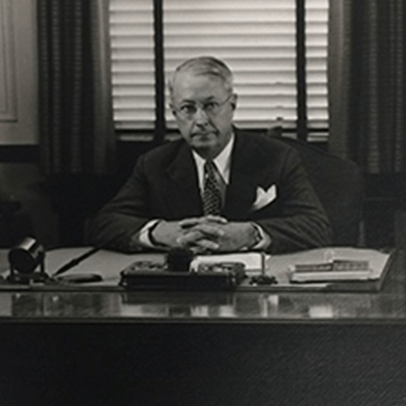
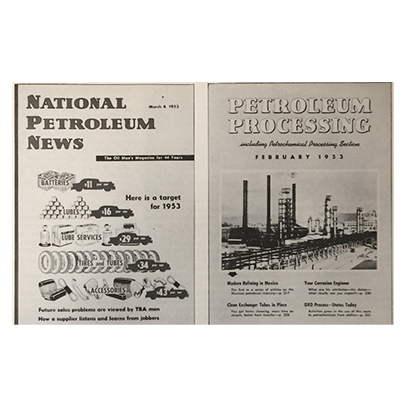
Reporter Warren C. Platt publishes the National Petroleum News, introducing competition to the markets and helps establish Platts as a leader in global energy, chemical and commodities information.
1913
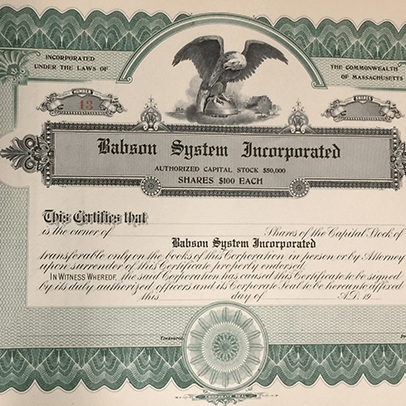
Standard Statistics expands the scale and scope of its index card capabilities by purchasing Babson’s Stock and Bond Card System. Standard Statistics index cards begin providing even more financial information in a portable format.
1916
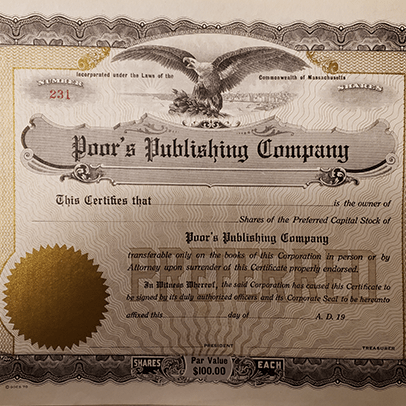
Poor’s Publishing issues its first credit rating, providing subscribers forward-looking, standardized data on issuers’ creditworthiness. Standard Statistics follows suit in 1922.

1923
Platts Oilgram Price Service offers data daily. Standard Statistics creates its first stock market index. Weekly, it covers 233 U.S. companies, and weights capitalization.
1928
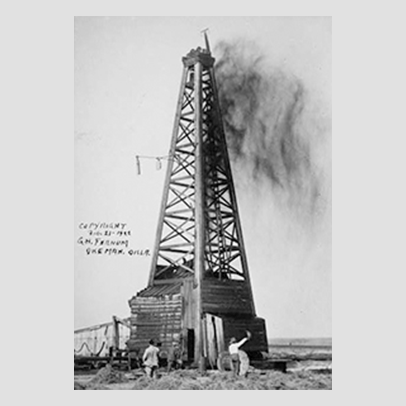
Platts Oilgram Price Service’s U.S. Gulf Coast oil prices become the basis for the first major international oil transaction between the largest companies in the U.S., Europe and the Middle East.
1929
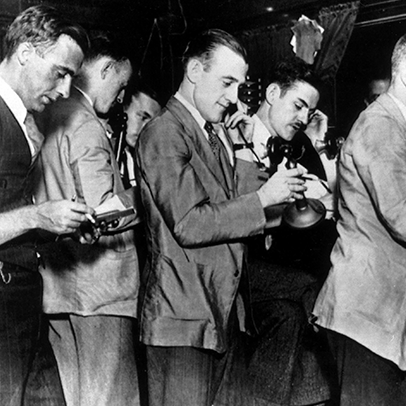
Poor’s Publishing and Standard Statistics protect subscribers with insights that lead customers to liquidate their assets before the October stock market crash. S&P Global works with customers to build understanding during uncertainty.

1941
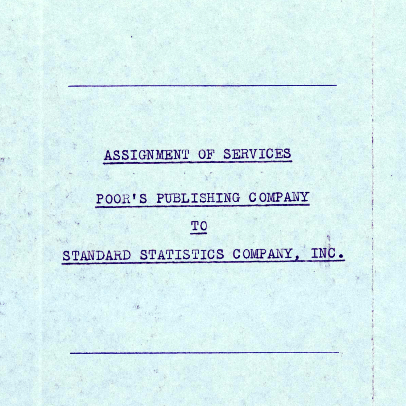
The merger of Standard Statistics and Poor’s Publishing brings Standard and Poor’s to life. The new organization leverages increased capabilities in credit ratings, business information and indices to serve customers across the globe.
1957
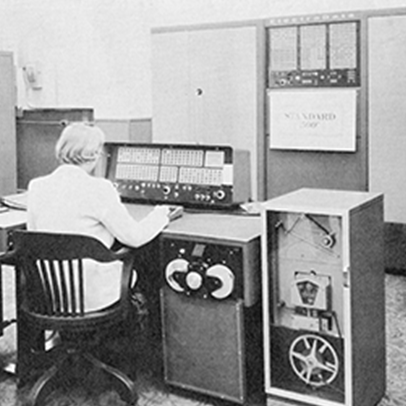
Standard and Poor’s creates the S&P 500, the world’s most tracked index. The first to be computer-generated, it uses new electronic punch card systems. We use new technology to turn complexity into clarity more efficiently than ever.

1959
Richard O’Brien forms the Technical Services Division, delivering printed data on microfilm. Two years later, a division is created now known as Information Handling Services.
1960
Platts’ Channel Port Index opens the European markets to transparency in oil price information. The new index further cements Platts’ status as a trusted global provider of commodities information.

1961
IHS flagship product, the Vendor Specs Microfilm File, gives insights to the aviation industry. Engineers use the data to support the military and in the space race. Source: NASA
1964
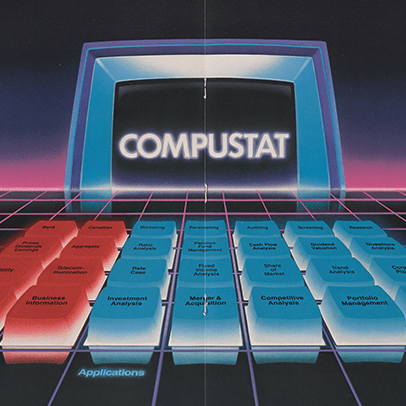
Standard & Poor’s introduces Compustat, a database of thousands of companies with stock prices and dividends data stretching back decades. Compustat gives investors the ability to compare standardized data across companies and industries.


1966
Standard and Poor’s joins McGraw-Hill, growing S&P’s scale and capabilities as a global purveyor of financial information. In decades to come, the ratings offering is nationally recognized by the SEC as a statistical rating organization.
1969
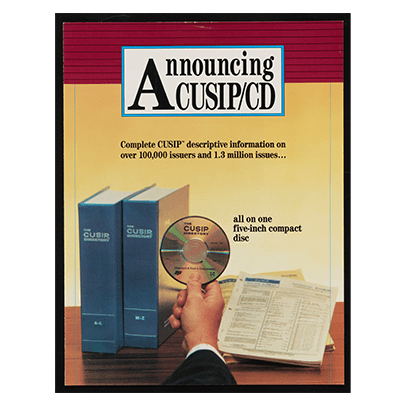
Standard and Poor’s creates the CUSIP numbering system, its nine-character identifiers quickly becoming the standard for all securities.

1977
IHS gains an international presence when it acquires Technical Indexes Ltd. in the United Kingdom. This positions IHS Group as the world’s largest producer of engineering information databases.
1987
Narayanan Vaghul and Pradip Shah establish CRISIL, India’s first and largest rating agency. Through CRISIL’s ratings and enterprise assessments, S&P Global creates clarity in one of the world’s largest economies.
1999
McGraw-Hill and RobecoSAM launch the Dow Jones Sustainability World Index, the first global benchmark for corporate responsibility. The DJSI collates criteria to provide best-in-class benchmarks for sustainable investing.

2012
IHS launches Connect, empowering users to gain insights, seize opportunities and manage risk world-wide.

2016
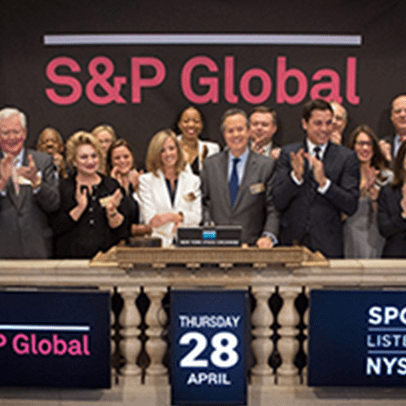
S&P Global, embodying Standard & Poor’s history and marketplace reputation, uses advancements in artificial intelligence, alternate data, data science and cloud computing, to help customers gain insights and avoid risk.

2018
S&P Global acquires Kensho. Its leading AI and machine learning capabilities drive actionable insight from complex data. Kensho Link allows users to organize company data with S&P Global’s Company IDs.

2018
S&P Global acquires Panjiva’s data analytics platform, helping clients grow their market share and increase global supply chain efficiency.

2019
S&P Ratings Ltd. is born and approved as the first international credit ratings agency to enter the domestic China bond market.

2020
We provide uninterrupted service to our customers even as the COVID-19 pandemic, renewed calls for social justice, and a heightened focus on sustainability create uncertainty.
Learn More