
ESG Scores and Raw Data
Our Corporate Sustainability Assessment (CSA) research process powers our ESG scores and empowers corporates and financial institutions to understand opportunities and challenges with granular, transparent information on a company’s sustainability performance.
What is an S&P Global ESG Score?
The S&P Global ESG Score measures a company’s performance on and management of material ESG risks, opportunities, and impacts informed by a combination of company disclosures, media and stakeholder analysis, modeling approaches, and in-depth company engagement via the S&P Global Corporate Sustainability Assessment (CSA). The Corporate Sustainability Assessment includes 62 industry-specific questionaries. You can view sample industry questionnaires for Banks, Pharmaceuticals, and Metals and Mining. CSA invited companies can access the most recent industry questionnaire in the CSA portal.
What is in an S&P Global ESG Score?

Source: S&P Global Sustainable1. All data as of May 2024, reflecting 2023 S&P Global Corporate Sustainability Assessment information. For illustrative purposes only.
How is double materiality factored into S&P Global ESG Scores?
The S&P Global ESG Score uses a double materiality approach whereby a sustainability issue is considered to be material if it presents a significant impact on society or the environment and a significant impact on a company’s value drivers, competitive position, and long-term shareholder value creation.
-
Environmental Dimension Criteria Topics
- Biodiversity
- Climate Strategy
- Decarbonization Strategy
- Energy
- Environmental Policy & Management
- Packaging
- Product Stewardship
- Sustainable Forestry Practices
- Sustainable Raw Materials
- Waste & Pollutants
- Water
-
Social Dimension Criteria Topics
- Community Relations
- Contribution to Societal Healthcare
- Customer Relations
- Financial Inclusion
- Health & Nutrition
- Human Capital Management
- Human Rights
- Labor Practices
- Occupational Health & Safety
- Privacy Protection
- Transportation Safety
-
Governance & Economic Dimension Criteria Topics
- Business Ethics
- Corporate Governance
- Information Security/ Cybersecurity & System Availability
- Innovation Management
- Market Opportunities
- Materiality
- Policy Influence
- Product Quality & Recall Management
- Risk & Crisis Management
- Supply Chain Management
- Sustainable Finance
- Tax Strategy
- Transparency & Reporting
How are companies scored on ESG?
Informed by investment practitioners with investment processes in mind.
Built on company engagement working with companies for 25 years.
Used by companies to derive measurable change.
Double materiality approach.
Scoring compares peer performance within the same industry.
Independent assurance of analytical processes provides quality assurance.
What is S&P Global ESG Raw Data?
We provide extensive access to up to 1,000 transparently disclosed ESG datapoints checked against reliable public sources for every company we assess in the S&P Global Corporate Sustainability Assessment (CSA), enabling users to explore the sustainability considerations that matter most in their specific context.
The granularity of our offering enables ESG Raw Data users to lower or remove factors where they see less value and increase the weights on factors they find more relevant. This enables a wide range of workflows, including customization of scoring-related analytics and models, thematic analysis of portfolios, development of alternative peer groups, and much more. Asset managers can run more sophisticated investment screens, banks can incorporate this data into risk evaluation, corporations can research and set operational targets against their peers, and much more.

Key Product Highlights
How are S&P Global ESG Scores and Raw Data used?
Clients use this data to engage with partners, companies or customers, to benchmark their performance, or to develop financial products including sustainability indices, and much more including:
- Corporate Benchmarking
- Active Engagement
- Market Leader Investment
- Impact/Thematic Investment
- Index Construction
- Portfolio Analytics
- ESG Integration
- Advanced Disclosure Analysis
- Custom Scoring
Our goal is to empower you to navigate your sustainability objectives with deep and robust data insights that are relevant to your context, seamlessly linked with our in-depth cross-reference data and comprehensively connected to our vast array of financial, market, and alternative datasets.
ESG Scores and Raw Data client case studies
What sets S&P Global ESG Scores apart?
They were built for practical material market insights
The S&P Global CSA methodology has been developed from annual analysis of correlations of sustainability factors with financial outcomes and business value drivers for 20+ years, alongside formal reviews by committees of leading sustainability and financial experts across S&P Global.
They offer comprehensive coverage of key topics
The CSA captures over 3,500 data points across over 35 different sustainability topics (including 11 social related topics). Sustainable1 consults the market on a regular basis to determine which topics should be covered in the CSA. Sustainable1 applies this framework across a broader universe of over 13,000 companies, of which over 3,500 directly participate.
They are aligned with sustainability market standards
Sustainable1’s research team has mapped 20+ Questions in the CSA to global and local sustainability market standards such as TCFD (ISSB S2), EU Taxonomy, and GHG Protocol. Sustainable1 routinely assesses standards alignment as the market evolves. In addition to data collection, S&P Global offers supplementary solutions to benchmark and report on standards alignment.
They offer enhanced data quality & access from participation
Sustainable1 has found that a large quantity of public data “as is” gets corrected, replaced, or rejected. Through active corporate participation, Sustainable1 analysts can identify potential errors, review with companies, and improve data quality as the assessment progresses. This participation also enables Sustainable1 to collect data on emerging sustainability topics that may not be found in the public domain.
Governance systems
With over 100+ years of experience in the market, S&P Global understands that data rigor and governance is critical for client confidence. Sustainable1 voluntarily requests a third-party audit of the CSA each year and has structured its organization to reflect the IOSCO Principals and any applicable requirements from regulatory bodies.
How can you access ESG Scores and Raw Data?
Delivery channels include API, Cloud, Desktop, and Feed. Delivery platforms include ClariFI®, FTP, Marketplace Workbench, S&P Capital IQ Pro, Snowflake, XpressAPI, Xpressfeed™ and more.
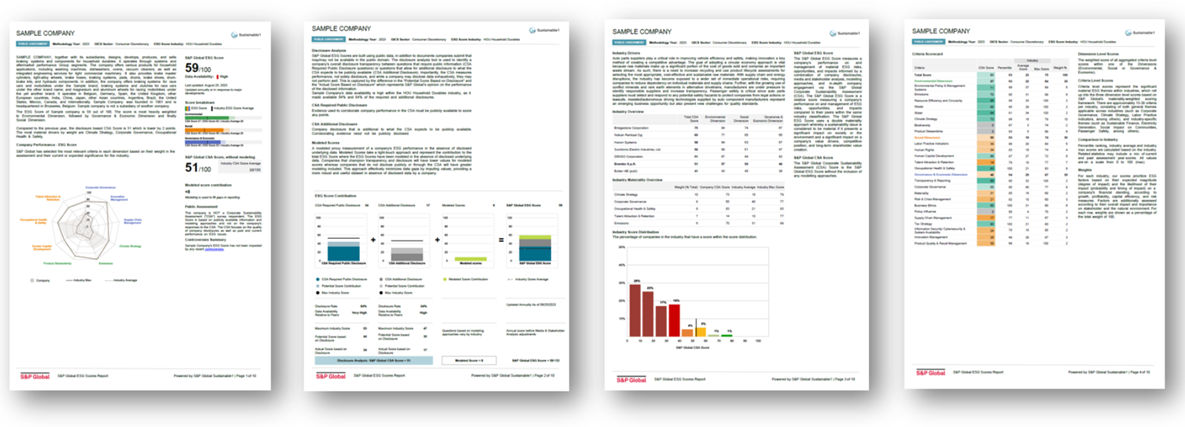
Available to clients accessing ESG Scores on S&P Capital IQ Pro, ESG Scores Reports provide an analysis of a company's ESG Score and aim to provide greater qualitative contextualization of a company’s ESG performance. The report highlights industry drivers, details performance across the most material criteria, controversy issues, and compares the company to its peers within the same industry classification.
Does the S&P Global ESG Score include modeling?
Our ESG Scores take a two-pronged approach that inclues modeling where disclosure is unavailable. The S&P Global CSA Score is the Score without the inclusion of any modeling approaches. For the S&P Global CSA Scores, questions with missing disclosure receive a score of zero.
Do ESG Scores and Raw Data include company controversy information?
The S&P Global Media and Stakeholder Analysis (MSA) forms an integral part of the S&P Global Corporate Sustainability Assessment (CSA). It enables S&P Global to monitor a company's sustainability performance on an ongoing basis by assessing current controversies with potentially negative reputational or financial impacts. The main objective of the MSA process is to gain insight into a company’s ability to mitigate financially material and reputational risks, as well as impacts on stakeholders and the environment, while protecting their shareholder value.
An MSA case typically exposes a failure at a company’s management level and gaps in systems and processes, such as risk management systems and operational controls. Consequently, a company’s S&P Global ESG Score may be adjusted. This has no impact on ESG Raw Data.
How does the Corporate Sustainability Assessment (CSA) underpin ESG Scores and Raw Data?
Covering over 13,000 companies globally, the CSA is an annual evaluation of a company’s sustainability practices. It enables benchmarking on a wide range of industry-specific economic, environmental, and social criteria that are relevant to the growing number of sustainability-focused investors and are expected to be financially relevant to corporate success.
The CSA delivers unparalleled insight into corporate sustainability practices, drawing on more than 25 years of engagement with thousands of companies each year. It goes far deeper than simply determining how transparent companies are by also uncovering how they manage the ESG risks and opportunities, including those new and underreported topics of growing importance that have yet to reach the disclosure agenda.