Metals & Mining, Coal, Electric Power, Non-Ferrous, Ferrous, Metallurgical Coal
October 09, 2026
TRADE REVIEW: Chinese copper concs TC/RC decline to slow in Q4 amid tight supply

By Lu Han
Editor:
HIGHLIGHTS
New smelting capacity to weigh on low TC/RCs
Smelters cut copper concs use on lower sulfuric acid prices
Cathode import premiums fluctuate
This report is part of the S&P Global Energy's Metals Trade Review series, where we dig through datasets and digest some of the key trends in iron ore, metallurgical coal, copper, alumina, cobalt, lithium, nickel and steel and scrap. We also explore what the next few months could bring, from supply and demand shifts to new arbitrages, and to quality spread fluctuations.
The decline in China's clean copper concentrate treatment and refining charges is expected to slow in the fourth quarter of 2026 as negative margins prompt smelters to curb concentrate consumption and increase plant maintenance. However, persistent supply tightness and new smelting capacity are likely to keep TC/RCs under pressure, according to traders, producers and smelters.
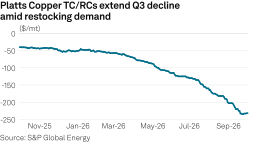
TC/RCs fell sharply in Q3, driven by ongoing supply shortages and restocking demand from Chinese smelters.
Adverse weather conditions in Chile also caused shipment delays for July and August loadings of copper concentrate, prompting Chinese smelters to seek prompt cargoes to secure feedstock requirements. Key producers such as Chile's Antofagasta Minerals and the country's state-owned mining company Codelco also cut copper concentrate output guidance due to adverse weather and aging mines.
China imported 19.49 million metric tons of copper concentrate in the first eight months of 2026, down 2.8% year over year, according to China Customs data.
Demand from smelters with new smelting capacity remained healthy, and will likely continue to pressure TC/RCs in Q4, some traders said.
In China, Inner Mongolia-based Chifeng Jintong's new 300,000 mt/year line began operations on Aug. 30. The core smelting furnace at Yingkou C&D Shenghai Non-ferrous Metal & Chemical Technology Co.'s multi-metals comprehensive utilization project was successfully ignited and entered the furnace-baking stage Sept. 12, marking a key milestone toward commissioning.
Platts, part of S&P Global Energy, assessed the CIF China clean copper concentrate treatment charge and refining charge at minus $235/mt and minus $23.5 cents/lb, respectively, on Oct. 8, down 81% from June 30.
Amid falling TC/RCs and increased competition to buy clean copper concentrate, other non-standard feedstocks have lower liquidity and were observed to be sold with standard clean as a bundle.
Wider spreads have been observed between high-arsenic-content complex copper concentrate and clean copper concentrate, with tradable spreads widening by at least $20/mt TC between standard clean and 1% arsenic content quality compared to early this year, according to market participants.
As demand from ex-China smelters weakened, more offers for gold concentrate to Chinese smelters were observed.
Less support from sulfuric acid
Falling sulfuric acid prices in Q3 led to negative smelting economics and prompted smelters globally to reduce copper concentrate consumption.
Platts assessed sulfuric acid prices at $280/mt on FOB Japan and South Korea basis on Oct. 7, down 25% from the peak on July 1. Domestic sulfuric acid prices in some regions of China traded about 900 yuan/mt ($134/mt), down about 50% from the July peak.
Smelters were seen turning to using more domestic concentrate and secondary materials.
China produced 1.28 million mt of refined copper in August, down 0.5% from the previous month and 1.2% year over year, according to data released by the National Bureau of Statistics on Sept. 18.
The decline in TC/RCs is also likely to moderate in Q4, as increasingly negative cash flows prompt smelters to curb concentrate purchases and schedule plant maintenance in October and November, market participants said.
However, the anticipated new smelting capacity is expected to continue pressuring TC/RCs in the longer term. Gold payable for pyrites has declined along with sulfuric acid prices, reflecting smelters' reduced willingness to accept high-sulfur materials.
Market participants were also generally bearish on the outlook for sulfuric acid prices for the rest of the year, citing the Chinese government's export restrictions on sulfuric acid and phosphate fertilizers.
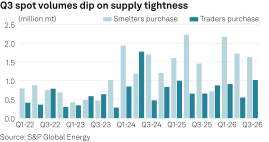
Platts observed 1.6 million mt of copper concentrate procured by smelters and 1.02 million mt of copper concentrate procured by traders in Q3 2026.
Tight supply supports cathode import premiums
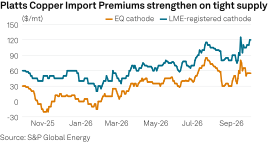
Copper cathode premiums in Asia have been supported in Q3 by tight spot availability and low inventory, despite historically high copper prices.
Scrap supply is limited due to invoice controls, and some downstream consumers turned to cathodes to meet demand. Domestic China cathode supply is constrained by smelters' production cuts and the anticipated increase in plant maintenance starting in October.
Offers of ER cathodes were limited, as most London Metal Exchange-registered brands were shipped to the US, even though the White House has yet to decide on tariffs, which weigh higher manufacturing costs against support for US mining.
China's refined copper demand in 2026 is forecast to grow 3% year over year, reflecting broad-based weakness across key end-use sectors, including solar and wind power, with grid investment growth also slowing, said Ruilin Wang, associate director for copper research at S&P Global Energy CERA.
PT Freeport Indonesia has resumed feeding copper concentrate from the Grasberg mine to its Manyar smelter following disruptions caused by a September landslide, easing tight cathode supply in the Asian market.
Platts assessed the CIF China copper cathode import premium at $120/mt over LME cash on Oct. 8, and the EQ cathode import premium at $60/mt on a CIF China basis.