Metals & Mining, Non-Ferrous
October 12, 2026
TRADE REVIEW: Asian lithium market likely to ease late Q4 on feedstock arrivals
By Tianhao Yang and Litian Wang
Editor:
HIGHLIGHTS
China lithium carbonate at end-Q3 fall 40.3% from May peak
Supply outlook and policy shifts pressure prices
Feedstock arrival timings likely drive Q4 direction
This report is part of the S&P Global Energy's Metals Trade Review series, where we dig through datasets and digest some of the key trends in iron ore, metallurgical coal, copper, alumina, cobalt, lithium, nickel and steel and scrap. We also explore what the next few months could bring, from supply and demand shifts to new arbitrages, and to quality spread fluctuations.
Asian lithium prices in the fourth quarter of 2026 could ease on the back of anticipated Zimbabwean shipments arriving later in the quarter and Australian spodumene production resuming after earlier suspensions. However, prices could remain volatile as strong spot demand may continue to support the market in October. The timing of additional feedstock reaching Chinese converters is likely to be a key determinant of lithium prices in Q4 2026.
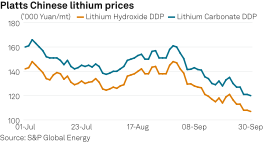
Platts, part of S&P Global Energy, assessed battery-grade lithium carbonate delivered and duty paid China at 120,000 yuan/mt on Oct. 9, down 25% from 160,000 yuan/mt on July 1 and 40.3% below its 2026 peak of 201,000 yuan/mt on May 12.
Lithium prices fell in Q3, then rallied, before coming under renewed pressure amid shifting expectations around feedstock availability, demand growth and policy developments, with futures volatility amplifying price movements throughout the quarter.
Feedstock disruptions supported price rallies
Expectations that CATL's Jianxiawo lepidolite mine could restart initially weighed on prices after the project received a safety production license in late June. However, uncertainty intensified after Yichun's Ecology and Environment Bureau withdrew its acceptance of the project's environmental impact assessment on Aug. 26.
Meanwhile, Zimbabwean feedstock shipments faced delays after exports resumed because of port congestion and vessel shortages, according to multiple market participants in August. Subsequent maintenance at several Chinese lithium converters further constrained lithium chemical output, adding to upward price momentum in August.
Strong spot demand supports physical market
Spot demand remained strong in Q3, supported by high battery production and active downstream buying when lithium prices fell. Several converters and traders reported limited spot material available for sale, while some downstream consumers sought to secure material through the exchange.
China's lithium-ion battery production across electric vehicles, energy storage systems and consumer applications is expected to reach around 332 gigawatt hours in September, up 9.2% month over month, supported by production and export frontloading ahead of the termination of value-added tax export rebates effective Jan. 1, 2027. As a result, spot lithium demand could remain supported in Q4.
Policy changes added uncertainty to demand outlook
China imposed a 2% consumption tax on battery cells on Sept. 1, 2026, and will increase it to 4% Sept. 1, 2027. Meanwhile, the export value-added tax rebate for lithium-ion batteries was cut to 6% from 9% effective April 1, 2026, and will be eliminated Jan. 1, 2027.
While market participants expect near-term production frontloading, uncertainty remains over the longer-term impact on demand.
The market came under renewed pressure in September after a third-party data provider expanded its inventory sample coverage, resulting in a sharp increase in reported inventories. Market talk of lower battery production at a major battery maker, coupled with ongoing concerns over the 2027 demand outlook, triggered a sell-off on the Guangzhou Futures Exchange, weighing on spot prices.
Commodity prices also face sustained pressure from the US Federal Reserve's Sept. 16 interest-rate hike, which could weigh on prices over the next 18 months, according to S&P Global Energy CERA's Lithium & Cobalt Medium-Term Outlook report.
Platts assessed battery-grade lithium hydroxide DDP China at 108,000 yuan/mt Oct. 9, down 23.9% from July 1. Domestic hydroxide remained under pressure amid weak demand from NCM batteries and excess supply from the seaborne market.
Seaborne market tracks China amid weak regional demand
Asian seaborne lithium prices broadly tracked China's domestic market in Q3, with China remaining an important outlet for surplus regional material amid lackluster demand in South Korea and Japan. Spot trading remained limited, with South Korean and Japanese buyers largely reliant on index-linked term contracts and showing little purchasing interest amid sufficient inventories.
However, volatile Chinese domestic prices resulted in short-lived import arbitrage windows, limiting trade flows into China. According to customs statistics, South Korea's lithium carbonate and lithium hydroxide imports fell 17.1% and 51.8% month over month to 537 mt and 4,451 mt, respectively, in August, while Japan's corresponding imports fell 49.7% and 35.1% month over month to 1,050 mt and 797 mt, respectively, in July. South Korean lithium hydroxide exports to China also fell 32.8% month over month to 711 mt in August.
Platts assessed battery-grade lithium carbonate CIF North Asia at $17,000/mt Oct. 9, down 11% from July 1, and lithium hydroxide at $17,650/mt Oct. 9.
Spodumene imports recover, but prompt availability remains limited
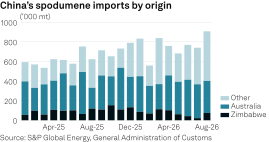
Upstream, spodumene supply remained relatively constrained during the quarter despite a rebound in August imports into China after weaker July arrivals.
China's spodumene imports fell 3.8% month over month to 739,344 mt in July, with Zimbabwean arrivals down 48.4%, according to China Customs data. Reduced feedstock availability contributed to converter maintenance and production cuts. Imports then rose 22.6% month over month to a record 906,566 mt in August, including a 245% increase in Zimbabwean volume to 74,575 mt.
Higher imports in August eased supply pressure, while lower converter operating rates reduced immediate demand and weighed on spodumene prices. At the same time, weaker lithium chemical prices squeezed conversion margins, leading converters to resist higher spodumene offers.
Miners, however, remained reluctant to lower offers as they awaited clearer market direction. The widening bid-offer gap, combined with Chinese holidays, limited spot trading toward the end of Q3.
Despite higher imports alleviating supply pressure, prompt material remained relatively tight near quarter-end, with some Zimbabwean cargoes facing further delays at Beira port, according to a Zhejiang-based trader.
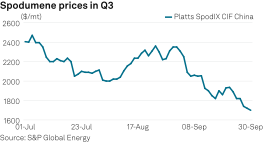
Platts assessed SpodIX CIF China at $1,730/mt Oct. 9, down 28.1% from July 1, while the Spodumene FOB Australia fell 28.5% from July 1 to $1,695/mt Oct. 9.
Feedstock arrival timing key to Q4 outlook
Feedstock availability in Q4 is expected to improve as additional Zimbabwean cargoes arrive and Australian production gradually returns, limiting the scope for further price gains.
Mineral Resources' Bald Hill mine restarted in May, with first shipments expected in Q1 of fiscal year 2026-27 (July-June), while Core Lithium is targeting its first spodumene shipment from the restarted Finniss operation in Q4 2026. CERA's Medium-Term Outlook, published Sept. 25, downgraded its 2026 lithium carbonate DDP China forecast by 2.4% to 150,156 yuan/mt because of higher expected Zimbabwean arrivals, with Sinomine Resource Group Co. Ltd expected to secure sufficient quotas to export all forecast 2026 production.
That said, market support could depend on the timing of feedstock reaching Chinese converters. "Spodumene arrivals are expected to pick up in October, but the material will take about a month to be converted into lithium chemicals. October could therefore be the last window for a price rally this year," the Zhejiang-based trader said.
