Metals & Mining, Ferrous, Non-Ferrous
October 14, 2026
TRADE REVIEW: Asian nickel market to ease in Q4 as weak demand outweighs supply risks
By Ezra Lim and Marco Loke
Editor:
HIGHLIGHTS
Indonesia's policy uncertainty clouds nickel outlook
El Niño could disrupt nickel supply
Falling NMC battery share curbs nickel demand
This report is part of S&P Global Energy's Metals Trade Review series, where we dig through datasets and digest some of the key trends in iron ore, metallurgical coal, copper, alumina, cobalt, lithium, nickel and steel and scrap. We also explore what the next few months could bring, from supply and demand shifts to new arbitrages and quality spread fluctuations.
Asian nickel prices are expected to fall in the fourth quarter of 2026, as weak downstream stainless steel demand and the declining market share of nickel-manganese-cobalt batteries continue to weigh on sentiment across the value chain, according to traders, producers and other market sources.
Market participants will continue to monitor Indonesia's evolving nickel policies and the potential for El Niño-related disruptions, as tighter supply could provide some support for prices and limit further downside.
Reflecting the weaker market outlook, analysts at S&P Global Energy CERA, in their September Nickel Medium-Term Outlook, lowered their average London Metal Exchange 3-month nickel price forecast for 2026 to $17,311/metric ton, down $234/mt from the August forecast of $17,545/mt.
Indonesia's policy, supply
Market attention in Q3 largely centered on the establishment and initial operationalization of PT Danantara Sumberdaya Indonesia (DSI), the state-owned entity designated to manage the country's Single-Gate Export System for strategic commodities, including critical minerals.
Market sources will continue to monitor DSI's role in Q4 as the system progresses through its transition phase ahead of expected full implementation in January 2027, following the delay of its Sept. 1 launch.
"DSI is still monitoring market conditions and collecting export transaction data. It won't intervene in pricing until clear regulations are in place," an Indonesian nickel smelter source told Platts after joining a focus-group discussion attended by Indonesian government officials and DSI's president director and CEO. "It is still a work in progress ahead of the expected implementation in January next year."
Market participants also remain focused on uncertainty surrounding revisions to Indonesia's annual RKAB (Work Plan and Budget), which sets approved production quotas for mining companies and influences potential nickel ore supply.
Meanwhile, PT Weda Bay Nickel resumed mining operations on Sept. 10 and is expected to provide some relief to market supply, although the extent and timing remain uncertain.
Despite Indonesia's policy developments and their potential implications for regional nickel ore supply, market participants said spot prices for nickel ore from the Philippines, a major supplier, were largely unaffected in Q3.
Platts, part of S&P Global Energy, assessed CIF China 1.3% Ni low-grade and 1.6% Ni high-grade nickel ore at $43.90/wet metric ton and $69.80/wmt, respectively, on Oct. 13, down $4/wmt and $1.10/wmt from July 1.
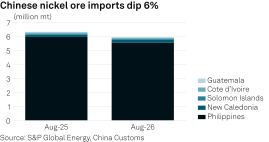
Market participants attributed the softer upstream nickel ore prices to weaker demand from the stainless steel and nickel-manganese-cobalt (NMC) battery sectors. China, a major nickel ore buyer for its stainless steel industry, imported 5.96 million mt in August, down 6% year over year, according to customs data.
El Niño risks; weak NPI demand
Supply concerns could persist into Q4 amid prolonged dry conditions. A report from S&P Global Ratings said a strengthening El Niño could heighten the risk of severe drought and other extreme weather events, potentially affecting industrial activity and commodity supply chains.
In Q3, low water levels affected a hydropower plant that serves a nickel smelter in Indonesia, while reduced river flows curtailed nickel pig iron (NPI) production at PT Indonesia Morowali Industrial Park, one of the country's largest nickel-processing hubs.
Despite supply-side concerns, weak stainless steel demand and lower prices squeezed mill margins and limited upside for NPI prices, with market sources attributing the decline in stainless steel prices to oversupply. Asia's stainless steel production rose 6.1% year over year in the first half of 2026, according to data from the World Stainless Association.
A Shanghai-based stainless steel trader told Platts that order books remained weak in Q3, limiting mills' ability to absorb higher-priced feedstock. "It is not an [NPI] oversupply issue; it is a downstream industry challenge," a source at a major Chinese steel mill said.
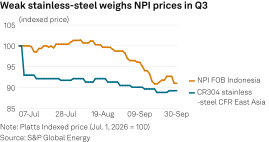
Platts assessed 10% Ni Indonesian NPI at $132/mtu FOB Indonesia on Oct. 13, down $13/mtu from July 1.
Falling NMC share
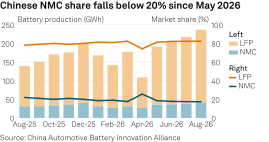
While NMC batteries — a key nickel-consuming product — continued to account for a meaningful share of China's EV battery demand in Q3, their market share fell for the fourth consecutive month in August, according to data from the China Automotive Battery Innovation Alliance. Market participants expect the decline to continue into Q4.
Lithium iron phosphate batteries gained traction, curbing growth in nickel demand and prompting battery producers and precursor manufacturers to adopt cautious purchasing strategies, which limited demand for battery-grade nickel chemicals.
End users in China, South Korea and Japan reported lower operating rates at precursor and cathode plants amid subdued demand for NMC batteries, while others said procurement activity remained limited, with purchases made only as needed.
"Recycled nickel sulfate supply is [more abundant] than expected," a Ningbo-based end user told Platts. Market sources said downstream end users were increasingly accepting recycled nickel sulfate, which now trades at parity with primary material, compared with a discount of about 1% in 2025.
The greater availability and price competitiveness of recycled material further weighed on demand for nickel sulfate produced from primary feedstock, market sources added.
Platts assessed spot battery-grade nickel sulfate, with a minimum nickel content of 22% and maximum magnetic material content of 100 parts per billion, at 26,500 yuan/mt ($3,938/mt) DDP China on Oct. 13, down 3,700 yuan/mt from July 1.
High output costs; weak MHP payables
Upstream, production costs rose in Q3, while realized payables for mixed hydroxide precipitate (MHP) fell amid higher sulfur prices. Market sources attributed the lower payables to weak battery demand and deteriorating cobalt market fundamentals, rather than to changes in production economics.
Prices for granular sulfur — the primary chemical used in high-pressure acid leaching (HPAL) to produce MHP — remained elevated at $970-$1,100/mt CFR Indonesia in Q3, according to Platts data, increasing HPAL production costs.
Platts assessed the MHP CIF North Asia basis LME nickel monthly average price at 84.9% payables on Oct. 13, down 7.5 percentage points from July 1. The all-in price, calculated on a payables basis using the LME nickel price, was at $13,841/mt on Oct. 13.
Platts assessed the MHP CIF North Asia basis cobalt metal price at 57% payables on Oct. 13, down 32.9 percentage points from July 1.
China's shift toward LFP batteries and weaker demand for consumer electronics continued to erode cobalt consumption in Q3, putting downward pressure on cobalt prices, market participants said.
Platts assessed the 99.95% cobalt metal price at 255,000 yuan/mt ex-works Shanghai at the end of Q3, down 33% from 380,000 yuan/mt at the start of the quarter.
"MHP cobalt payables are likely to decline further [in Q4] as cobalt prices remain low," a Zhejiang-based nickel smelter source said. Market sentiment indicated growing resistance to previous payable levels, with negotiations increasingly focused on downward revisions rather than increases to offset production costs.
