Metals & Mining, Non-Ferrous
October 13, 2026
TRADE REVIEW: Asian cobalt market to remain pressured in Q4 amid lackluster demand
By Sky Yu and Samantha Beh
Editor:
HIGHLIGHTS
DRC shipments rise; supply diversifies beyond Congo
China's cobalt imports surge 17%-50% year over year
LFP batteries capture 82% share; NMC output falls
This report is part of the S&P Global Energy's Metals Trade Review series, where we dig through datasets and digest some of the key trends in iron ore, metallurgical coal, copper, alumina, cobalt, lithium, nickel and steel and scrap. We also explore what the next few months could bring, from supply and demand shifts to new arbitrages, and to quality spread fluctuations.
Structural pressures on the Asian cobalt market are expected to persist in the fourth quarter of 2026, trade sources, producers, and other market participants told Platts, part of S&P Global Energy, with supply continuing to diversify beyond the Democratic Republic of Congo.
S&P Global Energy CERA analysts expect cobalt prices to decline in Q4 due to the output of alternative feedstocks, such as Indonesia's mixed hydroxide precipitate and China's recycled supply.
Improved shipment flows from the DRC, and sluggish nickel-manganese-cobalt (NMC) battery demand weighed on Q3 cobalt prices and sentiment across the cobalt value chain. Downstream buying interest and trading activity thinned as inventories remained elevated, and sellers continued their efforts to reduce inventory levels.
DRC export bottlenecks ease
Upstream supply conditions improved in Q3, driven by easing export bottlenecks and improved logistics in the DRC, the world's largest cobalt producer and exporter.
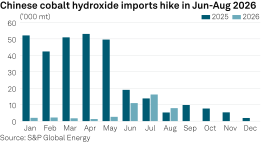
China's monthly cobalt hydroxide imports stood at 16,174 metric tons in July and 7,876 mt in August, up 17.34% and 50.38% year over year, respectively, after hovering below 3,000 mt for six consecutive months, customs data showed.
"Chinese domestic prices are extremely depressed because downstream demand has yet to recover, while continued arrivals of cobalt hydroxide cargoes have further increased supply availability," a Shanghai-based trader said.
Moreover, supply is becoming less dependent on a single feedstock as Indonesian nickel-processing operations produce cobalt-bearing MHP in addition to the wider acceptance of recycled-origin cobalt sulfate. Despite elevated sulfur costs in Q3, Indonesia's MHP production output remained broadly steady at 206,000 mt in H1 2026. China's retired power-battery volumes are also expected to reach 500,000 mt in 2026, capping price gains from DRC-led supply tightness.
Hydroxide, sulfate drop on cautious bidding
Cobalt hydroxide prices extended losses throughout Q3, reflecting cautious procurement activity. Price losses were steepest at the start of September, dropping $2.50/lb over Sept. 1-10, when increasingly bearish sentiment weighed on the market.
Platts assessed 30% Co cobalt hydroxide CIF China at $14.50/lb Oct. 12, down 40.33% from $24.30/lb July 1.
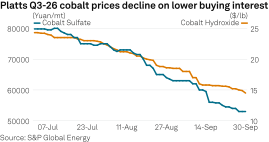
Downstream, cobalt sulfate prices tracked upstream weakness. Buyer resistance against high offers limited spot liquidity even during the traditional peak demand season in Q3.
"Cobalt sulfate pricing still depends on the consumer. Major suppliers are generally holding firm on their offers, while smaller producers have been cutting prices to move material more quickly," a Sichuan-based producer said.
Platts assessed cobalt sulfate at 51,000 yuan/mt ($7,620/mt) DDP China Oct. 12, a decline of 36.09% from 79,800 yuan/mt ($11,924/mt) July 1.
NMC, weak LCO pressure cobalt demand
Demand for cobalt across the battery sector remains subdued, with continued lackluster demand for NMC batteries.
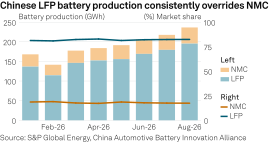
China produced 41.2 GWh of NMC batteries in August, up 33.5% year over year and accounting for just 17.4% of the domestic battery market, according to data from the China Automotive Battery Innovation Alliance. By comparison, August production of cobalt-free lithium-iron phosphate batteries reached 195.3 GWh, up 79.8% year over year and representing an 82.4% market share.
However, NMC battery manufacturers and cathode producers reported limited spot buying interest in Q3, which could weigh on production in Q4. A Chinese trader said that, amid growing pessimism about the demand outlook, buyers are finding it difficult to support previous price levels for Q4 NMC battery orders.
Lithium cobalt oxide (LCO) battery demand was also impacted by weakness in the consumer electronics sector. China's mobile phone shipments fell 5.5% year over year to 133 million units over January-June, according to the China Academy of Information and Communications Technology.
An international trader said refiners were considering replacing a portion of LCO production with high-nickel NMC material cathodes, which consume less cobalt, further pressuring cobalt demand and prices.
Weaker sulfate hits cobalt metal demand
As sulfate prices declined, market participants said there was little incentive to purchase cobalt metal for conversion into sulfate, reducing demand for cobalt metal.
Chinese cobalt metal prices declined in Q3, with offer indications last heard at 255,000-256,000 yuan/mt ($17.17-$17.24/lb) EXW China Sept. 29, before the Chinese market closed for the Oct. 1-7 National Day holiday.
Platts assessed cobalt metal (99.95% Co) at 254,500 yuan/mt ($17.22/lb) EXW Shanghai Oct. 12, down 33.03% from 380,000 yuan/mt ($25.75/lb) July 1.
Market eyes DRC policy developments
Market participants enter Q4 pending further development on the DRC's export policy, which could support cobalt prices. However, sentiment remained broadly bearish amid persistent price pressure and increased feedstock alternatives.
CERA analysts expect cobalt prices to remain under pressure as supply increases in Q4, with in-transit DRC shipments set to reach China during August-November and raise imports to 10,000-16,000 mt/month.
No new policy to tighten exports has been confirmed by the DRC in Q3. If further controls are imposed in Q4, CERA analysts expect export quota adjustments to be more likely than another blanket export ban.
