Metals & Mining, Non-Ferrous
September 21, 2026
China's cobalt price slump exposes a deeper shift in battery demand

Editor:
HIGHLIGHTS
LFP batteries capture 81.8% of China's output
Cobalt hydroxide price drops 39.2% since April
China EV cobalt demand falls 9.6% through 2030
The global cobalt market is losing the support that drove prices to multiyear highs earlier this year, as weakening demand from China's fast-growing battery sector increasingly outweighed supply curbs that the Democratic Republic of Congo imposed, industry sources told Platts, part of S&P Global Energy.
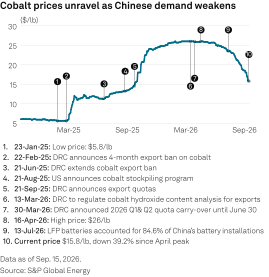
The Platts-assessed cobalt hydroxide CIF China price fell to $15.70/pound Sept. 18 from $26/lb, a level reached multiple times between January and May, representing a 39.6% drop. The correction unwound someof the rally sparked by DRC's February 2025 export ban on cobalt hydroxide and subsequent quota system, which helped lift prices from $5.80/lb, where it started 2025.
But as a shift toward cobalt-free lithium iron phosphate batteries gains momentum in China, market participants increasingly believe that supply controls alone will not be enough to sustain the market.
"Prices have fallen because China's cobalt demand is becoming less dependent on hydroxide feedstock," said Gil Michel-Garcia, co-founder and chief legal and strategy officer at EVelution Energy LLC. "Battery manufacturers are shifting toward cobalt-free LFP chemistries, while refiners are increasingly meeting demand through recycled cobalt and reprocessed metal."
EVelution Energy is building acobalt refinery in Yuma County, Arizona.
High cobalt prices may have driven China to change its battery production mix in favor of LFP batteries: LFPs made up 82.1% of China's battery production in the second quarter, up from 81.8% a year earlier, according to data from the China Automotive Battery Innovation Alliance, as reported and translated by CNEV Post, an EV industry publication by the China Automotive Battery Innovation Alliance (CABIA). In July, that figure reached 84.6%.
Because LFP batteries contain no cobalt and continue to gain market share from NMC chemistries in China, rising battery production and electric vehicle sales are no longer driving corresponding growth in cobalt demand.
China's cobalt demand from EVs is projected to fall 9.6% from 2026 levels to 35,564 metric tons by 2030, according to S&P Global Energy Horizons. Over the same period, China's EV sales are expected to increase 47.1% to 20.76 million units, underscoring the continued shift away from cobalt-intensive battery chemistry.
Congo gamble
Congo's efforts to restrict cobalt exports may have inadvertently accelerated that transition. The restrictions reduced available supply, and consumers responded by drawing down inventories, increasing recycling, and seeking alternatives to newly mined cobalt, said Kwasi Ampofo, metals analyst at BloombergNEF.
"In the pricing world, it takes two to tango," Ampofo said. "You need a willing buyer and a willing seller."
Chinese companies accumulated substantial cobalt inventories before export restrictions were imposed, Ampofo said. Imports of cobalt from Congo rose 65% in 2024, even as demand grew only about 3%, suggesting stockpiles were built ahead of anticipated disruptions. China's hydroxide imports fell 92% in the first half of 2026 compared with the same period a year earlier.
At the same time, the supply squeeze that buoyed prices earlier in the year has begun to ease slightly.
After months of quota-induced tightness, cobalt shipments from the DRC began to recover in June, reaching 17,348 mt -- well above an April low of 2,723 mt, but still far below the average monthly import of 45,703 mt from the H1 2025, according to S&P Global Energy's Global Trade Analytic Suite.
"The steep decline has been driven by a combination of recovering DRC shipments and soft demand," said Jomar Camposano, an analyst for Horizons. "Cobalt arrivals from the DRC into China began to recover meaningfully since June, easing concerns over feedstock shortages. At the same time, structural pressures from lower demand for cobalt-containing batteries and weaker consumer electronics demand have constrained consumption."
Uncertain path forward
Some industry participants argue that recent price moves should be viewed in the context of an unusually distorted market.
"Even with the 40% pullback from the highs earlier this year, prices remain vastly improved from where they were, and the DRC's export policies deserve a lot of credit for that," said Joel Crane, commercial manager at Australian miner and refiner Cobalt Blue Holdings Ltd.
Looking ahead, analysts expect Congo to continue managing the market through export quotas rather than implementing another blanket export ban.
"A second full export ban appears unlikely at this stage. The DRC seems more focused on managing supply through quotas and tightening oversight of exports rather than removing material from the market entirely. However, further quota adjustments remain possible," Camposano said.
