Metals & Mining, Non-Ferrous
July 14, 2026
TRADE REVIEW: Lackluster demand to cap Asian cobalt prices in Q3 despite DR Congo supply risks
By Sky Yu and Litian Wang
Editor:
HIGHLIGHTS
Q2 cobalt drops on weak consumer electronics sales
DRC supply risks persist, but fail to lift market sentiment
Upside in Q3 limited by weak demand despite quota forfeitures
This report is part of the S&P Global Energy's Metals Trade Review series, where we dig through datasets and digest some of the key trends in iron ore, metallurgical coal, copper, alumina, cobalt, lithium, nickel and steel and scrap. We also explore what the next few months could bring, from supply and demand shifts to new arbitrages, and to quality spread fluctuations.
Asian cobalt prices are expected to remain under pressure in the third quarter of 2026, as weak demand from both the battery and consumer electronics sectors continues to outweigh supply-side risks from the Democratic Republic of Congo. Although the DRC's forfeiture of unused export quotas could restrict future feedstock availability, market participants expect subdued downstream consumption to limit any upside potential for cobalt prices.
Cobalt prices eased across the value chain in the second quarter as weakening demand outweighed ongoing supply risks. Although logistical bottlenecks and quota restrictions continued to limit cobalt exports from the DRC, lower downstream consumption and growing recycled supply reduced buyers' urgency to secure material. Falling prices further reinforced cautious purchasing behavior, with many consumers delaying purchases in anticipation of additional price weakness.
Prices retreat across cobalt markets
Platts, part of S&P Global Energy, assessed 30% Co cobalt hydroxide CIF China at $23.50/lb July 13, down 9.27% from $25.90/lb on April 1.
Platts assessed cobalt sulfate at Yuan 79,000/metric ton DDP China July 13, down 14.13% from Yuan 92,000/mt on April 1.
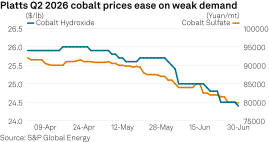
The decline in cobalt sulfate prices in Q2 reflected persistent weakness in downstream demand, particularly from cobalt-intensive lithium-cobalt-oxide, or LCO, and nickel-manganese-cobalt, or NMC battery applications.
Despite lower prices, buying interest remained limited as consumers delayed purchases amid expectations of further declines.
"After purchasing material, prices continued to fall, creating internal pressure on procurement teams. Many buyers preferred to wait rather than build inventory," a Zhejiang-based trader said.
Consumer electronics weakness, LFP weigh on cobalt demand
Thin demand from the consumer electronics sector and the continued shift toward lithium-iron-phosphate batteries weighed on cobalt consumption during Q2.
China's mobile phone shipments totaled 114 million units during January-May, down 3.6% year over year, reducing demand for LCO batteries used in mobile phones, according to data from the China Academy of Information and Communications Technology.
"Chip prices have increased and demand from the consumer electronics sector has been noticeably weaker than expected. The impact on LCO orders has already been reflected in the first half of the year," the Zhejiang-based trader said.
Several market participants also linked weaker consumer electronics demand to rising component costs, increasing handset prices and dampening purchasing interest.
Subdued demand also slowed inventory consumption across the supply chain.
"Cobalt sulfate prices look attractive, but our inventories can last until August and some LCO cathode makers are reportedly covered until September," a Zhejiang-based NMC cathode producer said.
Growth in China's battery sector increasingly came from cobalt-free chemistries. From January-May, LFP batteries accounted for 81.8% of China's battery production, while NMC batteries accounted for 18.2%, down from 20.1% during the same period a year earlier, according to data from the China Automotive Battery Innovation Alliance.
The continued shift toward LFP batteries limited cobalt demand growth despite rising battery output.
DRC supply risk persists
Cobalt supply from the DRC remained constrained in Q2 due to existing quota restrictions and logistical bottlenecks.
While cumbersome documentation requirements and export clearance procedures delayed shipments earlier in the year, market participants said trucking availability emerged as a key constraint in Q2.
An international trader said in May that their mines could dispatch only one to two truckloads of cobalt hydroxide per day due to tight trucking availability. The trader attributed this to transporters' reluctance to carry cobalt cargoes because of strict handling requirements and longer waiting times amid uncertainty over cargo clearance.
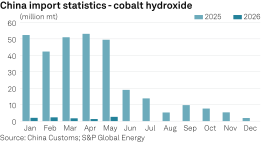
China's imports of cobalt hydroxide increased to 2,584 mt in May from 1,247 mt in April, but remained well below the 49,487 mt imported in May 2025, indicating only a limited recovery in feedstock arrivals.
Toward the end of the quarter, the DRC announced that unused export quotas allocated between Jan. 1 and June 30, 2026, would be forfeited and transferred to the strategic quota pool rather than carried forward.
A second international trader estimated that around 20,000-22,000 mt of cobalt could be affected based on Q1-Q2 export volumes.
"Meaningful volume — existing quotas had already restricted exports, and if another 20,000-22,000 mt is removed, the available quantity becomes smaller and smaller," the trader said.
Alternative supply options
While the primary cobalt supply remained constrained, market participants pointed to the growing availability of recycled units as an increasingly important source of feedstock.
An international producer estimated recycled cobalt supply, including Chinese domestic and imported black mass feedstock, at around 3,000 mt/month on a contained cobalt basis.
Another Zhejiang-based trader gave a similar estimate, saying domestic recycled cobalt supply was around 1,500-2,000 mt/month on a contained cobalt basis, while imported black mass feedstock contributed a further 1,000-2,000 mt/month following China's reopening of black mass imports in August 2025.
Demand overrides supply as dominant factor
Despite persistent supply constraints, market participants said sluggish downstream buying continued to outweigh concerns over feedstock availability.
A third international trader said the market response to the DRC quota forfeiture announcement had been relatively muted, highlighting persistent concerns over consumption rather than supply.
"Supply is no longer the dominant factor. As long as inventories remain low, demand will determine whether buying interest returns," the trader said.
In Q3, market participants expect demand conditions to remain the primary influence on cobalt prices.
Declining US plug-in electric vehicle sales, Europe's shift toward LFP battery and stagnant NMC market share in China would continue to weigh on cobalt demand, S&P Global CERA analysts said in a June report.
While tighter DRC quota management might support sentiment, most market participants expect sluggish consumer electronics orders and prolonged destocking across the supply chain to continue outweighing supply-side risks and limit upside potential for cobalt prices over Q3.
