Metals & Mining, Non-Ferrous
July 13, 2026
TRADE REVIEW: Asian lithium may ease in Q3 amid expectations of higher supply
By Wee hun Siah and Marco Loke
Editor:
HIGHLIGHTS
South Korea becomes net hydroxide exporter
Miners increase spodumene output on demand
Cost pressures for lithium carbonate, hydroxide to ease in Q3
This report is part of the S&P Global Energy's Metals Trade Review series, where we dig through datasets and digest some of the key trends in iron ore, metallurgical coal, copper, alumina, cobalt, lithium, nickel and steel and scrap. We also explore what the next few months could bring, from supply and demand shifts to new arbitrages, and to quality spread fluctuations.
Asian lithium prices are expected to ease in the third quarter of 2026, amid expectations of increased feedstock supply from Australian and Chinese mines and the arrival of lithium concentrate exports from Zimbabwe.
Lithium prices rose in the first half of Q2 on bullish sentiment stemming from temporary supply disruptions, but ongoing uncertainty on the supply side triggered heightened price volatility over the remainder of the quarter.
Supply-side volatility key driver of Q2 price movements
"Demand has become less crucial in determining lithium prices. Under the much tighter demand-supply balance this year, prices are highly sensitive to supply risks, with even perceived disruptions able to trigger outsized capital interest and price rallies," according to the S&P Global Energy Lithium and Cobalt Commodity Briefing Service May report.
The Middle East conflict raised concerns about an aggravated diesel shortage in Australia in early Q2, amid delayed shipments. According to two Chinese traders, the worsening diesel shortage could have adversely impacted spodumene production.
Bullish sentiment persisted after the approval of the draft Implementation Regulations of the Mineral Resources Law in China on May 9, ahead of the formal signing on May 15. "Previously, mining licenses were approved at the local government level, but oversight now appears to be shifting more toward the central authorities," a Shandong-based trader said, attributing the uptick in lithium prices to growing difficulties in securing lithium mining renewal licenses in the Jiangxi region.
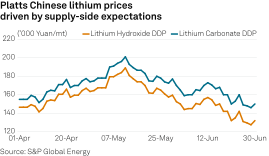
Platts, part of S&P Global Energy, assessed battery-grade lithium carbonate DDP China at Yuan 201,000 per metric ton ($29,375/mt) on May 12, a two-year high and up 71.8% since the beginning of 2026.
However, when China's Sichuan Yahua Group announced it would resume spodumene shipments from Zimbabwe -- which had suspended exports since February 2026 -- lithium prices slumped on expectations of increased supply arriving between June and July.
Meanwhile, mixed expectations about the restart of production at the Jianxiawo mine, which shut on Aug. 9, 2025, drove price fluctuations throughout the quarter.
Despite market chatters weighing on Q2 sentiment, lithium carbonate and hydroxide DDP China prices remained supported by robust downstream demand. China's EV sales climbed to 1.5 million units in May, rising 11.3% month over month and 14.4% year over year, according to data from China Association of Automobile Manufacturers, or CAAM. As of July 10, both carbonate and hydroxide prices were up 135.9% and 139.6%, respectively, year over year, Platts data showed.
Platts assessed battery-grade lithium carbonate at Yuan 151,000/mt ($22,209/mt) DDP China on July 10, down Yuan 15,000/mt week over week.
Battery-grade lithium hydroxide prices broadly tracked lithium carbonate prices but remained structurally weaker. Most nickel-manganese-cobalt cathode producers had secured their feedstock requirements through long-term contracts, limiting spot demand. The spread between battery-grade lithium carbonate and lithium hydroxide widened to Yuan 18,000/mt as of June 30, up from Yuan 8,500/mt on April 1.
Platts assessed battery-grade lithium hydroxide at Yuan 133,000/mt ($19,562/mt) DDP China on July 10, down Yuan 15,000/mt week over week.
South Korea turns net exporter amid weak lithium hydroxide demand
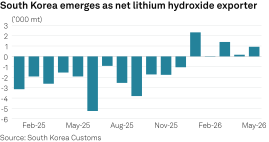
Historically a major importer of lithium hydroxide, South Korea has become a net exporter amid persistently weak domestic demand. Export volumes have risen steadily, and South Korea Customs data show a positive trade balance since January 2026.
Market participants noted that surplus material is increasingly being redirected to China. "South Korea has been re-exporting excess lithium hydroxide to China," a Chengdu-based producer said.
South Korea's demand for lithium hydroxide has remained weak since late last year, amid subdued demand from the NMC battery sector. According to a Zhejiang-based trader, NMC cathode plants were operating at reduced run rates.
However, Chinese traders noted that offer levels from South Korean sellers remained relatively high, largely due to higher production costs, which in turn dampened buying interest among Chinese consumers, the largest import market for South Korean lithium hydroxide.
Platts assessed battery-grade lithium carbonate and battery-grade lithium hydroxide at $19,200/mt and $17,700/mt, respectively, on July 10.
Firm spodumene demand spurs miners to raise production
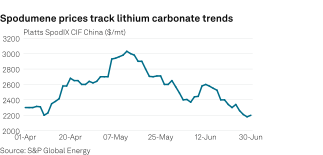
Prices of spodumene – the primary feedstock for both lithium carbonate and hydroxide, largely tracked lithium carbonate prices, as it is commonly traded on a tolling cost basis.
The tolling cost for spodumene-based lithium salts declined from Yuan 18,000-19,000/mt ($2,601-$2,745/mt) at the beginning of Q2 to Yuan 17,000/mt ($2,496/mt) in late June, resulting in a higher spodumene outright price.
Platts assessed SpodIX at $2,200/mt CIF China on July 10, down $270/mt from July 3. Spodumene concentrate with 6% lithium oxide content was assessed at $2,165/mt FOB Australia July 10.
According to Chinese sources, higher battery capacity per EV, rapid growth in the electric heavy-duty truck market, and expansion in energy storage were additional factors expected to further support strong demand. China's power and energy storage battery production reached 191.7 GWh in May, up 55.2% year over year, data from the China Automotive Battery Innovation Alliance showed.
Bald Hill spodumene mine -- owned by Mineral Resources -- restarted in June 2026 and is expected to make its first shipment in Q1 FY27, after being under maintenance since November 2024. The restart comes amid a recovery in spodumene concentrate prices, driven by stronger, sustained demand, MinRes said.
"Mining is a cyclical industry. During upcycles, miners tend to restart operations and ramp up output, while in downturns, production is often scaled back or halted," another miner said.
Concurrently, the recent approval of a $490 million expansion project at Mt Marion is expected to raise annual spodumene concentrate output by 6%, from 500,000 mt to 600,000 mt.
Moving into Q3, market participants will be monitoring the impact of additional supply from Western Australia and Zimbabwe, expecting potential easing of cost pressures for lithium carbonate and hydroxide.
Platts assessed spodumene concentrate with 5.5% lithium oxide content at $2,003/mt CIF China July 10, down $247/mt from July 3.
The 0.1% spodumene concentrate differential, reflecting the value of each 0.1% of lithium oxide for spodumene grades within a range of 5.5%-6%, was assessed at $36.08/mt FOB Australia July 10.
