Metals & Mining, Ferrous
October 16, 2026
TRADE REVIEW: Asian steel recovery runs up against weak demand in Q4
Editor:
HIGHLIGHTS
Cost support, mill losses limit Asian HRC downside
Chinese billet fills for disrupted Russian exports
Freight costs, tighter winter scrap supply support prices
This report is part of the S&P Global Energy's Metals Trade Review series, where we dig through datasets and digest some of the key trends in iron ore, metallurgical coal, copper, alumina, cobalt, lithium, nickel and steel and scrap. We also explore what the next few months could bring, from supply and demand shifts to new arbitrages, and to quality spread fluctuations.
Asian steel markets are expected to remain rangebound in the fourth quarter of 2026, with higher raw material, fuel and freight costs, weak margins and tight steel and scrap supply supporting prices, market participants said.
China's finished steel exports fell 3% year over year in January-August, while semi-finished exports rose 52% to about 14.05 million metric tons, allowing combined finished and semi-finished exports to rise 2.8% to 89.20 million mt, according to China Customs data.
The war in the Middle East continued to raise freight costs, and mill losses limited production growth and mills' ability to respond to stronger export demand or low-priced inquiries.
Platts, part of S&P Global Energy, assessed the spot price of Q235B 5.75-mm hot-rolled coil at 3,260 yuan/mt ($487/mt) ex-stock Shanghai on Oct. 15, including value-added tax, down 40 yuan/mt from July 1.
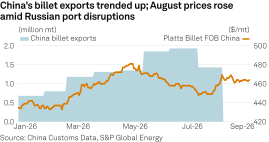
Platts assessed Chinese export 3SP 150 mm billet at $463/mt FOB China on Oct. 15, up $5/mt from July 1.
Cost support HRC, weak demand in Q4
Asian hot-rolled coil prices are expected to recover from summer lows, elevated inventories and weakening demand in Q4.
Higher raw material and production costs, alongside low mill profitability, will limit the downside. Cautious buying and subdued consumption could prevent a sustained price recovery, market participants said.
Most HRC producers were operating at breakeven or incurring losses of 100-200 yuan/mt by mid-September, regional sources said. Only 7.8% of mills in China were profitable as of mid-September, down 60.2% year over year, Paul Bartholomew, associate director of metals and mining research at S&P Global Energy CERA, said.
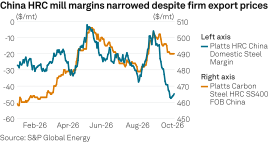
Mills were hesitant to negotiate amid high input costs in Q3, while buyers had ample supply, market sources said. This was expected to persist into Q4 with cautious purchasing and elevated supply, they added.
Vietnam's domestic HRC prices will be supported by tighter spot availability in Q4. Indian mills have been largely absent from the spot market since September amid firm post-monsoon domestic demand. In Indonesia, production disruptions in Morowali prompted suppliers to tighten allocations and delay shipments, market participants said.
However, spot demand will likely taper, with any recovery dependent on concluded transactions rather than supply constraints and higher offers, market participants said.
Q4 HRC prices are expected to average 3,317 yuan/mt, down from 3,326 yuan/mt in Q3, according to CERA's September forecasts. The full-year 2026 HRC forecast remains at 3,329 yuan/mt, representing a 0.25% year-over-year decline.
Chinese billet fills supply gap
Chinese billet export prices would remain supported in Q4 amid robust overseas demand and constrained supply, participants said.
In August, China exported about 1.43 million mt of billet, according to China Customs data, driven by overseas demand as shipping disruptions redirected trade flows.
Disruptions to Russia's Black Sea shipping routes and port operations intensified from late July into early August, creating a supply gap of about 200,000 mt/month, a Singapore-based trader said, adding that Saudi Arabia and Turkey bought an estimated 500,000 mt from other origins to fill the shortage, confirmed by a Turkish billet importer source and three Chinese traders.
"Some mills have already carried out maintenance work as a proxy for production cuts, given mill margins have been low to negative since mid-2022. We continue to forecast China's crude steel production at 978 million mt in 2026, down 2.7% year over year," Bartholomew said.
Chinese billet export prices will remain resilient in Q4, with any price movements likely to support steelmakers' margin recovery amid widespread mill losses and overseas demand, according to traders in Asia.
Freight, winter to support Asia scrap
Asian ferrous scrap prices could be supported in Q4 amid rising ocean freight rates and seasonally tighter supply, participants said.
Scrap prices fell through July and much of August, with Platts assessing containerized HMS 1/2 80:20 at $324/mt CFR Taiwan on Aug. 18, down $39/mt from the year-to-date high of $363/mt on May 19 amid weak demand.
Prices recovered in September on higher oil and freight costs and firmer international scrap markets, including in Turkey, regional market sources said.
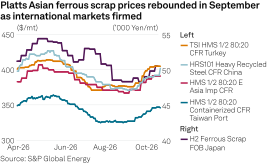
Higher oil prices were expected to support scrap prices in Q4, a Taiwan-based trader said.
"The new normal is likely to monitor oil prices. They are unlikely to return to previous [lower] levels," the trader said.
Higher freight was also expected to lift CFR scrap prices, a Vietnam-based trader said.
"Toward year-end, China normally has more cargo to deliver, occupying more vessels and driving up freight rates," the trader said.
A potentially harsher winter could tighten scrap supply, further supporting price levels, market participants said, although weak downstream rebar demand could add downward pressure in Q4.
