Metals & Mining, Non-Ferrous
October 15, 2026
TRADE REVIEW: Pacific alumina faces pressure in Q4 as China exports offset supply risks
By Nick Tan and Louissa Liau
Editor:
HIGHLIGHTS
FOB Australia alumina at quarterly highs in Q3
China flips to net alumina exporter in August
1.5 mil mt global alumina surplus forecast in 2026
This report is part of S&P Global Energy's Metals Trade Review series, where we dig through datasets and digest some of the key trends in iron ore, metallurgical coal, copper, alumina, cobalt, lithium, nickel and steel and scrap. We also explore what the next few months could bring, from supply and demand shifts to new arbitrages, and to quality spread fluctuations.
Pacific alumina prices could come under renewed pressure in the fourth quarter of 2026 as expanding Chinese refinery supply, emerging export availability and a projected global surplus weigh against supply risks in Guinea and recovering smelter demand in Indonesia and the Middle East.
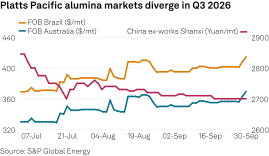
The Platts FOB Australia alumina assessment averaged $348.33/metric ton in Q3 and reached a quarterly high of $369.50/mt on Sept. 30. The assessment subsequently rose to $387/mt on Oct. 14, up $17.50/mt, or 4.7%, from the end of the quarter. Platts is part of S&P Global Energy.
By contrast, the Platts ex-works Shanxi domestic alumina assessment fell to 2,700 yuan/mt on Sept. 30 from a quarterly high of 2,845 yuan/mt on July 1. It averaged 2,732.54 yuan/mt in Q3 and fell 10 yuan/mt to 2,690 yuan/mt on Oct. 14.
The divergence characterized the Q3 market. Rising seaborne prices did not improve the economics of shipping alumina to China. Market participants attributed the shift partly to expanding Chinese refinery supply, limited growth in domestic smelter demand and higher freight costs, which encouraged Chinese refiners to seek export outlets.
Spot liquidity rises on Indonesian availability
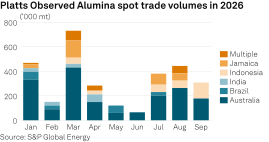
Observed spot alumina trade volume reached 1.131 million mt in Q3, up 38% from a year earlier. August led the increase, with volumes more than doubling year over year to 443,000 mt, while volumes in July rose 27.1% to 380,000 mt.
Volumes in September were broadly stable year over year at 307,500 mt but fell 31% from August, indicating that spot activity slowed toward quarter-end.
Australia-origin material remained dominant at 640,500 mt, or 56.7% of observed Q3 volume. Indonesia-origin trades nearly doubled year over year to 250,000 mt, lifting their share to 22.1%, while Jamaican volumes rose to 150,000 mt.
The increase highlights increased Indonesian availability in the seaborne market, although the slowdown in September raises questions about whether the stronger activity in Q3 will continue into Q4.
Guinea remains a supply risk
Uncertainty surrounding Guinea's proposed bauxite export quota system remained an upside risk due to China's dependence on Guinean ore. However, the proposal did not lead to a confirmed reduction in bauxite exports or Chinese alumina production during Q3.
As of Sept. 24, Guinea had provided no further update on the proposal. Some market participants expected additional delays and considered implementation in 2026 unlikely.
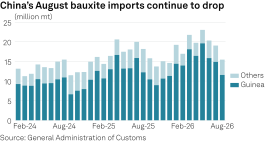
China imported 15.45 million mt of bauxite in August, including 11.55 million mt from Guinea, according to Chinese customs data. Guinea accounted for 74.8% of the monthly total. Market participants said Chinese buyers remained relatively well supplied, with ample inventories limiting the proposal's immediate effect.
The policy uncertainty supported market sentiment but did not establish that a physical shortage had developed. According to a trader, any effect on alumina output will depend on whether Guinea adopts binding measures, the timing of their implementation and refiners' ability to draw on inventories or secure alternative ore.
China turns to export markets
China moved away from an alumina import opportunity during Q3 as domestic prices weakened compared to seaborne material.
Platts survey showed Australian alumina at a theoretical premium of $35/mt to comparable Chinese material on July 20. The premium widened to about $54.80/mt by Sept. 23 as Australian prices and freight costs increased.
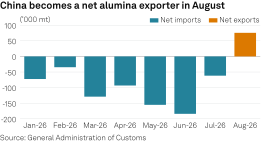
China became a net alumina exporter in August after 10 consecutive months of net imports. Exports totaled 425,003 mt, while imports were 349,531 mt, leaving net exports of 75,472 mt, Chinese customs data showed.
Market participants said newly commissioned refining capacity and limited growth in domestic smelter demand weighed on Chinese prices and encouraged refiners to seek export outlets.
Freight costs reinforced the divergence. The Platts 30,000-mt Handysize Bunbury/Kwinana-Lianyungang assessment rose to $35.45/mt on Sept. 30 from $32.30/mt on July 1, before rising to $36.35/mt on Oct. 14, up 90 cents/mt, or 2.5%, from Sept. 30.
The Platts 60,000-mt Panamax Bunbury-Lianyungang assessment rose to $26/mt on Sept. 30 from $18.95/mt on July 1, and then to $27.20/mt on Oct. 14, up $1.20/mt, or 4.6%, from Sept. 30.
Indonesia adds demand and supply
Indonesia's expanding aluminum sector remained a potential source of incremental alumina consumption. An S&P Global Energy CERA forecast June 25 projected Indonesian aluminum output at about 1.2 million mt in 2026, nearly double the previous year. The estimate represents annual aluminum output rather than Q3 production or alumina import demand.
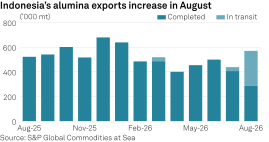
Indonesia also added to regional supply. Alumina exports reached 569,632 mt in August, up 30.2% from July as shipment bottlenecks eased, according to S&P Global Commodities at Sea data.
Russia's Rusal confirmed plans in September to develop a bauxite-to-alumina complex in Indonesia, but did not mention the capacity or start up date. Indonesia could therefore support both sides of the Pacific balance as demand for smelting and supply of refining expand.
Middle Eastern consumption recovers
Emirates Global Aluminium resumed hot-metal casting at Al Taweelah on July 2. By Aug. 26, EGA had restarted 315 of the smelter's 1,262 reduction cells, equivalent to 25%.
EGA said its alumina refinery was operating at about 50% of capacity and expected the smelter to return to full production in Q1 2027. The staged restart supported a gradual recovery in alumina consumption rather than an immediate return to pre-disruption demand.
Q4 correction expected despite firmer Q3
CERA's Sept. 28 Aluminum Medium-Term Outlook projected a global alumina surplus of about 1.5 million mt in 2026, about 36% lower year over year. It also anticipated a sentiment-led correction in FOB Australia prices during Q4.
Upside risks include binding restrictions on Guinea's bauxite exports, stronger alumina consumption as smelters ramp up, and tighter seaborne availability. These risks are counterbalanced by expanding Chinese refinery supply, China's shift toward exports and the projected global surplus.
Although Platts FOB Australia ended Q3 at quarterly highs, this alone did not indicate a structural market deficit. The main test in Q4 will be whether feedstock or policy concerns result in measurable production losses, or whether Chinese exports and surplus refining capacity renew downward pressure on seaborne prices.
