Metals & Mining, Coal, Ferrous, Metallurgical Coal, Non-Ferrous
October 20, 2026
TRADE REVIEW: Asian iron ore to face pressure in Q4 on ample supply, weak steel margins
HIGHLIGHTS
Mills cut output as margins weaken in Q3
Medium-grade price gaps narrow on cost focus
Lump and pellet premiums drop from peaks
This report is part of S&P Global Energy's Metals Trade Review series, where we dig through datasets and digest some of the key trends in iron ore, metallurgical coal, copper, alumina, cobalt, lithium, nickel and steel and scrap. We also explore what the next few months could bring, from supply and demand shifts to new arbitrages, and to quality spread fluctuations.
The Asian seaborne iron ore market is expected to remain under pressure in the fourth quarter of 2026, as ample seaborne supply and mills' voluntary production cuts amid weak steelmaking margins continue to weigh on prices, according to market participants, including traders and mill sources.
The market also continues to monitor the ongoing negotiations between China Mineral Resources Group and major Australian suppliers and assess their impact on iron ore supply and prices.
In the early third quarter, iron ore prices remained relatively resilient, hovering at around the $100/dry metric ton CFR China mark, supported by expectations of seasonal restocking ahead of China's National Day holidays. Sentiment, however, deteriorated in September as steelmakers grappled with domestic coke price hikes and elevated freight and energy costs.
The Platts Iron Ore Index, or IODEX, averaged $96.90/dmt CFR China in Q3, down from an average of $105/dmt in Q2, with the benchmark falling to a 15-month low of $92.85/dmt Sept. 30.
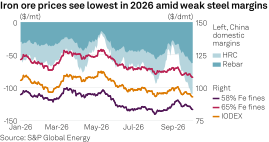
"Most Chinese steelmakers were operating at breakeven levels or reporting losses of 100-200 yuan/mt as of mid-September. The combination of negative mill margins, production discipline measures and lower pig iron output is expected to constrain iron ore demand through the remainder of 2026," said Paul Bartholomew, associate director of metals and mining analytics at S&P Global Energy Horizons.
Medium-grade fines differentials narrow
Amid five consecutive rounds of Chinese domestic coke price hikes and deteriorating mill margins, end-users increasingly focused on managing iron ore costs, leading to narrower price spreads among the five mainstream medium-grade fines brands that inform IODEX.
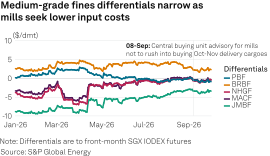
The narrowing spread between the lower-alumina brand of Brazilian Blend Fines (BRBF) and higher-alumina brands of Newman High Grade Fines (NHGF) and Jimblebar Fines (JMBF) highlighted the market's increasing focus on lowering costs on an outright price basis and greater tolerance for impurities, market participants said.
Meanwhile, JMBF and NHGF saw improvements in floating differentials over the front-month derivative, despite higher alumina content and general worsening quality specifications following BHP's August specifications revision.
JMBF's implied discount narrowed steadily in Q3, from $4.7/dmt over the August average of 61% indices to $3.48/dmt over the November average of 61% indices by the end of Q3, with Q2 recording a discount in the range of $5.13-$6.5/dmt, according to data from Platts, part of S&P Global Energy. Similarly, NHGF's implied discount level narrowed from 92 cents/dmt over the August average IODEX to 55 cents/dmt over the November average of IODEX by end Q3.
Despite lower iron ore prices, market participants viewed the narrowing discount levels as factoring in expectations of better-than-typical specifications for the first few shipments after BHP's specifications update and stronger import margins for BHP goods.
Among the five mainstream brands, JMBF recorded the strongest relative performance, in part because scarce low-grade supply drove spillover demand into discounted medium-grade products, market participants said.
Meanwhile, Pilbara Blend Fines (PBF) premiums showed signs of a recovery in early August as import margins for the brand at Chinese ports improved, said market participants, with its floating differentials converging with the other medium grades.
However, a fresh advisory by China's central iron ore buyer to not rush purchases of October-November delivery shipments, given ongoing negotiations between Rio Tinto and CMRG on Sept. 8, renewed caution among buyers and pressured PBF premiums once again, with subsequent ample spot supplies from Rio Tinto.
Discount levels for PBF fell back to the 75 cents-$1/dmt range over the average of October and November IODEX, respectively, on Sept. 30, Platts data showed. Meanwhile, the miner was also heard to have concluded several bilateral trades for full Capesize PBF cargoes, ranging from discount levels of $1-$1.20/dmt over the front-month IODEX derivative, according to market participants.
Reflecting the widening discounts on PBF trades against the other medium grades, Platts assessed the brand adjustment for PBF at 30 cents/dmt by end Q3. This was also because the physical and derivative forward curves gradually turned into contango in an oversupplied prompt market, with demand weakening due to voluntary output cuts by mills.
"The market is expecting more [spot] volumes from Rio Tinto as term contract negotiations have yet to be finalized, which will continue to add more pressure on PBF differentials. Not only will this bring down [price] levels for PBF, but other medium grades differentials are also expected to weaken as the entire market is facing an oversupplied outlook," an eastern China-based trader source said.
Despite lower front-month derivative prices prompting more fixed-price spot trades, buyers remained cautious about building inventories amid lackluster downstream demand. Market participants, therefore, expected medium-grade fines to continue trading within relatively narrow discount ranges.
Impact of tight low-grade supply
Prolonged negotiations between CMRG and Fortescue have remained a key feature overshadowing the low-grade market through Q3. In contrast to how negotiations with Rio Tinto have seen more spot availability of PBF, Fortescue's spot tenders have been few.
Super Special Fines, which accounted for 47.6% of Q2 low-grade spot volumes, saw no spot tenders observed during Q3, according to Platts data. Spot volumes of Fortescue Blend Fines, which accounted for 26% in Q2, saw only two tenders concluded in Q3, the data showed.
Brazilian products such as CSN's IOH4, Vale's Sinter Feed Guaiba and Rio Tinto's Robe Valley Fines reappeared in the spot market. Supply of Vale's blends, including Sinter Feed High Silica Carajas and Sinter Feed High Silica Guaiba, also saw increased spot sales at a time when Fortescue's sales via tenders declined, the data showed.
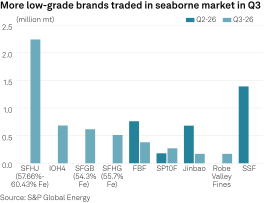
The increases in low-grade prices and general weak mill margins also prompted end-users to blend high and low-grade cargoes, and to reassess their use of high-grade material, as higher Brazil-China freight rates and more cost-effective use of imported concentrates saw lower spot activity in Q3, market participants said.
Pellet, lump premiums retreat
While fines prices weakened through Q3, demand for direct-charge material, such as lump and pellet, kept prices comparatively well supported amid rising coke prices and overall tighter supply conditions, according to sources.
Platts Iron Ore Spot Lump Premium CFR China climbed to a four-year high of 28.60 cents/dmtu on Aug. 25, averaging 23.8 cents/dmtu in Q3, up from Q2's average of 17.9 cents/dmtu, supported by a positive spread between seaborne and portside prices, and limited substitutability with alternative direct-charge materials.
Premiums later retreated during the quarter as rising coke prices significantly increased steelmaking costs while steel prices failed to keep pace. Weakening margins reduced mills' willingness to pay elevated premiums, prompting some end-users to increase sinter use and substitute lump.
Portside lump inventories also began to accumulate as buying activity slowed along with production cuts. Traders mentioned weaker import margins and declining appetite for inventory positions, with demand also picking up for lower-cost, lower-Fe alternatives such as Vale's Lump Ore Non-Screened Guaiba and Lump Ore Non-Screened Tubarao.
Market participants expected lump premiums to face further downside pressure in Q4 as inventories rise and steel margins remained depressed.
Meanwhile, the pellet market is expected to enter Q4 with similar fundamentals, though limited seaborne supply has given pellet premiums better support compared with lump premiums. Demand for high-grade, low-alumina pellets remained supported due to the limited availability of Chinese domestic concentrate, according to market participants.
With the spot blast furnace 63% Fe pellet premium having averaged at the highest in nearly four years at $15.5/dmt in Q3, up from Q2's average of $10.8/dmt, the market also saw gradual longer-term shifts away from pellet to lump by end-users, Platts data showed.
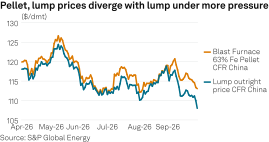
Limited spot availability from key Indian suppliers was expected to continue supporting premiums in the near term, although improving domestic pellet and concentrate availability observed at the end of Q3, together with weaker steel profitability, pig iron production and freight pressures, could gradually ease the market through Q4.
