Coal, Metals & Mining, Metallurgical Coal, Ferrous
July 21, 2026
TRADE REVIEW: Asian met coal market looks to India in Q3 as China-led rally fades
By Olivia Zhang and Samuel Chin
Editor:
HIGHLIGHTS
China-led rally fades as domestic supply recovers
Indian demand seen as key swing factor in Q3
LVHCC relativity falls to near historical lows in Q2
This report is part of the S&P Global Energy's Metals Trade Review series, where we dig through datasets and digest some of the key trends in iron ore, metallurgical coal, copper, alumina, cobalt, lithium, nickel and steel and scrap. We also explore what the next few months could bring, from supply and demand shifts to new arbitrages and quality spread fluctuations.
The Asian seaborne metallurgical coal market entered the third quarter of 2026 after a China-led rally faded, as demand for imported premium hard coking coal eased amid ample portside stocks and expectations of a recovery in domestic output, with traders, suppliers and market sources now looking to India for signs of the next demand upturn.
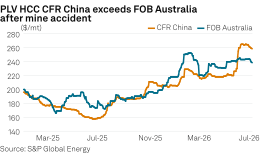
The Platts Premium Low Vol Hard Coking Coal CFR China index surged in Q2, reaching a peak of $265/metric ton in late June -- its highest level since March 2024 -- before ending the quarter at $263.50/mt, up $44.50/mt from April 1. Platts is part of S&P Global Energy.
The FOB market was also bolstered, with the Platts PLV HCC FOB Australia assessment rising $6.70/mt to $243.50/mt over the same period.
The Q2 rally followed a fatal mining accident in Shanxi province in late May, which triggered intensified safety checks across China's main coal-producing regions. Concurrently, weather-related Australian supply disruptions that began in Q1 started to ease, while Indian buying softened seasonally ahead of the Q3 monsoon.
For much of June, the CFR China assessment remained above the net forward equivalent of the FOB Australia index, highlighting strong Chinese import demand in the aftermath of the accident. This contrasted with the December 2025-to-late May 2026 period, when the CFR China index traded below the FOB Australia equivalent, according to Platts data.
Even as Australia's weather-related disruptions eased and India's seaborne demand softened, "FOB Australia prices remained firm ... due to Chinese demand and lower freight costs," an analyst at S&P Global Energy CERA said in a medium-term outlook June 30. "But [prices] could face pressure as Chinese [coal] supply gradually recovers and Indian demand stays weak."
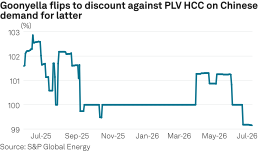
China's return as the key driver of seaborne PHCC demand in Q2 reshaped PLV-premium mid-vol differentials, with buyers favoring high coke strength after reaction and low-sulfur PLV cargoes over some lower-CSR PMV material. This reversed the earlier PMV Goonyella premium, pushing the Goonyella differential back into discount against the Platts PLV HCC FOB Australia assessment.
Activity in the CFR China market picked up sharply in Q2, with Platts publishing 1,828 heardsacross coking coal trades, bids, offers and tradable levels -- up 63.2% from Q1. June accounted for most of the jump, reflecting brisk spot trading after the Shanxi mine accident tightened domestic supply.
Whether Chinese buying can sustain its momentum into Q3 remains uncertain, market sources said, as weak steel demand and poor margins have prompted mills to reduce production and curb consumption of higher-priced coals.
Rising seaborne coal inventories at northern Chinese ports also helped cushion the market as Shanxi coking coal supply gradually recovered, market sources added.
"Australian PMV cargoes previously purchased by traders are due to arrive at [Chinese] ports soon," a North China-based trader said. "Since they have yet to be placed with end users, they will have to compete with cheaper portside cargoes for sales."
"Only mills facing a genuine shortage of domestic supply may occasionally buy a high-CSR Australian PLV cargo such as Peak Downs," anotherChinesetrader said.
Australian premium supply is also expected to remain ample into Q3, with at least five seaborne cargoes for loading in June, July and August still observed as unsold as the quarter gets underway, according to market participants.
With supply risks easing, demand has become the key question for Q3, with any further price strength likely to hinge on Chinese import appetite and India's willingness to increase spot purchases, market sources said.
India's late-Q3 buying eyed
While China dominated seaborne demand in Q2, attention in Q3 has increasingly turned to whether India returns as a buyer ahead of the post-monsoon period, according to India-based traders.
Indian end users were largely absent from the spot market late in Q2, instead relying on long-term coking coal contracts and existing inventories amid weakness in the domestic steel industry, market sources said.
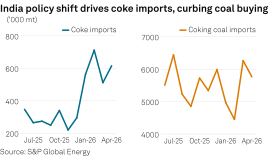
At the same time, a recovery in coke imports after India replaced country-specific quota restrictions with provisional antidumping duties from Jan. 1 further reduced the need for spot coking coal purchases, according to buyers and sellers.
Demand for imported coke remained robust through Q2, with major Indonesian suppliers reporting cargoes sold out several months ahead of production amid strong Indian buying interest.
"Our coke sales have been very strong in recent months, supported by robust Indian demand," an Indonesian coke supplier said. "At the same time, we are seeking to diversify sales across other markets rather than relying on a single destination."
As such, India's final antidumping duty decision has become a key focus for Q3, following the expiry of the provisional measures on June 30. Market participants said a government recommendation to reduce the duties, if finalized, would improve policy clarity and further strengthen the competitiveness of imported coke, including Indonesian material.
"Some Indian end users have been discussing long-term supply contracts for Indonesian coke, but both buyers and sellers are waiting for clarity on the final policy," another Indonesian coke supplier said.
LVHCC relativity nears historical lows
LVHCC's relativity to Platts PLV HCC FOB Australia came under pressure through most of April and May, falling to 72.7% on May 22 from 80.7% on April 1 -- near the record low of 70.5% recorded in January 2018, before recovering to 81.6% by June 30.
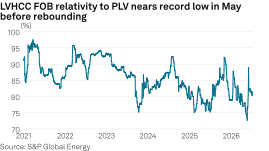
The widening LVHCC discount to PLV HCC reflected ample LVHCC spot availability and subdued end-user demand, while the PLV HCC FOB Australia market remained relatively rangebound, market sources said.
The supply overhang was broad-based, with Australian miners offering spot volumes across several LVHCC brands, including Daunia, Olive Downs, Carborough Downs, Metropolitan, Anglo LVHCC, Burton and Middlemount. Rising Mongolian coking coal exports over the past few years have also given Chinese buyers competitively priced alternatives, further pressuring seaborne LVHCC prices.
"Almost all major LVHCC suppliers have spot cargoes available," a Chinese trader said in April."Such high availability of LVHCC-grade coal is rarely seen."
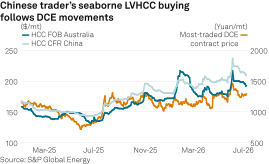
The relativity rebounded in June, reaching 88.9% on June 5, Platts data showed, as stronger futures on the Dalian Commodity Exchange opened arbitrage opportunities for seaborne LVHCC flows into China following the Shanxi mine accident.
The rally was short-lived, however, as inventories of seaborne LVHCC purchased by Chinese traders built up at Chinese ports and expectations of a gradual recovery in domestic supply, market sources said.As a result, relativity eased back to 81.6% by the end of the quarter, according to Platts data.