Metals & Mining, Fertilizers, Chemicals, Non-Ferrous
July 15, 2026
TRADE REVIEW: Asian nickel market to face structural headwinds, upstream uncertainties in Q3

By Samantha Beh
Editor:
HIGHLIGHTS
Indonesia mining policy changes roil market
MHP prices rise on sulfur costs, then ease
Weak NMC battery demand caps nickel sulfate
This report is part of the S&P Global Energy's Metals Trade Review series, where we dig through datasets and digest some of the key trends in iron ore, metallurgical coal, copper, alumina, cobalt, lithium, nickel and steel and scrap. We also explore what the next few months could bring, from supply and demand shifts to new arbitrages and to quality spread fluctuations.
Indonesia's Work Plan and Budget, or RKAB, nickel ore mining mid-year quota review is set to be a key factor for nickel prices in the third quarter of 2026, as expected mining quota revisions, new export management measures and feedstock costs continue to uphold supply expectations.
Q2 price gains across nickel pig iron, mixed hydroxide precipitate, and nickel sulfate were capped by weakened downstream demand despite these supply-side drivers.
The Q3 outlook remains mixed with price support from Indonesia's supply uncertainties offset by structural oversupply, according to S&P Global Energy CERA analysts Jason Sappor and Joenelle Donato. S&P Global Energy's Nickel Commodity Briefing Service June report forecast the 2026 average LME 3M nickel price at $18,245/metric ton as of June 17, down 2.15% from the previous estimate in May.
Indonesian policy changes
Indonesia began Q2 by overhauling its Harga Patokan Mineral ore benchmark pricing formula, incorporating by-product metals into the calculation alongside nickel, effective April 15. However, market participants observed limited ore price support, as ample inventories cushioned the initial shock and smelters resisted higher absolute prices.
Indonesia, which accounted for 66.6% of global mined nickel output in 2025, according to CERA data, previously set its RKAB for annual nickel ore at 260 million-270 million metric tons for 2026, below smelters' estimated needs of 300 million-310 million mt.
One of the world's largest nickel mines, Indonesia's Weda Bay, halted production since May, after Eramet exhausted its initial quota of 12 million wet metric tons, but additional approvals were expected in July. The Indonesian government is currently evaluating quota revisions from nickel miners, and applications are due by July 31.
With Indonesian ore output reduced, Chinese nickel processors increased Philippine imports to address the supply gap. China imported 5.48 million mt of Philippine nickel ore in May, up 61.55% month over month and 53.06% year over year, customs data showed.
Platts, part of S&P Global Energy, assessed 1.3% Ni low-grade ore at $45.8/wmt CIF China on July 13, down $17.2/wmt since the beginning of Q2.
Platts assessed 1.6% Ni high-grade ore at $68.8/wmt CIF China on July 13, down $15.2/wmt since April 1.
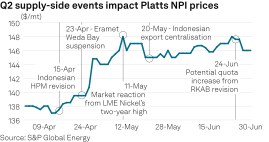
Upstream policy changes and tight Indonesian supply elevated NPI prices throughout Q2.
Indonesia announced potential commodity exports centralization under state-owned PT Danantara Sumber Daya Indonesia, including processed nickel.
Although NPI was later exempted from the proposed centralization, market participants still expressed uncertainty regarding the distinctions between NPI and ferronickel.
The transitional period for the export centralization regime began June 1 and runs through December. Amid the uncertainty, producers' offers strengthened, and Platts' NPI assessment hit a record high of $148/mtu on June 23 since its launch in February 2024.
However, weak demand from China's stainless steel sector capped the ability of steel mills to absorb higher NPI prices. Trading also thinned as factories entered summer maintenance.
Platts assessed 10% Ni Indonesian NPI at $144.1/mtu FOB Indonesia on July 13, up $6.1/mtu from April 1.
Sulfur costs boost MHP
MHP was particularly affected by the sulfur crisis, as sulfur is a crucial raw material in the high-pressure acid leach process. Platts assessed granular sulfur CFR Indonesia at $1,050/mt on July 9, up 59.1% from the start of Q2.
Sources, including producers, traders, and consumers, told Platts that disruptions around the Strait of Hormuz compressed HPAL margins to near-zero or loss-making levels for much of Q2.
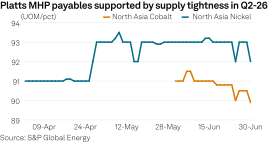
In response, Zhejiang Huayou Cobalt announced a temporary suspension of MHP production lines from May 1, reducing output by 50%. Several other major Indonesian HPAL operations also reduced production, tightening spot availability and delaying MHP payable negotiations, Asia-based sources said.
Sentiment reversed in late June as sulfur supply expectations improved following the US-Iran memorandum of understanding. Buyers continued to resist high offers, citing dwindling cobalt demand and prices.
Market participants also monitored additional MHP supply from HPAL projects, including Nickel Industries' Excelsior Nickel Cobalt (ENC) project, expected by mid-July.
Platts assessed the MHP CIF North Asia basis LME nickel monthly average price at 91.5% payables on July 13, up 0.5 percentage point from the start of Q2. The all-in price, as calculated from the payables' basis of the LME nickel price, was $16,157/mt on July 13.
The MHP CIF North Asia basis Platts cobalt metal price was assessed at 89.8% payables on July 13, down 2 percentage points since the assessment's launch on June 2.
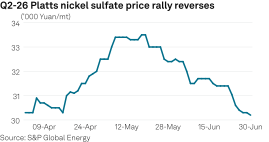
Downstream, Chinese nickel sulfate prices initially rose on increasing feedstock costs following the HPM revision, sulfur shortage, and tight MHP supply. However, prices declined through June, as downstream demand remained weak and recycled material increased.
Chinese consumers remained cautious, purchasing only as needed amid subdued demand for nickel-manganese-cobalt batteries.
China's NMC battery production totaled 35.6GWh in May, up 13% year over year but accounting for only 18.6% of the market. In comparison, LFP battery production reached 155.8GWh, rising 62.1% year over year and capturing 81.3% of the market, according to China Automotive Battery Innovation Alliance data.
"Demand for nickel sulfate has decreased, largely due to the expectation that the Strait of Hormuz will reopen, which has made the supply of MHP less constricted," said a major nickel producer.
Platts assessed spot battery-grade nickel sulfate with a minimum of 22% nickel content and a maximum of 100 parts per billion magnetic material at Yuan 30,000/mt ($4,414/mt) DDP China on July 9, down Yuan 300/mt from April 1, returning to a similar level at the start of Q2 after the price rally.
