Metals & Mining, Ferrous, Non-Ferrous
July 17, 2026
TRADE REVIEW: Asian steel under pressure in Q3 on seasonal demand lull, trade barriers
Editor:
HIGHLIGHTS
Trade measures spur export competition amid weak demand
Evolving Middle East conflict gives pause to steel trade
Taiwan mills favor cheaper domestic scrap over imports
This report is part of the S&P Global Energy's Metals Trade Review series, where we dig through datasets and digest some of the key trends in iron ore, metallurgical coal, copper, alumina, cobalt, lithium, nickel and steel and scrap. We also explore what the next few months could bring, from supply and demand shifts to new arbitrages, and to quality spread fluctuations.
Asian steel markets are expected to face persistent headwinds in the third quarter of 2026 as a seasonal monsoon lull weakens demand, while seaborne scrap prices could see further pressure from cost-competitive domestic scrap, slow rebar sales and lower appetite for imports amid higher regional summer electricity costs, potentially prompting mills to undergo maintenance or reduce operations, market participants said.
Against weakening seasonal demand, export opportunities continue to tighten amid further trade protection measures to support domestic industries due to global steel overcapacity, including the EU's steel import regulations, which took effect July 1, and India's initiation of an antidumping probe into hot-rolled flat steel imports from China, Japan and Russia.
Market participants also remained cautious about developments in the evolving US-Iran conflict, as any resumption of Iranian billet and slab exports could intensify competition with Chinese semi-finished steel exports.
Bearish sentiment pressures HRC despite supply-side support
Asian hot-rolled coil prices are expected to remain under pressure in Q3, as weak demand continues to outweigh limited supply-side tightening.
While a few Hebei mills were scheduled to cut output in July due to rising coke costs, market participants expect a limited impact as downstream demand remains sluggish and inventories are rebuilding after months of destocking, indicating that supply continues to exceed consumption.
Middle East buyers returned cautiously toward the end of Q2, although the fragile US-Iran ceasefire continued to limit purchasing activity.
Platts, part of S&P Global Energy, recorded six Indian and Chinese HRC transactions to Turkey and the UAE in Q2, double the number in Q1, with market participants attributing the deals to temporary optimism following the ceasefire.
Indian and Indonesian suppliers regained market share in Vietnam in Q2, after largely scaling back exports in Q1, amid weak domestic demand and fewer sales opportunities in Europe and the Middle East, market participants said.
Indian and Indonesian HRC prices were initially supported by higher-priced Q1 bookings but weakened as domestic demand faded and more short-selling and position cargoes were offered to Vietnam.
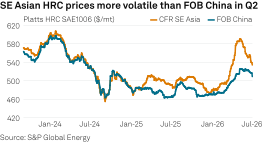
Platts SAE1006 CFR Southeast Asia assessment in Q2, which mainly reflected Indian and Indonesian coils following Vietnam's antidumping duty on Chinese coils, showed greater price volatility than its FOB China counterpart.
"In Q2, Asia's HRC markets saw China slipping on weak spot demand and limited cost support, while Southeast Asia firmed on export-linked optimism tied to potential Middle East buying," said Paul Bartholomew, associate director of metals and mining analytics at S&P Global Energy CERA.
Upcoming capacity expansions by Indian steel mills are expected to intensify competition in Southeast Asia amid reduced European import quotas, as exporters seek alternative markets.
"With additional capacity set to come onstream, Indian mills are expected to increasingly pursue export opportunities across a wider range of overseas markets, including Southeast Asia and the Middle East," an India-based mill source said.
Weak demand, rising competition pressure Chinese billet exports
Chinese billet export prices are expected to face pressure in Q3 amid softening seasonal demand.
In Q2, Chinese billet export volumes and prices increased as Iranian billet offers -- previously dominant in Thailand and Indonesia -- remained absent, allowing Chinese steelmakers to capture market share.
Over March-May, China's billet exports rose 42% year over year to about 3.85 million metric tons, with outflows to Thailand and Indonesia increasing 80.4% to about 901,000 mt, according to China Customs data.
Higher energy prices lifted steel prices, while geopolitical uncertainty prompted downstream buyers to secure supply in advance. "Customers feared further price increases and booked two months' volume in one month in March and April," a Malaysia-based mill source said.
Chinese billet FOB prices peaked in May, with Platts assessing 3SP 150-millimeter billet at $481/mt FOB China May 14, the highest since the assessment began in February 2025.
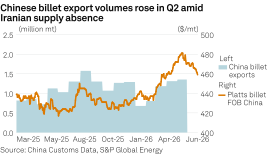
However, from late June, weak seasonal demand in China and the rainy season in Southeast Asia reduced finished steel demand and billet buying interest, while Asian traders noted high inventories and slow sales.
Asian steel demand remained thin, with buyers largely in a wait-and-see mode as the US-Iran situation evolved further and they awaited lower energy prices, another Malaysia-based mill source said.
A Thai trader said Iranian suppliers were still seeking buying indications but could not commit to shipments.
Chinese billet export prices will likely face further pressure in Q3 amid weak demand and rising competition, according to market participants.
Asia scrap sentiment bearish on summer, monsoon lull
Likewise, Asia scrap prices are expected to face headwinds in Q3 amid weak summer and monsoon-season demand, extending declines seen in Q2.
In Q2, the Platts containerized HMS 1/2 80:20 CFR Taiwan index fell to $339/mt CFR June 30, down $24/mt from its peak of $363/mt May 19.
Summer electricity rates and the monsoon season are expected to weaken scrap demand, according to market participants.
Market participants expect downstream activity to remain sluggish amid low demand and weather-related construction disruptions, which may further pressure scrap prices downward.
"Demand for scrap is weak, and expected to [remain weak until] September or October," a Vietnam-based trader said.
Scrap demand typically softens during summer, when higher electricity costs in markets such as Japan, India and Bangladesh often prompt mills to schedule maintenance or reduce operations, a Taiwan-based trader said.
In Taiwan, weak market fundamentals and thin rebar demand continued to weigh on scrap prices. Imported scrap also competed with cheaper domestic material, while billet buying interest remained thin amid a widening billet-scrap spread and sluggish rebar demand.
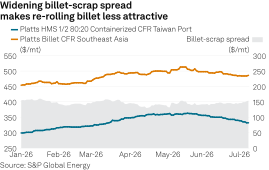
While scrap prices are expected to decline in Q3, some market participants do not expect a sharp fall, citing strong domestic scrap prices in Japan and relatively strong buying interest from Bangladesh compared with other regional markets.
