Metals & Mining, Ferrous
July 20, 2026
TRADE REVIEW: Seaborne iron ore market braces for Q3 pressure as buyers reassess Australian brands
Editor:
HIGHLIGHTS
Steel mill demand patterns to shift on reduced Newman Fines specs
Pilbara Blend Fines premiums erased as demand falters
Lump, pellet premia hit multi-year highs
This report is part of the S&P Global Energy's Metals Trade Review series, where we dig through datasets and digest some of the key trends in iron ore, metallurgical coal, copper, alumina, cobalt, lithium, nickel and steel and scrap. We also explore what the next few months could bring, from supply and demand shifts to new arbitrages, and to quality spread fluctuations.
The Asian seaborne iron ore market may extend its tepid run into the third quarter of 2026, while buyers reassess Australian brands in view of BHP's August quality adjustment and evolving negotiations between China's central iron ore buyer and Australian miners, including Fortescue.
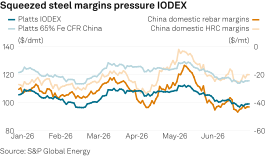
The Platts Iron Ore Index, or IODEX, declined sharply in May and has remained below $100/dmt CFR China since June 17, as improved supply certainty following the conclusion of BHP's negotiations with China Mineral Resources Group coincided with a time when steel margins became squeezed amid successive increases in Chinese domestic coke prices.
BHP's latest specification revisions, effective for August-arrival shipments, mark another step down in medium-grade fines quality, as the iron content for Newman High Grade Fines (NHGF) declines to 60.7% from 61.2%.
With four of the five mainstream medium-grade fines now below 61% Fe, the change could drive a reassessment of blending economics and pricing relativities against the 61% Fe index.
Pricing mechanisms relying on a 62% Fe basis could also come under greater contention, as market participants seek to understand the detailed steps taken to arrive at it.
On the other hand, potential delivery restrictions on Fortescue's flagship Super Special Fines to Chinese mills starting July 15 may provide some support for medium-grade iron ore prices in the immediate term, given the narrow range of low-grade substitute options, market participants said.
S&P Global Energy CERA analysts expect iron ore prices to average $98/dmt in the second half, down 6% year over year, for a full-year average of $101/dmt. "A resumption of the conflict in the Middle East poses upside risk to this forecast, but this is likely to be offset by record-high port stocks, weaker Chinese mill margins, and a drop in steel production," according to lead ferrous analyst Paul Bartholomew.
PBF premiums erased amid cheaper alternatives
Demand for Pilbara Blend Fines, previously supported by flight-to-safety buying during the BHP product curbs, declined in Q2, as steel mills started to weigh the brand against the full slate of available options again.
The seaborne market for PBF showed signs of a supply overhang in mid-June, with CMRG International Supply Chain having offered 16 spot cargoes at one go then, according to an offer list seen by Platts. The accumulation of PBF port inventories and negative landing margins in the Chinese port stock market further weighed on seaborne prices.
Rio Tinto's spot PBF premium was nearly erased, shrinking from $2.72/dmt over the May IODEX at the end of Q1 to an implied 25 cents/dmt over the August SGX IODEX derivative by the June 17 fixed price trade, Platts data showed. By late June, spot PBF offers reported to Platts had fallen to as low as a discount of 50 cents/dmt to the July average of IODEX.
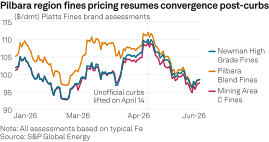
Meanwhile, prices for BHP medium-grade fines have recovered from steep discounts since import curbs were lifted on April 14, Platts data showed, as buyers viewed the products as being competitively priced relative to their quality.
The implied floating discount for MACF and NHGF narrowed to around minus 45 cents/dmt and minus 60 cents/dmt by the end of June, from discounts of as much as $5.5/dmt and $5.2/dmt, respectively, before the lifting of the buying curbs.
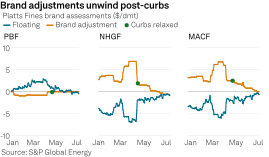
Platts accounts for pricing factors other than differences in chemical properties and timing via brand adjustments, which are normalized to the IODEX benchmark. Platts lowered the brand adjustment for all three BHP medium-grade fines since the relaxation of buying curbs, from as much as $6.80/dmt on March 24 to zero by July 6 for MACF.
While BHP's quality specifications update for August included minor revisions across its flagship products, market participants zeroed in on the renewed specifications of NHGF.
"Last year, when its specifications dropped, most mills that used NHGF had already started seeking alternatives for it, mainly in the form of MACF," said a northern China-based trader. "The dip in quality for NHGF is quite significant this time round too, which may see a greater reliance on MACF and PBF moving forward," added the trader.
Pellet, lump premia hit multi-year highs
While overall iron ore prices have eased since May, premium products, including lump and pellet, have retained their attractiveness among buyers, as mills leaned on their superior chemical properties and direct-charge role in blast furnaces amid repeated coke price hikes.
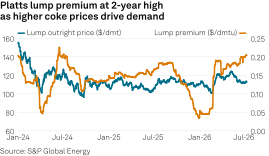
Platts Iron Ore Spot Lump Premium CFR China reached a two-year high of 20.45 cents/dmtu on July 8, with the Q2 average rising around 68.2% quarter over quarter to 18.18 cents/dmtu.
Chinese cokeries have implemented nine consecutive rounds of domestic coke price hikes since early March. Higher coke prices weighed on steel margins, but supported lump demand, as its higher Fe and lower silica help reduce the coke rate in ironmaking, a north China-based mill source said.
"Mills still prefer to use lump, especially with anticipated hikes to coke prices, as it can help reduce the coke rate without the need to buy low silica products, which are limited in supply now," said a northern China-based trader.
Relatively low portside lump inventories also helped keep reselling margins for Australian lump positive, providing support for seaborne premiums into the third quarter.
However, as higher coke prices also hurt mill margins, some mills that could not justify the use of mainstream lump have sought lower-cost material such as non-mainstream lump, captively produced pellets, and sinter, market participants said.
Iron ore pellet, an alternative direct charge material, also saw prices supported in Q2, backed by historically low port inventories of pellet at ports and reduced domestic pellet production rates. Particularly, there was a strong preference for low-alumina pellets, as steelmakers use them to lower sinter ratios and reduce coke costs, market participants said.
The spot blast furnace pellet premium for high-grade, low alumina pellets over the 61% Fe Iron Ore Index jumped to the highest in more than three years of $23.5/dry metric ton CFR China July 8, after adjusting to a 65% Fe basis, Platts data showed.
High-grade pellet supply to China was expected to stay tight, helped by solid demand in Europe and the Middle East, lifting Vale's Q3 contract BF pellet premium to $40/dmt from $34/dmt in Q2. Additionally, potential China sintering restrictions later this year and maintenance of domestic pelletizing operations could further support premiums in the near term, market participants said.
