Coal, Metals & Mining, Metallurgical Coal, Ferrous
April 24, 2026
TRADE REVIEW: Asian met coal market sees pricing support in Q2 from Middle East war
By Sumita Layek and Samuel Chin
Editor:
HIGHLIGHTS
War lifts freight costs, fuels diesel shortage concerns
New Indian mills enter long-term contracts from April
PLV CFR China-FOB Australia spread may widen in Q2
This report is part of the S&P Global Energy's Metals Trade Review series, where we dig through datasets and digest some of the key trends in iron ore, metallurgical coal, copper, alumina, cobalt, lithium, nickel and steel and scrap. We also explore what the next few months could bring, from supply and demand shifts to new arbitrages, and to quality spread fluctuations.
The Asian seaborne metallurgical coal market is expected to see pricing support in the second quarter from the Middle East conflict due to supply chain disruptions, participants said.
Met coal prices have been elevated since April on persisting concerns of a diesel supply shortage, which could impact mining operations, particularly in Australia.
Higher freight costs have been the most direct impact of the war on met coal markets. The Platts Panamax freight rates from East Coast Australia to east coast India averaged $25.18/metric ton in March, up 50.2% from the February average of $16.76/mt and 73.2% from the March 2025 average of $14.54/mt. Platts is part of S&P Global Energy.
The freight from East Coast Australia to Qingdao, China, averaged $22.38/mt in March, higher by 46.4% from the February average of $15.29/mt and by 70.8% from the March 2025 average of $13.10/mt, Platts data showed.
Even with a fragile ceasefire, market participants saw it doing little to alleviate supply shocks and costs in the medium term, given the significant damage to energy supply infrastructure.
These war-led challenges followed the first quarter's wet weather and mining-related disruptions in Australia, with miners like GM3 calling for a force majeure on mining-related issues alongside various shipping delays from other premium coal suppliers.
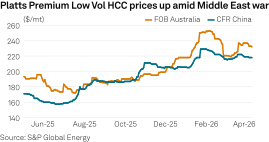
Platts Premium Low-Vol Hard Coking Coal prices rose in Q1, with the FOB Australia index touching an over-one-and-half-year high at $252.50/mt Feb. 4.
The PLV HCC assessment ended Q1 at $236.80/mt FOB Australia March 31, up $18.80/mt from the start of the quarter.
The Platts PLV HCC CFR China index also increased by $14.50/mt from the beginning of the quarter to $220/mt March 31.
"We expect the Middle East conflict to keep metallurgical coal prices at higher levels in the short term," S&P Global Energy CERA analysts said in a March 26 note, adding that elevated seaborne freight rates and coal's role as an alternative to oil and LNG amid supply shortages were indirectly supporting met coal prices.
India's spot demand may shrink
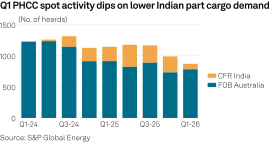
India was the most active spot buyer of met coal in Asia in 2025 and for Q1 2026, although at a slower pace. This came alongside a lull in the Chinese import market as buyers there relied mainly on domestic and Mongolian sources, while Southeast and Northeast Asian buyers entered the spot market only opportunistically.
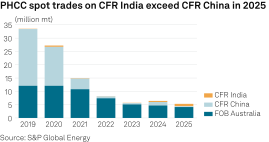
Coming into 2026, several Indian mills, which were previously dependent on the spot market for their premium coal requirements, were said to have entered into long-term contracts with Australian suppliers in the new Indian fiscal year starting April 1. At the same time, end-users with existing term contracts have also increased volumes bought on these terms.
Market participants anticipated the trend to likely sap spot demand this year.
"The newly-contracted term volumes should meet our projected demand," an Indian steelmaker said. "But if spot prices are competitive enough, perhaps we might give that a thought too ... perhaps."
Barring any slowdown in steel production due to the conflict, traders expected Indian mills to restock adequate spot volumes in Q2 in preparation for the monsoon season from June to September.
India's spot demand for coal imports dipped in Q1 as end-users' preference for imported coke resurfaced, after antidumping duties on coke came into effect in January, replacing the country's 2025 import quotas.
Indonesian coke, being competitively priced when compared with Indian domestic supply, made some end-users weigh the benefits of importing it as opposed to buying coal as a raw material.
"Mills were actively debating whether to buy coke or coking coal in Q1 due to attractive imported coke prices," an India-focused trader said.
Entering Q2, however, higher coking coal prices have led Indonesian coke producers to hike offers for 65%/63% coke strength after reaction cargoes loading in June to up to $270/mt FOB Indonesia, an increase of up to $20/mt from March levels. This reduced the relative attractiveness of buying coke as opposed to coal.
Indian end-users have held back from buying expensive coke in Q2, an international coke trader said. He estimated that for Indian mills to actively consider buying Indonesian coke, prices would need to be below $250/mt FOB.
The Platts 65%/63% CSR FOB Indonesia met coke assessment ended Q1 at $253/mt March 31, up $33/mt from $220/mt Jan. 2.
Australian PHCC spot transactions fall
In Q1, Platts observed nine Australian PHCC spot transactions, down from 27 in the previous quarter across various incoterms.
The decline was largely driven by reduced end-user demand from India and from the uncertainty of Australian supply due to wet weather conditions and mining-related disruptions, which were affecting mines producing premium medium-volatile coals.
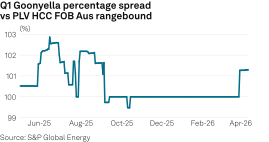
In Q1, Goonyella was observed to have traded at parity with the Platts PLV HCC FOB Australia assessment, as demand for both PLV and PMV coals was seen equal amid the volatile supply situation.
The PLV-PMV spread entered negative territory in Q2, as market participants expected a return of PMV demand for premonsoon restocking amid unsteady supply from Australia.
Wide PLV HCC CFR China-FOB Australia spread
The PLV HCC CFR China-FOB Australia spread is expected to widen further in Q2 from Q1 levels. This is contingent upon strengthening Indian demand ahead of the monsoon season, contrasted with continued lackluster interest from China-based buyers.
The spread had widened in Q1 from the previous quarter. The spread between the two indexes deepened to minus $16.80/mt by March 31, compared to minus $12.50/mt Jan. 2, according to Platts data.
Despite a tight supply-driven rally in early Q1, there was limited interest in the CFR China market from both end-users and traders.
FOB traders engaged in active position-taking during Q1, which supported firmer Australian prices.
This capped the impact of rising Australian FOB prices on the CFR China market, widening the basis gap.
