Metals & Mining, Non-Ferrous
April 10, 2026
TRADE REVIEW: Chinese copper concs TC/RC to remain under pressure in Q2 amid tight supply

By Lu Han
Editor:
HIGHLIGHTS
Indonesia, DRC export cuts tighten supply
Index-linked pricing gains market momentum
Cathode premiums rise amid demand recovery
This report is part of the S&P Global Energy's Metals Trade Review series, where we dig through datasets and digest some of the key trends in iron ore, metallurgical coal, copper, alumina, cobalt, lithium, nickel and steel and scrap. We also explore what the next few months could bring, from supply and demand shifts to new arbitrages and quality spread fluctuations.
China's clean copper concentrate treatment and refining charges are expected to remain under downward pressure in the second quarter of 2026, as the global market continues to grapple with tight copper concentrate supply, according to international traders, producers and smelters.
This comes as the copper concentrate export permit for Indonesia's Batu Hijau mine is set to expire at the end of April, potentially reducing the country's concentrate exports.
Meanwhile, the Democratic Republic of Congo's Kamoa-Kakula smelter began anode production at the end of 2025 and will consume domestically produced copper concentrate, further curbing exports.
Copper concentrate exports from Indonesia and the DRC -- both important exporters of high-grade material -- totaled 2.27 million metric tons in 2025, according to customs data. Market participants expect this volume to fall sharply in 2026 due to the export curbs.
Spot demand for copper concentrate picked up in March, despite some Chinese smelters slightly curtailing output in the first quarter, driven by supply concerns after shipment delays in Peru due to rough seas, according to a producer and a trader. As a result, demand for prompt cargoes rose, with some Chinese smelters advancing deliveries under long-term contracts.
Smelters' willingness to purchase copper concentrate increased further as sulfuric acid prices in China rose, allowing them to secure short-term margins while putting additional pressure on TC/RC, according to several China-based smelters and traders.
Platts, part of S&P Global Energy, assessed sulfuric acid FOB China at $210/mt on April 8, up 73.6% from Jan. 7, following disruptions to sulfur supply caused by the Middle East conflict.
Platts assessed the CIF China clean copper concentrate treatment charge and refining charge at minus $78.50/mt and minus $7.85 cents/lb, respectively, on April 9.
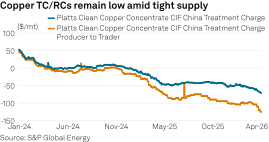
Q1 saw TC/RC fall so low that smelters struggled both to finalize term deals and to maintain operations. Several Japanese smelters secured long-term contracts with suppliers at treatment charges of $15-$25/mt for 2026-loading shipments, with some negotiations continuing into Q2.
Japan's Mitsubishi Materials will stop processing copper concentrate and suspend related smelting operations at its Onahama smelter and refinery by the end of March 2027 due to low TC/RC.
Index-linked pricing gains traction
The adoption of index-linked pricing mechanisms in the spot market is expected to continue in Q2, driven by widening gaps between bids and offers and expectations of further declines in TC/RC, according to market participants and data compiled by Platts.
Fixed TC/RC spot offers remained scarce, particularly from traders, pushing more transactions toward index-based settlements amid a weakening market, according to Chinese smelters.
Chinese smelters purchased 2.17 million mt of copper concentrate in Q1, with 33% traded on an index basis, according to data compiled by Platts.
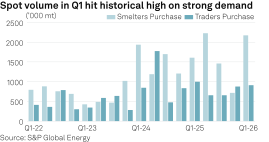
Meanwhile, challenges in sourcing certain types of copper concentrate were seen. Spot liquidity for high-arsenic concentrate remained limited, despite increased supply in Q1, including material from Timok in Serbia and Toromocho in Peru, with blenders reporting difficulties in obtaining clean concentrate to blend with these more complex materials.
Refined copper production in China remained high as smelters increased the use of alternative, domestically sourced feedstocks -- including concentrate, blisters, anodes and scrap -- according to Chinese smelters and traders.
China's refined copper output reached 2.47 million mt over January-February, up 9% year over year, data from the National Bureau of Statistics showed.
Scrap use as an alternative smelter feedstock grew in Q1. Japan's scrap imports rose 50% year over year to 64,470 mt over January-February, while South Korea's imports increased 43% to 61,116 mt over the same period, data from S&P Global Market Intelligence's Global Trade Analytics Suite showed.
At the same time, offers for non-standard materials -- including gold concentrate, silver concentrate, crude copper ore and pyrites -- also rose, supported by smelters' production needs and elevated sulfuric acid prices, according to traders and a smelter.
Cathode premiums rise as demand recovers
Copper cathode import premiums into China are expected to continue rising in Q2, building on March levels that were supported by a favorable arbitrage window, limited availability of grade A offers in Asia and strong demand from Chinese end users, according to traders.
Platts assessed Chinese copper cathode import premiums at $65/mt plus London Metal Exchange cash, CIF China, on April 9.
Global visible stocks reached a multiyear high of 1.35 million mt as of March 20, according to S&P Global Energy CERA. This reflected subdued demand amid high copper prices, while ongoing conflict in the Middle East added further uncertainty to regional consumption, traders said.
Term contract coverage in Q1 was lower than in previous years, as end users continued to restock only as needed, while spot premiums remained under pressure earlier in the quarter, traders added.
Spot liquidity began to improve in March after copper prices fell below $12,000/mt, prompting fabricators to resume restocking amid a gradual recovery in sales orders, according to traders and a producer.
Higher energy prices and a stronger US Dollar Index -- linked to disruptions in the Strait of Hormuz -- contributed to downward adjustments in copper prices, stimulating spot market activity, said Ruilin Wang, senior principal analyst for copper at CERA.
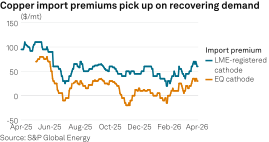
Copper cathode supply in Southeast Asia is expected to remain supported in Q2, driven by the ramp-up of two Indonesian facilities -- the Manyar smelter and Batu Hijau mine -- which could put downward pressure on copper premiums in the regional market, a Singapore-based trader said.
