Metals & Mining, Non-Ferrous
April 15, 2026
TRADE REVIEW: Rising costs to support Asian nickel in Q2 despite supply surplus

By Louissa Liau
Editor:
HIGHLIGHTS
Supply disruptions boost MHP payables in Q1
MHP payables rise on supply disruption, high production costs
Weak battery demand caps nickel sulfate prices
This report is part of the S&P Global Energy's Metals Trade Review series, where we dig through datasets and digest some of the key trends in iron ore, metallurgical coal, copper, alumina, cobalt, lithium, nickel and steel and scrap. We also explore what the next few months could bring, from supply and demand shifts to new arbitrages, and to quality spread fluctuations.
Rising production and fuel costs are likely to support the Asian nickel market in the second quarter of 2026, even as ample supply and cautious downstream demand from the battery sector may continue to limit price gains, market participants told Platts, part of S&P Global Energy.
Although demand from the stainless steel and battery markets remained subdued in Q1, higher input costs, including nickel ore, sulfur, and logistics, helped support prices for nickel pig iron, mixed hydroxide precipitate, and nickel sulfate.
"Disruptions in sulfur supply - critical for battery-grade nickel production -- combined with rising fuel costs in the wake of the US-Israel war with Iran are expected to increase input costs and potentially reduce production volume," said Joenelle Donato, analyst at S&P Global Energy CERA, adding that "this could lead to tighter MHP and nickel sulfate availability, and potentially induce volatility in nickel prices".
NPI prices track higher nickel ore prices
Indonesian nickel pig iron prices strengthened across most of Q1, supported by higher nickel ore prices amid favorable policy signals from Indonesia. NPI prices rose 22.9% since the start of Q1 to $140/metric tons of nickel content FOB Indonesia March 17, according to Platts data, marking the highest level since Platts began publishing prices in February 2024.
Upstream, nickel ore prices rose after Indonesia reduced its 2026 nickel ore production quota to 260 million-270 million metric tons from the 379 million mt approved for 2025.
Asosiasi Penambang Nikel Indonesia estimates annual smelter demand at about 380 million-400 million mt, indicating a deficit of 110 million-120 million mt based on current approved mining quotas. Government officials have also indicated that the nickel benchmark price formula, or HPM, could be increased further to boost state revenue if prices remain favorable, reinforcing expectations of cost support along the supply chain.
Concurrently, Indonesia's reliance on the Philippines laterite nickel ore is likely to increase in the near term amid the reduction in approved mining quotas for 2026.
Platts assessed high-grade 1.6% nickel ore at $83.5/wmt on April 14 on a CIF China basis, up $21.5/wmt from Jan. 2.
Platts assessed low-grade 1.3% nickel ore at $63/wmt on April 14, up $22/wmt since the start of Q1.
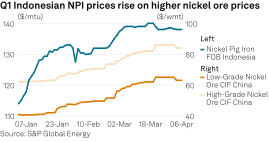
Platts assessed daily spot NPI with 10% nickel content at $137.3/mtu FOB Indonesia on April 14, up 20.5% since the beginning of 2026.
Higher costs support MHP payables
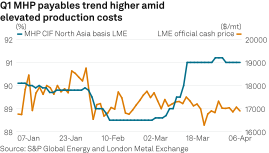
Mixed hydroxide precipitate payables rose throughout Q1 due to supply disruption and rising production costs.
Higher operating costs at HPAL facilities were observed due to limited sulfur availability. Prices of sulfuric acid -- a critical input for MHP production -- rose amid supply disruptions from the Middle East and higher energy and freight costs.
Several market participants said that ongoing sulfur cost pressures could restrict operational flexibility or delay ramp-ups at some projects. CFR Indonesia sulfuric acid prices increased by 31.25% to $210/mt as of April 1, reaching the highest level since the assessment began in July 2024, Platts data showed.
Platts assessed MHP CIF North Asia, basis London Metal Exchange nickel, at 91% payables April 14, up from 90.1% on Jan. 2. The all-in price at $15,550/mt, calculated from the payable basis LME nickel, rose $2,147/mt since the start of 2026.
Nickel sulfate prices capped by weak demand
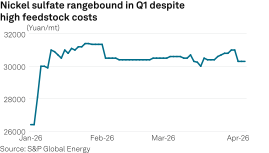
Nickel sulfate prices remained largely stable throughout Q1, as weak downstream demand from the battery sector offset rising feedstock costs.
Demand from nickel-manganese-cobalt battery producers remained weak as China's electric vehicle market entered a seasonal lull and continued shifting toward nickel-free lithium-iron-phosphate batteries, with many buyers sourcing material only on a need basis.
China's NMC battery production totaled 58.2GWh in the first two months of 2026, accounting for just 18.8% of the market, according to the China Automotive Battery Innovation Alliance. In contrast, LFP battery production was at 251.3GWh, representing 81.17% of the market.
Meanwhile, higher MHP payables and sulfur prices squeezed margins for nickel sulfate refiners. While some producers tried to keep offer levels high, overall weak downstream demand discouraged buyers from accepting higher prices. Market sources said this will likely lead to production adjustments for some refiners who are higher on the cost curve.
Platts assessed nickel sulfate at Yuan 30,500/mt ($4,447/mt) on April 14, up 15.5% since the start of the year.
Sulfur supply disruption to raise input costs
Disruptions in sulfur supply and higher fuel costs tied to Middle East tensions could further increase input costs and limit output in Q2, especially for battery-grade nickel products, analysts said.
Higher energy prices and uncertainty over global economic conditions, following the conflict in the Middle East, may cause downstream consumers to remain cautious, limiting restocking and dampening near-term demand.
Although higher production costs may establish a floor for nickel prices in Q2, market uncertainty, combined with ample supply and weak demand in both the battery and stainless-steel sectors, could continue to limit nickel prices.
