Metals & Mining Theme, Non-Ferrous
December 29, 2025
Indonesia navigates nickel market with output cuts, policy shifts
By Anthony Barich and Gaurang Dholakia
HIGHLIGHTS
Indonesia to cut nickel output in 2026 to support prices
Reverses mining quota policy to regulate supply volatility
Actual production lags approved quotas, inflating oversupply perception
Indonesia's nickel mining quota policy places the country in a position to capitalize on market volatility, but its evolution has also created some market confusion, experts said.
On Dec. 19, Indonesia's Minister of Energy and Mineral Resources Bahlil Lahadalia confirmed plans to cut nickel production in 2026 in an effort to support prices and government revenue, and crack down on environmentally harmful operations. This came after raising royalties in April when the London Metal Exchange three-month (LME 3M) closing nickel price plunged to a near-five-year low of $14,084 per metric ton.
Indonesia increased its market share from 31.5% in 2020 -- when it implemented a nickel exports ban that sparked investment in downstream processing -- to 60.2% in 2024, according to S&P Global Market Intelligence data, through Chinese-backed investments that forced a significant portion of global supply out of business.
Though Lahadalia did not specify production reduction targets, as of Dec. 8, Indonesia was expected to further ramp up its market share from 59.9% in 2025 to 74.1% by 2035, by which point the LME 3M price is expected to reach $17,600/mt, according to forecasts from S&P Global Energy CERA analysts.
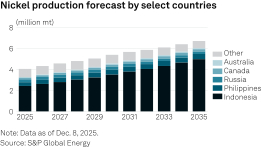
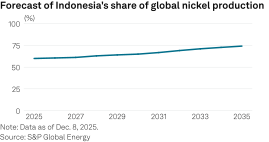
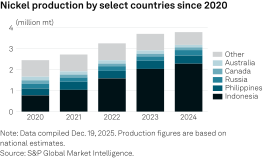
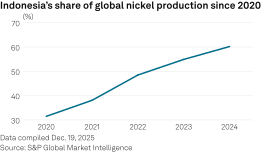
Indonesia's move to cut production could ease global oversupply and provide price support. S&P Global Energy CERA forecast the market to flip into a deficit in 2032.
That forecast came out just before Lahadalia's announcement of 2026 output cuts, which will come through production quotas known as RKABs. The government initially introduced three-year RKAB mining quotas in 2023 to cut bureaucratic delays and prevent depletion of domestic nickel reserves.
This policy was reversed on Oct. 3 as part of a broader strategy to address price fluctuations, oversupply and regulatory gaps in the domestic ore and coal industries, Joenelle Donato, nickel analyst with CERA, said in an email interview.
This reversal "allows the government to increase revenue by regulating production to capitalize on the nickel market volatility," Donato said.
Under the new system introduced in October, companies must now reapply for previously issued quotas for 2026 and 2027, and must allocate funds for mine rehabilitation once mining operations have ceased. This aims to improve compliance, following the suspension of 190 permits in September 2025 for failure to meet rehabilitation or production obligations, Donato said.
"While the triennial RKAB quota is more convenient for mining companies operating under long-term permits, the one-year RKAB will allow the government to regulate production to capitalize on nickel market conditions, which could potentially increase government revenue," Donato said.
Inflated market perception
The RKAB system, introduced in 2023, also created misconceptions about market oversupply.
The mining quota policy "created an opportunity for producers to secure quotas that are beyond their actual production capacity for them to anticipate future regulatory changes and/or price swings," Donato said.
"This contributed to an inflated market perception of supply as compared to the actual production."
The Industrial and Commercial Bank of China (ICBC) also said the 2023 RKAB policy "created perverse incentives for speculative quota hoarding rather than productive capacity expansion," according to a Dec. 1 note.
"Rather than requesting quotas aligned with near-term production plans, firms submitted aggressive multiyear allocations intended as strategic reserves, creating what industry observers now term 'zombie allocations,'" ICBC said.
ICBC also said, "Indonesian production quotas grossly exceed actual output, creating a 'paper surplus' that bears little resemblance to physical market realities."
"The fundamental driver of the perceived nickel glut is the massive disconnect in Indonesia, the largest nickel-producing country, between approved production capacity and actual production volumes. This distinction is crucial and frequently overlooked by market participants relying on headline quota figures," ICBC said.
Supply outpacing Chinese demand
Despite reports circulating that Indonesia has not fully utilized the production quotas, as actual production is below the approved levels, the current actual Indonesian primary nickel supply still outpaces demand, Donato said.
Indonesia's drive to expand capacity was designed to meet the growing demand for electric vehicles, particularly by developing more downstream processing facilities, Donato said.
This is despite the growing popularity of lithium iron phosphate (LFP) batteries as a cost-efficient alternative.
"Since the LFP is more widely used in China in plug-in EV manufacturing, nickel-containing batteries are being used for EV models requiring higher energy density. As a result, primary nickel supply in Indonesia is outpacing primary nickel demand in China, which is the largest importer of Indonesian primary nickel, eventually contributing to oversupply," Donato said.
The build-up of LME stocks also contributed to the supply glut, as LME nickel stocks surged above 250,000 mt in the quarter ending Dec. 31, Donato said.

Editor: