Metals & Mining, Non-Ferrous
April 14, 2026
TRADE REVIEW: Asian cobalt market faces tight Q2 amid supply concerns
By Samantha Beh and Leah Chen
Editor:
HIGHLIGHTS
DRC export delays tighten cobalt supply
Chinese cobalt hydroxide imports plunge 95%
Weak NMC battery demand limits price growth
This report is part of S&P Global Energy's Metals Trade Review series, where we dig through datasets and digest some of the key trends in iron ore, metallurgical coal, copper , alumina, cobalt, lithium, nickel, and steel and scrap. We also explore what the next few months could bring, from supply and demand shifts to new arbitrages and quality spread fluctuations.
Asian cobalt prices are expected to remain elevated through the second quarter as export disruptions from Democratic Republic of the Congo persist and Indonesian production faces potential constraints from sulfur shortages, raising concerns about feedstock availability.
Despite limited downstream NMC battery demand, there remains a possibility of further price upside if cobalt hydroxide exports from DRC take longer than expected to normalize, and if Indonesia's cobalt production remains constrained by sulfur and sulfuric acid availability, according to S&P Global Energy CERA analysts.
Upstream activity muted
Supply disruption from DRC has extended into early 2026, as shipments scheduled through Dec. 31, 2025, faced further delays, keeping spot cobalt feedstock availability limited. The DRC's Authority for the Regulation and Control of Strategic Mineral Substances Markets (ARECOMS) first announced a cobalt export ban on Feb. 22, 2025, which was replaced with a quota system on Sept. 21, 2025.
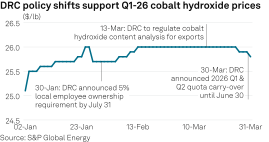
Initial expectations for 5,000-6,000 mt of material to ship by the end of March have been pushed back to the second quarter, with some sources citing inconsistent inspection outcomes during the export process, while others believe that the material ready for export may have been held back to consolidate shipments.
On March 30, ARECOMS confirmed that unused Q4 2025 quotas must be utilized by April 30 or will be forfeited to the strategic reserve, while Q1 and Q2 2026 quotas must be used by June 30, 2026.
"Not sure if they can export quickly enough. Based on this, if exports proceed smoothly, April to June will be the peak period for DRC's cobalt hydroxide exports this year, with arrivals in China expected around June to August," said a North Asian producer.
DRC's evolving policies collectively signaled stronger governance over cobalt exports and supported hydroxide pricing in Q1. The export quotas were also reshaping mineral flows, as the country aims to reduce reliance on Chinese supply chains through a US–DRC strategic partnership, CERA analysts said.
Chinese cobalt hydroxide imports dip in Feb
With supply chain diversification, Chinese market participants generally expected low import volumes to reach Chinese ports in the near term, with market talk suggesting that some cobalt materials could be redirected to the US market.
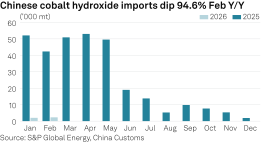
Chinese imports of cobalt hydroxide fell 96.2% and 94.6%, respectively, on a year-over-year basis in January and February , according to data from the China Customs. China's imports of cobalt hydroxide amounted to only 1,979 mt in January and 2,281 mt in February.
Platts, part of S&P Global Energy, assessed 30% Co cobalt hydroxide CIF China at $25.90/lb on April 13, up 3.19% from $25.10/lb on Jan. 2.
Indonesian risks
Indonesia's cobalt output from mixed hydroxide precipitate (MHP) faces potential disruption as a prolonged Middle East conflict has tightened the country's access to sulfur, a key input for high-pressure acid leaching (HPAL) processing, according to CERA analysts.
Indonesia has been the world's second-largest cobalt supplier, helping to offset the gap in DRC feedstock exports, and produced 38,324 mt of cobalt in 2025, or 18.3% of global production, according to S&P Global Market Intelligence data.
CERA analysts expect cobalt prices to begin easing from Q2 when DRC export flows normalize, though timing remains a key swing factor, and any Indonesia-related disruption could add upside risk.
Weak NMC demand limits sulfate price growth
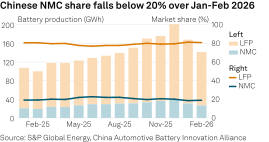
Downstream, cobalt sulfate prices are expected to remain firm in Q2 due to high feedstock cobalt hydroxide prices, although continued weakness in the downstream nickel-manganese-cobalt (NMC) battery demand limits price growth.
"We are not buying cobalt sulfate, there's no demand," a Zhejiang-based NMC cathode maker said.
Market sources attributed the shift toward LFP batteries to increased demand from the battery energy storage sector.
"Battery storage demand is emerging as a fast-growing pillar of the energy transition, with growth now outpacing EVs as renewable scale and grid firming becomes critical," Rio Tinto CFO Peter Cunningham said on a Feb. 19 earnings call.
Demand from energy storage is expected to start slowly with 1.6% growth in 2026, CERA analysts said in a March report. Energy storage demand will take off in 2027, jumping 16% year over year.
Platts assessed cobalt sulfate at Yuan 90,000/mt DDP China on April 13, down Yuan 2,500/mt from Yuan 92,500/mt on Jan. 2.
