Metals & Mining, Non-Ferrous
April 13, 2026
TRADE REVIEW: Asian lithium likely to extend uptrend in Q2 amid ongoing supply uncertainties
By Marco Loke and Litian Wang
Editor:
HIGHLIGHTS
Zimbabwe ban tightens lithium supply chain
Australian diesel shortage threatens spodumene production
Lithium hydroxide trades at premium in Feb
This report is part of S&P Global Energy's Metals Trade Review series, where we dig through datasets and digest some of the key trends in iron ore, metallurgical coal, copper, alumina, cobalt, lithium, nickel, and steel and scrap. We also explore what the next few months could bring, from supply and demand shifts to new arbitrages and quality spread fluctuations.
Asian lithium prices are expected to remain elevated in the second quarter of 2026 due to supply uncertainties amid the ongoing conflict in the Middle East that threatens mining operations in Australia through diesel shortages, Zimbabwe's upstream export ban, and licensing challenges affecting lithium mining in China, market participants told Platts, part of S&P Global Energy.
Lithium prices largely strengthened in Q1 amid supply disruptions and front‑loaded orders ahead of China's reduction of the VAT rebate on lithium‑ion battery exports effective April 1.
Q1 marked by supply uncertainties
Zimbabwe announced the immediate suspension of all lithium concentrates exports on Feb. 25, and outflows remain suspended as of April 9.
"Our base case estimates that the sudden policy tightening will remove 46,000 metric tons of lithium concentrate exports from the market in 2026, equivalent to 25% of Zimbabwe's originally expected output and about 2% of global raw material supply," according to the S&P Global Energy Lithium and Cobalt Commodity Briefing Service report.
A Tianjin‑based cathode maker said it has been seeking spodumene in the spot market due to insufficient supply at its Guangxi plant, forcing it to revise down the expected lithium chemical output for April.
"Zimbabwe's suspension is expected to affect spodumene arrivals in China from April to early May, given the 40-day voyage," a trader based in Zhejiang said. "Each additional day Zimbabwe keeps exports suspended means one more day of disrupted spodumene arrivals in May," the trader added.
Market participants are also monitoring for potential pressure on Australian diesel supplies from the Middle East conflict, with the country already facing fuel shortages due to delayed shipments. Spodumene production could be hit if fuel availability becomes further constrained, according to sources.
"It's unclear how long domestic fuel reserves will last, but based on publicly available data, they should support operations until the end of April," said a miner.
In Jiangxi, the production at the major lepidolite mine Jianxiawo has been suspended since August 2025, and a preliminary environmental impact assessment was announced on Dec. 19. Most market participants expect operations to resume no earlier than the second half of 2026, later than the previously anticipated H1 restart.
Spodumene buying amid feedstock concerns
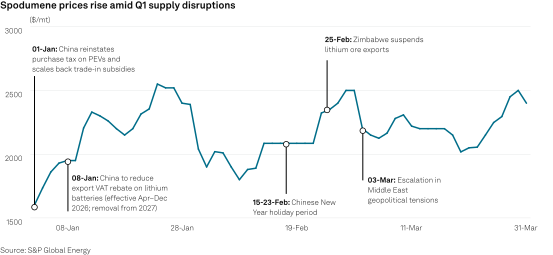
Several traders with selling positions said they had received higher spodumene inquiries in the week ended March 31. However, they did not rush to conclude deals, anticipating further price increases amid ongoing spot tightness.
The tolling fee for spodumene-based lithium salts declined from Yuan 20,000/mt ($2,845/mt) at the beginning of Q1 to Yuan 18,000-19,000/mt ($2,601-$2,745/mt) in late March, resulting in a higher spodumene outright price and indicating tighter spodumene availability in China.
Platts, part of S&P Global Energy, assessed SpodIX at $2,230/mt CIF China on April 10, up $30/mt day over day but down $70/mt from April 2.
Platts assessed spodumene concentrate with 5.5% lithium oxide content at $2,035/mt CIF China April 10, up $27/mt day over day but down $64/mt from April 2.
Spodumene concentrate with 6% lithium oxide content was assessed at $2,190/mt FOB Australia April 10, up in tandem with SpodIX.
The 0.1% spodumene concentrate differential, reflecting the value of each 0.1% of lithium oxide for spodumene grades within a range of 5.5%-6%, was assessed at $36.50/mt FOB Australia April 10.
Lithium demand surge before VAT rebate cut
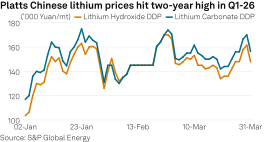
Both lithium carbonate and hydroxide DDP China prices were also supported by strong downstream demand in Q1. China's State Taxation Administration announced that the export value-added tax (VAT) rebate phase-out would begin on April 1 and will be eliminated entirely on Jan. 1, 2027.
This policy change prompted nickel-manganese-cobalt battery cathode makers to front-load orders, significantly increasing lithium chemicals demand in January and February, alongside seasonal restocking ahead of the Lunar New Year in February.
Platts assessed battery-grade lithium carbonate DDP China at Yuan 175,000/mt ($25,025/mt) on Jan. 23, the highest since September 2023 and up 32.5% from Yuan 117,000/mt ($16,646/mt) on Jan. 2.
In March, NMC cathode demand fell 5%-10% month over month as front-loaded export orders subsided. Despite this, overall Q1 demand remained robust relative to the typical seasonal level. Lithium-ion phosphate cathode producers continued to operate near full capacity throughout Q1.
China's power and energy storage battery production reached 309.7 GWh in January-February, up 48.8% year over year, according to the China Automotive Battery Innovation Alliance.
Platts assessed battery-grade lithium carbonate at Yuan 155,100/mt DDP China on April 10, up Yuan 3,600/mt day over day and Yuan 100/mt from April 2.
Platts assessed battery-grade lithium hydroxide at Yuan 145,100/mt DDP China on April 10, up Yuan 3,600/mt day over day but down Yuan 1,400/mt from April 2.
Korean lithium hydroxide exports
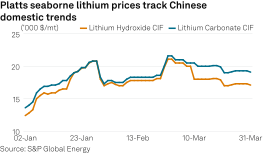
There has been a significant rise in lithium hydroxide shipments from South Korea to China since December 2025, with volumes over December-February standing at 4,476 mt, 3,270 mt, and 1,451 mt, respectively, compared with below 100 mt for the same period a year earlier, Korea Customs data showed.
China has shifted from being a net exporter to a net importer of lithium hydroxide since January, according to the Zhejiang-based trader.
"South Korea's demand is weak, but another reason is Chinese domestic spot prices for battery-grade lithium hydroxide are relatively higher, so South Korean suppliers are selling to China," said a Sichuan-based lithium refiner.
A second lithium refiner based in Zhejiang said that activity was stronger before the Lunar New Year, with exporters seeking to secure VAT rebates, but demand had softened in March.
Platts assessed battery-grade lithium carbonate at $20,200/mt CIF North Asia on April 10 and battery-grade lithium hydroxide at $19,200/mt.
