Metals & Mining, Non-Ferrous
April 16, 2026
TRADE REVIEW: FOB Australia alumina prices to face continued supply pressure in Q2

By Zuyu Tian
Editor:
HIGHLIGHTS
FOB Australia alumina oversupply to persist into Q2
Alumina demand dampened by Middle East smelter curtailments
Chinese arbitrage offers limited relief amid refining expansions
This report is part of the S&P Global Energy's Metals Trade Review series, where we dig through datasets and digest some of the key trends in iron ore, metallurgical coal, copper, alumina, cobalt, lithium, nickel and steel and scrap. We also explore what the next few months could bring, from supply and demand shifts to new arbitrages, and to quality spread fluctuations.
FOB Australia alumina prices are expected to remain under pressure in the second quarter of 2026 as structural oversupply persists.
As the geopolitical conflict in the Middle East forced smelter curtailments toward the end of the first quarter, alumina demand fell faster than supply adjusted, resulting in surplus material flowing into the spot market and limiting the potential for a sustained price recovery, despite intermittent regional arbitrage opportunities.
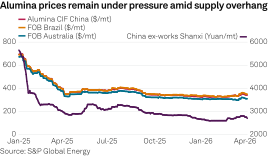
The Platts CIF China alumina assessments averaged $331.36/mt in Q1, down 2.03% quarter over quarter, with Q1 averaged Chinese domestic alumina prices declined 5.49% quarter over quarter to Yuan 2,659.59/mt ex-works Shanxi.
The weekly Brazilian alumina premium to Australian material rose 10.22% quarter over quarter, averaging $28.50/mt in Q1.
Geopolitical turmoil
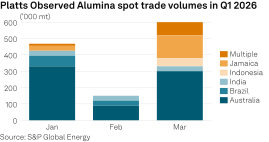
Initial market impact was driven by disruptions to industrial operations and logistics following the effective closure of the Strait of Hormuz. On March 3, QatarEnergy announced plans to halt selected downstream production, including aluminum, after military attacks on facilities in two industrial cities. In response, Hydro issued a force majeure to customers of its Qatalum joint venture, citing a controlled shutdown after gas supplies were reduced.
On March 12, QatarEnergy confirmed it would continue gas deliveries at reduced levels, allowing Qatalum to stabilize aluminum production at around 60% of nameplate capacity. While this eased immediate supply tightness, operating rates remained materially below normal levels.
In Bahrain, Aluminium Bahrain (Alba) declared a force majeure on metals output from its 1.6 million-mt/year smelter on March 4. The company subsequently said on March 15 that it had begun shutting down three potlines, representing around 19% of its 1.62 million mt/year aluminum capacity, citing ongoing logistics disruptions linked to the Strait of Hormuz.
Continued disruptions at the Strait of Hormuz led Gulf aluminum producers to reassess both export and import routes, increasing logistical complexity and costs amid heightened uncertainty over delivery timelines and freight availability, particularly for smelters in the region reliant on imported alumina supplies.
Risks intensified toward the end of the quarter following direct attacks on major smelting facilities, with material implications for regional alumina demand and balance.
Emirates Global Aluminium (EGA) confirmed that its Al Taweelah complex in Abu Dhabi sustained "significant damage" from missile and drone strikes on March 28, triggering an emergency shutdown of the smelter, captive power plant, alumina refinery, and downstream operations. In an April 3 statement, EGA said that while some refining and recycling assets may be able to resume earlier, full restoration of primary aluminum production could take up to 12 months.
Aluminium Bahrain said that its smelter was also affected by an attack on March 28 and that damage assessments were ongoing.
Smelter outages and reduced operating rates sharply lowered regional alumina consumption, while refinery output largely continued, resulting in the displacement of excess alumina into the seaborne market.
This imbalance was reinforced by developments outside the Middle East. On March 15, South32 placed its Mozal aluminum smelter in Mozambique under care and maintenance due to power supply constraints. Volumes previously supplied from South32's Worsley alumina refinery to Mozal were subsequently redirected to third-party customers under index-linked pricing arrangements.
As a result, rising seaborne alumina availability amid reduced regional demand entrenched structural oversupply and widened the divergence between aluminum and alumina fundamentals, with market dynamics increasingly driven by geopolitical developments.
Chinese arbitrage support
Rising energy costs and higher seaborne freight rates amid ongoing geopolitical tensions lent firm cost-side support to China's alumina market from early March.
Chinese alumina prices in both spot and futures markets strengthened through mid-March, as sentiment shifted on concerns over potential disruptions to bauxite supply after indications that Guinea may tighten oversight of exports.
According to Vural Burc Cakır, founder and director of the Africa Mining Community, talks between the Guinean government and miners could lead to supply curbs, though he cautioned that coordinated production or export cuts would be difficult to implement, Platts reported on March 20. Market sources said no concrete policy changes had been introduced, with developments still being monitored.
Bauxite prices remained underpinned by elevated freight costs linked to bunker price adjustments. The Platts-assessed Kamsar to China Capesize freight averaged $29.96/mt in March, up 22% quarter over quarter. Platts also assessed CIF China spot bauxite at $68/dmt April 9 for low temperature ore with 45% alumina and 3% silica, while FOB Guinea spot bauxite was assessed at $34/dmt.
Additionally, stronger Chinese alumina prices had absorbed ex-China surplus through an open import arbitrage, easing oversupply pressure on the FOB Australia market, sources said.
Sentiment, however, softened toward late March and early April, weighed by Middle East smelter curtailments and anticipated supply growth from new refinery projects in Guangxi, which are expected to add around 4 million mt/year of capacity by the end of Q2, subject to commissioning progress.
Looking ahead, FOB Australia alumina prices are expected to remain guided by the market's capacity to absorb surplus material through trade flows. While Chinese import arbitrage may underpin spot activity, sustained improvement in prices will likely require clearer evidence of a recovery in alumina demand and supply-side adjustments that tighten availability, particularly as new refining capacity continues to enter the market.
