Metals & Mining, Agriculture, Electric Power, Non-Ferrous, Biofuels
July 14, 2026
COMMODITY TRACKER: 5 charts to watch this week

By Staff
Editor:
VLCC and Suezmax tanker rates fluctuate on cargo availability, while Asian cobalt prices remain under demand pressure. Ecuadorian shrimp hits record lows on China disruptions, Brazil's soybean crush climbs to new records and MISO power prices rise on capacity constraints.
1. VLCC and Suezmax rates shift on cargo demand
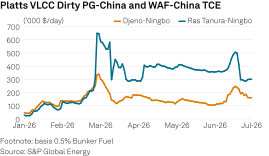
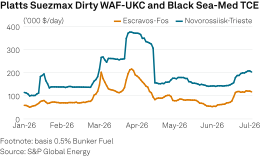
What's happening? VLCC and Suezmax dirty tanker activity West of the Suez remained dominated by cargo availability versus booking timing, with sentiment shifting quickly as prompt windows were either covered cleanly or left exposed to list pressure, according to market sources. VLCC rates on the West Africa-to-East route declined from around w175 in mid-April to the w125-w130 range by late April as fresh inquiries weakened, before recovering to the w200s by June. Suezmax rates on West Africa-to-UK Continent slipped to the mid-to-low w200s in April, then eased into the w190s by early May. Platts, part of S&P Global Energy, assessed Dated Brent at $77.50/b, the lowest since Feb. 27.
What's next? In VLCCs, the reported July under-fixing in West Africa raises the prospect of tighter prompt conditions if activity re-accelerates. In Suezmaxes, the outcome depends on whether CPC dynamics and fresh testing keep conversion tight, rather than allowing charterers to regain optionality as workable tonnage reappears according to market sources.
2. Asian cobalt prices face demand pressure in Q3
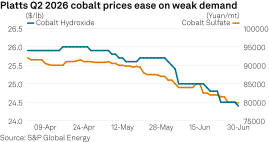
What's happening?Asian cobalt prices declined across the value chain in the second quarter as weak demand outweighed supply-side risks from the Democratic Republic of Congo. Platts assessed 30% Co cobalt hydroxide CIF China at $23.50/pound July 13, down 9.27% from $25.90 /pound April 1. Cobalt sulfate was assessed at Yuan 79,000/metric ton DDP China on July 13, down 14.13% from Yuan 92,000/mt April 1. China's mobile phone shipments totaled 114 million units during January-May, down 3.6% year over year, reducing demand for lithium-cobalt-oxide batteries. Lithium-iron-phosphate batteries accounted for 81.8% of China's battery production from January-May, while nickel-manganese-cobalt batteries' share fell to 18.2% from 20.1% a year earlier.
What's next? Asian cobalt prices are expected to remain under pressure in the third quarter as sluggish demand continues to outweigh supply constraints. The DRC announced that unused export quotas allocated between Jan. 1 and June 30, would be forfeited, potentially affecting about 20,000-22,000 mt of cobalt according to trader estimates. However, market participants expect subdued consumer electronics orders and prolonged destocking across the supply chain to limit upside potential. Declining US plug-in electric vehicle sales, Europe's shift toward LFP batteries and stagnant NMC market share in China will continue weighing on cobalt demand, according to S&P Global CERA analysts.
Related content: METALS MONITOR: China, Namibia deepen critical minerals pact; ReElement secures $25 mil from US Defense
3. Brazil soybean crush to hit record high on rising biodiesel demand
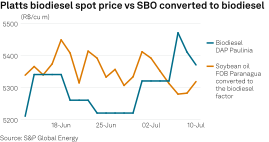
What's happening? Brazil's domestic soybean crush is forecast to reach a record 62.5 million mt in marketing year 2026-27, up 2.4% year over year, according to the US Department of Agriculture's Foreign Agricultural Service. The increase is driven by strong domestic biodiesel blending demand and robust global export appetite, with total exports projected to hit 117.5 million mt, supported by steady buying from China.
What's next? USDA kept its Brazil soybean production forecast for MY 2026-27 (Feb-March) at 184 million mt, a third consecutive record, while flagging that crush growth will remain below the five-year average. Moving forward, market participants will closely watch government updates on the blending roadmap, as the pace of local biodiesel policy implementation remains the critical swing factor for future domestic oil utilization and crushing margins.
4. MISO wholesale power prices rise on capacity advisory
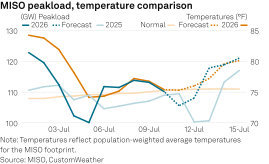
What's happening? The Midcontinent Independent System Operator declared a capacity advisory starting at noon ET July 10 and conservative operations from July 13-15 due to forecast above-normal temperatures, forced generation outages and a tightening reserve margin. MISO, which manages the electric grid across 15 states in the US Midwest and South, forecast peakload to average 119.2 GW from July 13-15, reaching as high as 121 GW July 15. So far in July, peakload has averaged 111.9 GW, 3.3% higher year over year. In response to the grid operator notices and rising demand, MISO Indiana Hub on-peak day-ahead traded at $90 /MWh for July 13 on the Intercontinental Exchange, up $16/MWh from the previous settlement.
What's next? MISO Indiana Hub on-peak day-ahead locational marginal prices have averaged $128.50 per MWh so far in July, 63.4% higher than the July 2025 average. The balance-of-the-week package was bid at $135 per MWh and offered near $198.75 per MWh, indicating continued price pressure through the conservative operations period.
5. Ecuadorian shrimp prices hit record low on China concerns
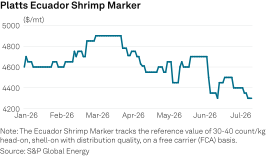
What's happening? Ecuadorian shrimp prices reached their lowest level since Platts began the assessment as concerns over recent export disruptions to China weighed on sentiment in the week to July 10. Platts assessed the Ecuador Shrimp Market at $4,300/ mt on July 10, down $50/mt week over week and the lowest since the assessment began Sept. 2, 2024. China's General Administration of Customs suspended import declarations for products shipped on or after June 30 from seven Ecuadorian shrimp processing plants, including facilities operated by major exporters Industrial Pesquera Santa Priscila, Omarsa and Songa. A Shanghai-based importer said the suspension could be related to higher levels of sodium metabisulfite in frozen shrimp shipments, noting that China rejected nearly 200 containers in May due to elevated levels. Platts assessed HOSO shrimp CFR China at $4,150/mt on July 10, down $150/ mt week over week.
What's next? An Ecuadorian producer said prices could fall further if affected companies are forced to sell inventory at discounted levels. Some participants see a possible price floor developing later in the year if Ecuadorian farmers continue to reduce stocking rates, which could eventually help rebalance supply and demand. Ecuador's National Chamber of Aquaculture said it is monitoring the restrictions and supports the creation of a technical working group between authorities from both countries to address the issue.
Reporting and analysis by Cresida Rodrigues, Sky Yu, Litian Wang, Samyak Pandey, Ronnie Turner, Kassia Micek, Elvis John and Mariana Farhat.
