Agriculture, Energy Transition, Refined Products, Oilseeds, Biofuels, Renewables, Fuel Oil, Diesel-Gasoil, Jet Fuel
July 09, 2026
Brazil soybean crush to hit record high on rising biodiesel demand: USDA

Editor:
HIGHLIGHTS
Brazil soybean crush hits record 62.5 million mt
Biodiesel demand drives oil use despite B16 delay
Exports reach 117.5M mt on steady China buying
Brazil's domestic soybean crush is forecast to reach a record 62.5 million metric tons in marketing year 2026-27, up 2.4% from the current season, driven by higher biodiesel blending, the US Department of Agriculture's Foreign Agricultural Service said in its latest Oilseeds and Products Update.
The increase is expected despite Brazil's delay of the planned B16 blending requirement, the July 7 report said.
USDA kept its Brazil soybean production forecast for MY 2026-27 (Feb-March) at 184 million mt, a third consecutive record, while flagging that crush growth will remain below the five-year average due to policy uncertainty about the pace of biodiesel demand growth.
Growth moderating
USDA held its soybean planted area forecast for MY 2026-27 at 50.5 million hectares, a 3% increase from the revised 49-million-hectare estimate for MY 2025-26, a slower expansion than the five-year average annual growth rate of 4.2%.
Most of the area growth is expected in the MATOPIBA region spanning Maranhão, Tocantins, Piauí and Bahia, along with anticipated expansion in northern Mato Grosso and parts of Pará and Maranhão following the suspension of the Soy Moratorium in early 2026, which gives farmers greater latitude to expand into Amazon frontier areas, subject to Forest Code and EU deforestation-free import requirements.
National yield is projected to dip slightly to 3.64 mt/ha as El Niño-related weather risks and elevated input costs, particularly for fertilizer, prompt some producers to scale back spending.
For the current MY 2025-26 season, harvest is over 99% complete, with production revised to a record 180 million mt and national yield estimated at 3.66 mt/ha; Bahia state posted a record 4.25 mt/ha, among the highest ever recorded in Brazil, while Rio Grande do Sul continued to underperform expectations amid uneven rainfall during flowering and grain-filling.
Biofuel-linked oil demand
Soybean oil production for MY 2026-27 is forecast at 12.8 million mt, with industrial domestic consumption, which captures biodiesel blending, projected to rise to 7 million mt from 6.8 million mt in the current season, even though the B16 mandate originally scheduled for March 2026 has been delayed.
The report attributed the continued rise in industrial oil use to biodiesel blending mandates already in place, while noting that overall crush growth remains constrained by policy uncertainty around the timeline for further mandate increases.
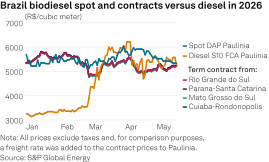
Adding to processing capacity, Chinese trading giant COFCO said it is investing more than $400 million to expand its plant in Mato Grosso, targeting biodiesel output, while it will become Brazil's largest soybean crushing complex once complete.
The facility currently processes about 4,500 mt of soybeans daily, a figure set to more than double to roughly 10,000 mt per day. The plant already produces soybean meal, oil and biodiesel, reinforcing COFCO's integrated industrial footprint in a key production and logistics hub, the report said.
Soybean oil exports climb
USDA maintained its MY 2026-27 soybean oil export forecast at 1.7 million mt, up 6.2% from the current season's 1.6 million mt, supported by recovering demand from India alongside stronger buying from Iran and Thailand.
Brazil has already exported 11.1 million mt of soybean oil so far in 2026, up 8.8% year-over-year.
The report noted an unusual price dynamic: global soybean stocks remain relatively tight, and rising biofuel-linked demand for soybean oil would theoretically support higher prices, yet the CEPEA soybean price index at the Port of Paranaguá has posted three consecutive weekly declines, currently at $25.91 per 60-kg sack, with Chicago futures also falling. Sector specialists attributed the disconnect primarily to unpredictability in the global geopolitical environment, as per USDA FAS.
Exports support oilseed complex
Total soybean exports are forecast to reach another record 117.5 million mt in MY2026-27, up 2.1% from the current season's 115 million mt, driven by steady Chinese demand.
However, growth is expected to be more moderate than in prior years, given competition from Argentina and Brazil's own rising domestic processing. China took 78.9% of Brazil's record 108.1 million mt of 2025 soybean exports.
Soybean meal exports were revised up to 26 million mt for MY2026-27, supported by demand from Southeast Asia and the EU, which could be reinforced by the EU-Mercosur free trade agreement's potential to improve logistics and reduce non-tariff barriers for Brazilian soy products.
Cost, macro backdrop
Production costs in Mato Grosso rose to R$7,651.51 per hectare in MY2025/26, up 7.9% year-over-year, driven by higher fertilizer and labor costs, with elevated costs expected to persist into MY2026-27 amid recent oil price increases tied to geopolitical conflicts.
Brazil's benchmark Selic interest rate stands at 14.75%, continuing to constrain producer investment, while the real is forecast to average R$5.45 per dollar in 2026, a level that could modestly support export competitiveness, the report said.
Separately, a Senate-approved bil that would let farmers refinance climate-related agricultural debt using resources from Brazil's Pre-Salt Social Fund remains pending before the Chamber of Deputies, aimed at easing financial strain following consecutive years of droughts and floods, particularly in southern Brazil.
Platts assessed the SOYBEX FOB Santos soybean contract for August loading on July 8 at $479.25/metric ton, 18 cents/mt higher from the previous assessment.
