July 13, 2026
Ecuador shrimp prices at all-time low amid concerns over China import suspension
By Elvis John and Mariana Farhat
Editor:
HIGHLIGHTS
Oversupply fears intensify market pressure in Ecuador
China wholesale prices stable, CFR prices fall
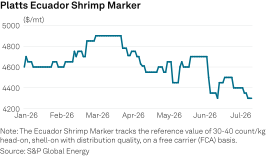
Ecuadorian shrimp prices reached their lowest level since Platts, part of S&P Global Energy, began the assessment as concerns over recent export disruptions to China weighed on sentiment in the week to July 10, domestic traders said.
Platts assessed the Ecuador Shrimp Market at $4,300/metric ton on July 10, down $50/mt week over week, and the lowest since Platts began the assessment Sept. 2, 2024.
The General Administration of Customs suspended import declarations for products shipped on or after June 30 from seven Ecuadorian shrimp processing plants, according to media reports. The list mentions plants operated by some of the biggest shrimp exporters in Ecuador, including Industrial Pesquera Santa Priscila (registration numbers 24887 and 71696), Omarsa (41068) and Songa (56), among others.
Omarsa and Songa did not respond to a request for comment by Platts at the time of publishing.
Ecuador's National Chamber of Aquaculture (CNA) said in a statement July 9 that they are monitoring restrictions imposed by China on Ecuadorian shrimp-exporting companies and supported the creation of a technical working group between authorities from both countries to address the issue.
A Shanghai-based importer said they were awaiting more clarity and the reason for the import suspension was still unknown, as the GACC has not yet made any public comments on the issue.
The source said it could be related to the higher sodium metabisulfite content in frozen shrimp shipments, adding that China rejected nearly 200 containers of frozen shrimp shipments in May due to higher levels of sodium metabisulfite as the country was tightening its quality compliance norms.
A trader based in Ecuador said they were unaware of the number of containers being returned, but confirmed that "China suspended exports from Omarsa and Santa Priscila, Ecuador's largest shrimp processors."
Ecuador market under pressure
Recent trade disruptions affecting part of Ecuador's shrimp exports may further pressure an already weak market, amid concerns about the potential redistribution of volumes to alternative destinations.
Ecuadorian exporters and traders said the main concern is not a supply reduction, but the possibility that large volumes may be redirected into alternative markets already facing weak demand.
An Ecuadorian producer said prices could fall further if affected companies are forced to sell inventory at discounted levels, adding that some may need to enter markets where they had not previously been active to move product.
"The China-related restrictions are definitely impacting the market as a whole. A large number of containers are being returned from China to Ecuador, which affects inventory levels in both markets," a second Ecuadorean trader said.
"While this could ultimately tighten supply in China and support local prices there, the uncertainty is weighing on replacement prices, as there is still no clarity on how Chinese customs will handle new shipments upon arrival," the source added.
The Ecuadorean shrimp market was already struggling with abundant supply and slow demand.
Several participants said fears of additional supply are reinforcing an already weak market environment. "There is more supply than demand," an exporter said, while another suggested that companies could be attempting to sell inventory and even forward-sell future harvests in anticipation of market disruptions.
However, some participants see a possible price floor developing later in the year if Ecuadorian farmers continue to reduce stocking rates. Lower future harvest volumes could eventually help rebalance supply and demand, although the current market sentiment remains cautious.
China market stable
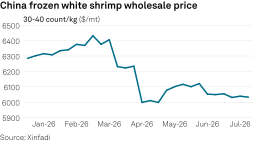
A Mumbai-based trader said such regulatory and compliance uncertainty would support Chinese domestic shrimp prices. Domestic shrimp prices have rebounded in May after falling to record lows in the March-April period, the trader said.
Despite rising compliance pressure in China, the country's frozen shrimp imports in May rose 15% year over year to 85,458 mt, according to the latest GACC data.
The data covers imports of frozen warm-water shrimp under tariff codes 03061730 and 03061790.
Chinese frozen shrimp demand remained robust in May, despite a 9% month-over-month decline, as imports over January-May increased 25% year over year to 429,076 mt, the data showed.
For Chinese importers, the current scenario presents a mixed picture. While domestic wholesale prices remain relatively attractive, customs uncertainty and compliance risks have increased substantially. The new restrictions have pressured Ecuadorian shrimp prices and CFR China prices have also declined.
Platts assessed HOSO shrimp CFR China at $4,150/mt on July 10, down $150/mt week over week.
China's wholesale prices remained stable. Frozen white shrimp 30-40 count/kg was priced at $6,033/mt on July 9, down $6/mt from July 2, according to data from S&P Global Energy sourced via Xinfadi.
