Agriculture, Refined Products, Maritime & Shipping, Electric Power, Biofuels, Wet Freight
November 24, 2026
COMMODITY TRACKER: 5 charts to watch this week
By Staff
Editor:
The EU and Indonesia finalized a trade agreement to enhance access to critical minerals, while five countries have tightened biofuel mandates since March. Shipowners debate newbuild orders as tanker prices climb and US battery storage capacity rises.
1. EU, Indonesia sign trade deal to boost critical minerals
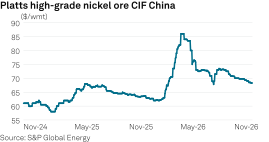
What's happening? The EU and Indonesia signed a Comprehensive Economic Partnership Agreement in Brussels on Nov. 21, aimed at strengthening the EU's access to critical raw materials from Indonesia, Southeast Asia's largest economy. The pact will remove tariffs on more than 98% of European exports to Indonesia and improve market access for goods and investment in strategic industries including critical raw materials, electric vehicles, batteries, electronics and pharmaceuticals. European Commission President Ursula von der Leyen described it as one of the EU's most ambitious deals in Asia. Platts, part of S&P Global Energy, assessed high-grade nickel ore at $68.30/wet metric ton CIF China on Nov. 23, unchanged day over day.
What's next? The agreement requires approval from the European Parliament and Indonesia's domestic ratification process before it can provisionally enter into force in early 2027. The EU estimates that by 2042, its GDP will be about €16 billion higher and Indonesia's €27 billion higher than they would be without the agreement. The pact is expected to increase EU exports to Indonesia by almost 40% over 15 years. The agreement is expected to save European businesses more than €650 million annually on customs duties.
2. Biofuel mandates tighten but SAF faces cost hurdles
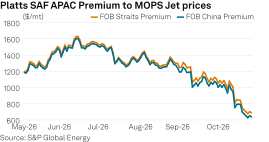
What's happening? Five countries have tightened biofuel mandates since March, with the US finalizing new Renewable Fuel Standards in March, Vietnam bringing forward its E10 ethanol program in June and Indonesia implementing its B50 biodiesel mandate in July, according to the International Energy Agency's World Energy Outlook 2026 released Nov. 19. Forty-nine countries now have biofuel blending mandates in their transport sectors. Global liquid biofuel production reached about 2.6 million barrels of oil equivalent per day in 2025, cutting oil demand by more than 2.5 mboe/d. Platts assessed SAF HEFA-SPK FOB Straits at $2,070/mt on Nov. 19, down $15/mt from the previous week, with the SAF FOB Straits premium at $969/mt over the Platts Jet Kero FOB Singapore forward curve.
What's next? Sustainable aviation fuel will make up only about 5% of aviation fuel by 2035 because it costs three to 10 times more to produce than conventional jet fuel, the IEA said. Liquid biofuel output grows to 3.9 mboe/d by 2035, with investment in low-emissions fuels tripling to over $40 billion/year. Jet fuel demand rises by 185,000 b/d annually to 2035 as passenger travel expands by 45%. Biofuels would meet around 80% of SAF demand in 2035, the IEA said.
3. Tanker owners split on newbuild orders
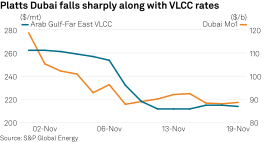
What's happening? Shipowners are divided on ordering new vessels at current elevated prices, with newbuild VLCC prices reaching approximately $145 million in October, up from $90 million in 2021, according to S&P Global Energy CERA's tanker fleet supply short-term outlook released Oct. 28. Tanker ordering slowed in the third quarter due to high prices, limited yard availability and the existing orderbook size, according to CERA. Platts assessed the Dirty Tanker Basis Global Index VLCC at an average of $1,091,963/day in October, up from $416,840/day in August, although it fell to $810,868/day on Nov. 19.
What's next? Owners face supply risks intensifying from 2028, when global tanker fleet capacity is expected to expand by 6.7% compared with 4.7% in 2027, according to CERA. Scheduled tanker deliveries are projected to reach 67.47 million deadweight tons in 2028, up from 48.09 million dwt in 2027, CERA data showed. Scheduled VLCC deliveries alone are expected to rise to 39.85 million dwt in 2028 from 19.33 million dwt in 2027, CERA reported. Heidmar Maritime Holdings CEO Pankaj Khanna said there will be greater risk from deliveries in 2028-29, particularly if trade disruptions ease around the same time.
4. WECC leads US battery storage additions in Q3
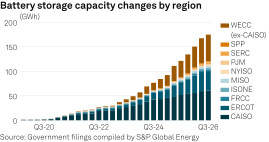
What's happening? The Western Electricity Coordinating Council led the US in utility-scale battery storage capacity additions in Q3, accounting for 35% of the 2 GW installed across the country, according to an S&P Global Energy compilation. US battery storage capacity increased by 4% quarter over quarter and rose 39% year over year to total 58.034 GW by the end of Q3. However, Q3 additions came in 46% lower than the 3.762 GW initially expected to come online during the quarter. Most of the shortfall was from five facilities now projected to come online in Q4.
What's next? Nearly 7.8 GW are planned for installation in Q4 with WECC accounting for 36%. If all projected projects come online, it would bring the US total to more than 65.8 GW. Several projects expected in Q4 were pushed back from previous quarters. Transgrid Energy's 382.4-MW Atlas VIII in Arizona was initially slated for Q3. Invenergy Renewables' 275-MW Hashknife Energy Center in Arizona was previously planned for Q2. Jupiter Power's 204-MW Tidwell Prairie II in Texas was initially planned for Q1 2026. NextEra Energy Resources' 200-MW Dry Lake East Center in Nevada was originally expected in Q3.
Related Infographic: US BATTERY STORAGE: WECC leads additions with 35% of Q3 total; SERC with 30%
5. Brazil's solar rise strains electric grid
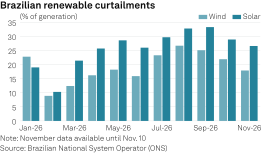
What's happening? Brazil's small-scale distributed generation capacity increased from 5 GW in 2020 to over 55 GW in 2026, reaching about 20% of Brazil's generation capacity, according to a study by the Brazilian Electric Energy Distribution Association, or Abradee. The rapid expansion, primarily from solar panels in households and commercial buildings, is causing system instability as the electric grid faces a sudden cut of over 40 GW of electricity generation every evening when consumption rises, Abradee's director of regulation Ricardo Brandão said. Curtailments of wind and solar generation reached a combined 20.5% of potential generation in the first 10 days of November, after hitting 24% in October, according to the National System Operator.
What's next? The Brazilian Energy Research Bureau expects small-scale distributed generation capacity to reach 72.5 GW by 2030. Abradee urges adopting hourly electricity rates for energy consumers who use distributed generation. The Brazilian government has proposed implementing hourly tariffs for low-tension consumers, though the proposal remains under discussion. Remaining subsidies are estimated at 18 billion reais ($3 billion) in 2026, according to the National Electric Energy Agency.
Reporting and analysis by Euan Sadden, Samyak Pandey, Mia Pei, Kassia Micek and Felipe Peroni.
