Agriculture, Crude Oil, Refined Products, Energy Transition, Biofuels, Jet Fuel, Renewables, Fuel Oil
November 19, 2026
Energy crisis drives Asian biofuel mandates, but SAF stuck near 5% by 2035: IEA
Editor:
HIGHLIGHTS
Southeast Asia accelerates biofuel mandates
High costs limit sustainable aviation adoption
Countries have raised biofuel blending mandates in response to the Middle East energy crisis, with Southeast Asia leading the move, but sustainable aviation fuel will still make up only about 5% of aviation fuel by 2035 because of its high cost, the International Energy Agency said Nov. 19.
Five countries have tightened biofuel mandates since March 2026, the IEA said in its World Energy Outlook 2026. The US finalized new Renewable Fuel Standards in March, Vietnam brought forward its E10 ethanol program in June, and Indonesia began implementing its B50 biodiesel mandate in July.
"The 2026 energy crisis has accelerated the adoption of new regulations notably in Southeast Asia," the IEA said. Forty-nine countries now have biofuel blending mandates in their transport sectors.
The shift was already under way before the crisis. Higher blending mandates and energy security priorities raised biofuel consumption in 2025 by around 50% in India, 40% in Japan, 10% in Southeast Asia and 5% in Europe, according to the IEA.
Displacing oil demand
Global liquid biofuel production reached around 2.6 million barrels of oil equivalent per day in 2025, almost all of it used in road transport. Biofuel use cut oil demand by more than 2.5 mboe/d in 2025, and is expected to displace a further 0.25 mboe/d in 2026, mainly through increases in the US, Indonesia and India, the IEA said.
The US is the largest producer, with 25% of global output, followed by Brazil at 15%, and Southeast Asia and Europe at 9% each.
Under the IEA's Stated Policies Scenario, which reflects current policy settings, liquid biofuel output grows to 3.9 mboe/d by 2035. Investment in low-emissions fuels more than triples to over $40 billion/year in its Current Policies Scenario, with biofuels driving most of the growth.
SAF faces cost barrier
Aviation is set to remain one of the main sources of global oil demand growth. Jet fuel demand rises by 185,000 b/d each year to 2035 as passenger travel expands by 45%, the IEA said.
SAF accounts for less than 1% of aviation fuel today because it costs three to 10 times more to produce than conventional jet fuel, the report said. Under the Stated Policies Scenario, its share rises to nearly 5% by 2035, driven by EU and UK mandates, and about 10% by 2050.
Biofuels would meet around 80% of SAF demand in 2035, with synthetic fuels becoming more important later, the IEA said. It expects most SAF to come from Brazil, China, Europe, Japan, South Korea and North America.
The crisis has exposed how heavily airlines depend on a single fuel. Airline fuel spending is expected to rise to $350 billion in 2026 from $252 billion in 2025, the report said, citing IATA. The IEA said more emphasis on security of supply could help raise SAF use and lower its cost.
Liquid biofuel use in aviation and shipping rises from marginal levels today to 1.4 mboe/d by 2050, with more than 60% consumed in the EU under ReFuelEU Aviation and FuelEU Maritime.
The IEA's outlook comes as some Asian countries slow their SAF plans. Malaysia this month pushed its proposed 1% SAF blending requirement for international flights back to 2030 from January 2027, citing higher jet fuel costs for airlines.
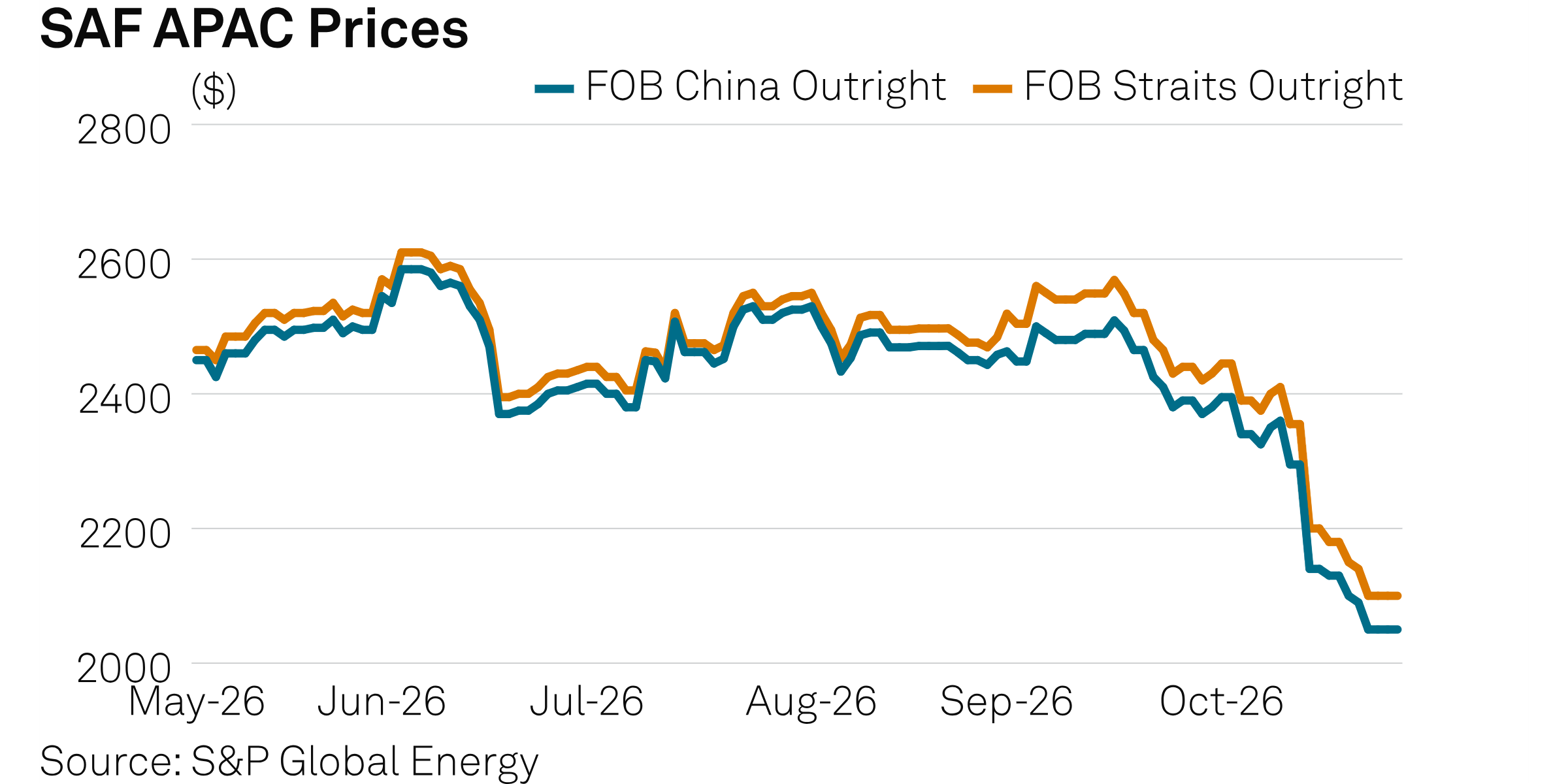
Platts, part of S&P Global Energy, assessed SAF HEFA-SPK FOB Straits at $2,070/mt on Nov. 19, down $15/mt from the previous week. The SAF FOB Straits premium was assessed at $969/mt over the Platts Jet Kero FOB Singapore forward curve (MOPS), up $82.25/mt week over week. Platts also assessed SAF HEFA-SPK FOB China at $2,020/mt on Nov. 19, down $15/mt from the previous week. The SAF FOB China premium was assessed at $919/mt over the Platts Jet Kero FOB Singapore forward curve (MOPS), also up $82.25/mt from the week before.
