Metals & Mining, Ferrous, Non-Ferrous
November 23, 2026
EU and Indonesia sign trade deal to boost critical minerals access
By Euan Sadden
Editor:
HIGHLIGHTS
Indonesia key producer of nickel and other critical minerals
Agreement removes 98% of export tariffs
Deal projected to add €16B to EU GDP by 2042
The EU and Indonesia signed a landmark trade agreement in Brussels on Nov. 21 that could strengthen Europe's access to critical raw materials from Southeast Asia's largest economy.
The Indonesia-European Union Comprehensive Economic Partnership Agreement (CEPA), together with an Investment Protection Agreement, is expected to promote trade and investment in strategic industries, including critical raw materials, electric vehicles, batteries, electronics and pharmaceuticals.
European Commission President Ursula von der Leyen and Indonesian Minister of Economic Affairs Airlangga Hartarto attended the signing ceremony. Von der Leyen described the pact as "one of the most ambitious deals the EU has concluded in Asia."
In a press release issued after the ceremony, the European Commission said the agreement would make supply chains between the two markets more predictable by removing tariffs on more than 98% of European exports to Indonesia and improving market access for goods and investment.
According to the commission, the agreement will provide EU manufacturers with greater stability and predictability in accessing critical raw materials, while strengthening the bloc's strategic supply chains and helping protect them from disruptions caused by sudden economic or geopolitical shocks.
The pact comes as Brussels works to diversify trade and secure access to strategic inputs amid economic tensions with the US and China. According to the commission, the deal is expected to increase EU exports to Indonesia by almost 40% over 15 years and save European businesses more than €650 million annually in customs duties.
The EU estimates that, by 2042, its GDP will be about €16 billion higher and Indonesia's €27 billion higher than they would have been without the agreement.
The agreement still requires approval from the European Parliament, while Indonesia must complete its domestic ratification process. It could provisionally enter into force in early 2027.
Indonesia seeks investment to expand critical minerals processing
Indonesia is a major producer of nickel, a key input for some EV batteries and stainless steel. It also has significant reserves of other minerals used in industrial and clean energy technologies.
The agreement could help European companies develop partnerships in Indonesia and secure more diversified sources of processed materials as the EU seeks to reduce its dependence on concentrated global supply chains.
Indonesia's nickel export ban, which took effect in January 2020, prohibits the export of unprocessed nickel ore. The policy was introduced to encourage domestic processing and support the development of downstream industries, including EV batteries and stainless steel.
In October, Tri Winarno, Indonesia's director general of minerals and coal, told the Indonesia Critical Mineral Forum in London that the country was seeking partners capable of contributing capital, technology, expertise and access to international markets.
Since its introduction, the ban has significantly increased Indonesia's smelting capacity, particularly for nickel pig iron and nickel matte. It has also reshaped global supply chains, reducing the availability of Indonesian nickel ore to traditional importers such as China and the EU.
Consequently, companies have invested in Indonesian smelters or sought alternative sources of supply, while the policy has contributed to heightened volatility in global nickel markets.
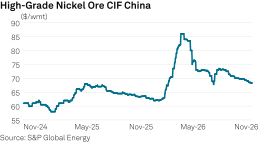
Platts, part of S&P Global Energy, assessed high-grade nickel ore at $68.3/wet metric ton CIF China on Nov. 20, unchanged day over day and down 21% from its 2026 high of $86/wmt on March 31.