Electric Power, Natural Gas
November 19, 2026
US BATTERY STORAGE: WECC leads additions with 35% of Q3 total; SERC with 30%
By Kassia Micek
Editor:
HIGHLIGHTS
7.8 GW expected to come online in fourth quarter
ERCOT leads US in capacity at 21.519 GW or 37%
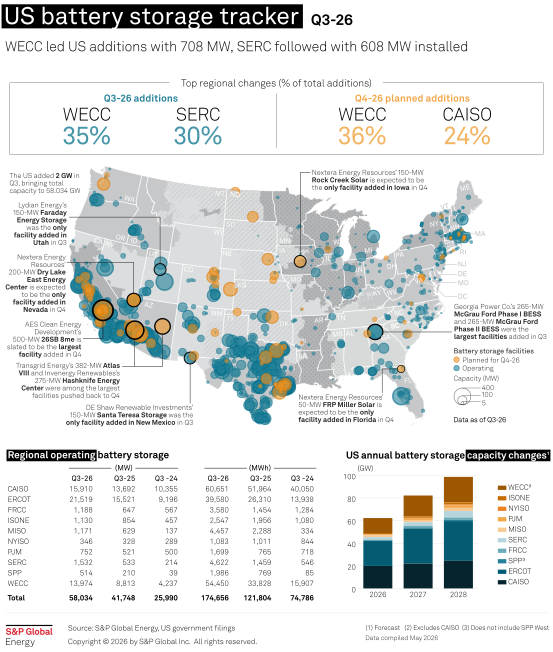
The Western Electricity Coordinating Council has retained its lead as the region with the most utility-scale battery storage capacity added in the third quarter, accounting for 35% of the 2 GW installed across the US.
US battery storage capacity increased by 4% quarter over quarter and jumped 39% from a year ago to total 58.034 GW by the end of Q3, according to an S&P Global Energy compilation of various government filings. The data includes utility-scale facilities that either began commercial operation or were synchronized to the grid.
However, Q3 additions came in 46% lower than the 3.762 GW initially expected to come online during the quarter, according to the data. Most of the shortfall was from five facilities that are now projected to come online in Q4:
- 382-MW Atlas VIII in Arizona
- 275-MW Hashknife in Arizona
- 204-MW Tidwell Prairie II in Texas
- 200-MW Dry Lake East Center in Nevada
- 150-MW Agave BESS in Arizona
"It's common to see delays throughout the year and I would still expect to see significant additions in Q4," Annie Gutierrez, S&P Global Energy CERA senior research analyst, said Nov. 18. "Q4 has historically seen the highest number of additions each year as developers are incentivized by financing and contractual agreements to come online by year-end, but some projects will inevitably slip into 2027."
Q4 expectations
Nearly 7.8 GW are scheduled to begin operation in Q4 with WECC leading the way with 2.776 GW. If all projected projects come online, it would bring the US total to more than 65.8 GW, an increase of 13% quarter over quarter, according to the data.
Following the trend of past quarters, most of the Q4 additions are planned for the WECC region with 36%, followed by the California Independent System Operator footprint with 24% and the Electric Reliability Council of Texas footprint with 20.5%. Outside of those regions, an additional nearly 1.5 GW are slated to come online.
"California is an established battery market and the [California Public Utilities Commission] continues to encourage battery storage development through large-scale procurement orders, which gives larger battery storage projects a little more confidence compared with less established markets despite declining merchant revenue the past few years," Gutierrez said. "ERCOT is an attractive market due to historically attractive ancillary service revenue opportunities, speedier interconnection processes, and general ease of building compared with other markets. This has allowed for massive amounts of battery storage to be built over the last few years."
However, revenues have waned over the past few years as the market has rapidly expanded and saturated, she added.
"We are closely monitoring whether market signals remain strong enough to support this pace of deployment," Gutierrez said.
The top five largest projects slated to be completed in Q4 are:
- AES Clean Energy Development's 500-MW 26SB 8me in California
- Transgrid Energy's 382.4-MW Atlas VIII in Arizona
- Copia Power's 366.7-MW MEC Phase 2 in Arizona
- Invenergy Renewables' 275-MW Hashknife Energy Center in Arizona
- Peregrine Energy Solutions' 257.3-MW Mallard Energy Storage in Texas
When AES Clean Energy Development's 26SB 8me facility comes online, it will tie the company's 500-MW 50LW 8me facility for largest facility in the US, according to the data. Both facilities are in California.
Several projects expected to come online in Q4 were pushed back from previous quarters. Atlas VIII was initially slated to come online in Q3, Hashknife Energy Center was previously planned to come online in Q2, Tidwell Prairie II was initially planned for Q1 2026, Dry Lake East Energy Center was originally expected to begin operations in Q3, and Agave BESS was initially expected online in Q4 2025.
Q3 additions
Of the 2.027 GW added in Q3, the WECC region, excluding CAISO, accounted for 708 MW or 35%, followed by the SERC Reliability Corp. area with 608 MW or 30% of US additions and ERCOT with 379 MW or 18.7% of the total, according to the data. Outside of those three regions, an additional 332 MW came online in Q3. The SERC Reliability Corp. was formerly known as the Southeast Electric Reliability Council.
"Utilities in SERC have been showing significant interest in diversifying their portfolios and are looking at battery storage to complement solar and gas," Gutierrez said. "Georgia Power is leading this charge, with over 4 GW of projects planned over the next 5 years. Duke in the Carolinas also has over 2 GW of planned projects from 2026-2029. These projects in regulated markets can also be larger in size. We expect SERC to see sustained additions over the next few years."
At the state level, Georgia had the most additions with 530 MW, followed by California at 386 and Texas with 379.
The top four largest projects to came online in Q3 were:
- Georgia Power Co.'s 265-MW McGrau Ford Phase I BESS
- Georgia Power Co.'s 265-MW McGrau Ford Phase II BESS
- Copia Power's 183-MW MEC Phase 1
- GridStor's 155-MW Gunnar Reliability Project
There was a three-way tied for fifth place between DE Shaw Renewable Investments' Santa Teresa Storage in New Mexico, Lydian Energy's Faraday Energy Storage in Utah, and Recurrent Energy's RE Desert Bloom in Arizona, which are all 150 MW, according to the data.
McGrau Ford Phase I BESS was originally slated to come online in Q1 and was pushed back twice, according to the data. The two McGrau Ford projects are now the 25th and 26th largest battery storage facilities in the US.
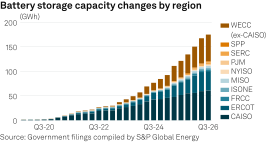
By the end of Q3, ERCOT led the US in battery storage capacity with 21.519 GW, or 37% of total US capacity, according to the data. CAISO followed with 15.91 GW or 27.4% of the total. WECC had 13.974 GW or 24%.
Company, state rankings
NextEra Energy Resources, which added 200 MW in Q3, remained the company with the most operating battery storage capacity in the US at 5.979 GW, according to the data. Despite not completing any projects in Q3, ENGIE North America remained in second place with 3.662 GW, followed by AES Clean Energy Development with 1.978 GW of capacity.
Likewise, Intersect Power remained in fourth place with 1.936 GW and Arevon Energy in fifth place with 1.47 GW, despite neither company adding any facilities in Q3, according to the data.
Looking ahead, NextEra Energy Resources is expected to add 1.978 MW in Q3, while ENGIE North America is slated to add 99 MW and AES Clean Energy Development 500 MW.
At the state level, Texas continues to lead the US in utility-scale battery storage capacity with 21.519 GW, followed by California with 16.767 GW, Arizona with 7.061 GW, Nevada with 1.704 GW and New Mexico with 1.449 GW, according to the data. Florida, which has 1.194 GW, and Utah, which had 1.07 GW, are the only other states with more than 1 GW. There are 18 states that have between 100 MW and 1 GW, three states between 50 MW and 100 MW, while 14 states have less than 50 MW, leaving eight states with no battery storage capacity.
