Electric Power, Energy Transition, Renewables
August 14, 2026
US BATTERY STORAGE: WECC leads US battery storage additions with 2.2 GW in Q2

By Kassia Micek
Editor:
HIGHLIGHTS
US battery storage capacity surpassed 55 GW in Q2
SERC expected to add 740 MW in Q3, second most
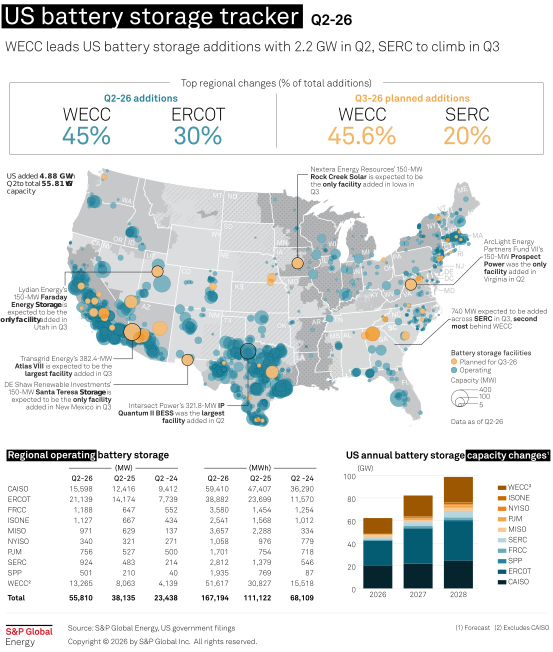
The Western Electricity Coordinating Council region added the most utility-scale battery storage capacity in the second quarter, accounting for 45% of the 4.883 GW installed across the US.
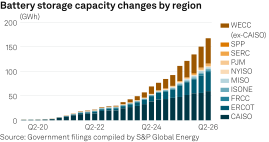
The US capacity increased by 9.6% quarter over quarter and jumped 46.4% from a year ago to total 55.81 GW by the end of Q2, according to an S&P Global Energy compilation of various government filings. The data includes facilities that either began commercial operation or were synchronized to the grid.
However, out of an expected 6.7 GW to be added in Q2, only about 73% of the planned projects came online during the quarter. Most of the shortfall came from a handful of large facilities that are now expected to come online in Q3, according to the data.
Annie Gutierrez, S&P Global Energy CERA senior research analyst, said the Q2 completion level is as expected.
"I expect many of these projects will slide into Q4 and will be hustling to come online before the end of 2026," Gutierrez said Aug. 13. "We can expect another record year for battery storage."
There have already been about 8 GW of battery storage that have come online in 2026, with another roughly 13 GW under construction with planned commercial operation dates in 2026, she added.
"Our May 2026 outlook forecast over 18.5 GW of BESS additions in 2026, and the market is on track to hit that," Gutierrez said. "However, many projects rushed to begin construction in early 2026 to circumvent [Foreign Entity of Concern] restrictions and claim the [Investment Tax Credit], so we could see inflated construction timelines going forward compared with past years."
Q3 expectations
If all 3.762 GW of planned third-quarter additions are completed, the US total would surpass 59.5 GW of battery storage capacity, which would be an increase of 7% quarter over quarter, according to the data.
Most of the planned Q3 additions are focused on the Western Electricity Coordinating Council region with 45.6%, followed by the SERC Reliability Corp. area with 20% and the California Independent System Operator footprint with 15%. Outside of those regions, an additional nearly 740 MW are slated to come online. The SERC Reliability Corp. was formerly known as the Southeast Electric Reliability Council.
The top five largest projects planned to be completed in Q3 are:
- Transgrid Energy's 382.4-MW Atlas VIII in Arizona
- Invenergy Renewables' 275-MW Hashknife Energy Center in Arizona
- Georgia Power Company's 265-MW McGrau Ford Phase I BESS in Georgia
- Georgia Power Company's 265-MW McGrau Ford Phase II BESS in Georgia
- Jupiter Power's 203.6-MW Tidwell Prairie II in Texas
Hashknife Energy Center was previously slated to come online in Q2, but was pushed back to Q3, according to the data. Hashknife I, the first phase of the Hashknife Energy Center, began construction in 2024 and is anticipated to reach commercial operations in Q3 of 2026, according to an Invenergy spokesperson who did not answer questions on the project's completion delay.
McGrau Ford Phase I BESS and Tidwell Prairie II were originally slated to come online in Q1, have been pushed back twice and are now expected for completion in Q3, according to the data. In addition, Arizona Public Service Company's 150-MW Agave BESS was originally expected online in Q4 2025 but has been pushed back each quarter since and is now planned to come online in Q3.
Several other large facilities that were expected to be complete in Q2 were pushed back to Q3, including Copia Power's 183.3-MW MEC Phase 1 in Arizona and DE Shaw Renewable Investments' 150-MW Santa Teresa Storage, which is slated to be the only facility added in Iowa in Q3, according to the data.
Q2 additions
Of the 4.883 GW added in Q2, the WECC region, excluding CAISO, added 2.197GW, followed by the Electric Reliability Council of Texas footprint with 1.461 MW or 29.9% of US additions and the California Independent System Operator region with 924 MW or 18.9% of the total, according to the data. Outside of those three regions, an additional 300 MW came online in Q2.
Within WECC, Arizona added the most capacity at 1.552 GW, followed by Utah with 320 MW, Idaho with 200 MW and New Mexico with 125 MW.
The top five largest projects that came online in Q2 were:
- Intersect Power's 321.8-MW IP Quantum II BESS in Texas
- Arevon Energy's 300-MW Nighthawk Energy Storage in California
- DE Shaw Renewable Investments' 250-MW Catclaw Solar in Arizona
- Copenhagen Infrastructure Partners' 250-MW Beehive Energy Storage in Arizona
- Aypa Power Development's 250-MW Pediment BESS in Arizona
IP Quantum II BESS is tied with IP Quantum I BESS, which came online in Q1, for the ninth-largest battery storage facility operating in the US.
"Quantum is designed to generate 640 MW of solar power and includes 1.3 GWh of battery storage," Intersect spokesperson Sara Blask said Aug. 14, adding the facilities are co-located with a Google data center campus, which recently began construction.
According to Intersect, "This approach to co-locating energy supply with data center load is a crucial strategy to reduce the need for new infrastructure and optimize existing grid utilization, easing demands on the Texas grid."
Separately, Nighthawk Energy Storage is now the 20th largest, according to the data. In addition, Catclaw Solar is now the 29th largest project in operation in the US, while Beehive Energy Storage is the 30th largest and Pediment BESS is the 33rd largest, according to the data.
AES Clean Energy Development's 500-MW 50LW 8me, which came online in December, remains the largest facility in operation in the US.
By the end of Q2, ERCOT led the US in battery storage capacity with 21.139 GW, or 37.9% of total US capacity, according to the data. CAISO followed with 15.598 GW or 28% of the US total. WECC had 13.265 GW or 23.8%.
Company, state rankings
NextEra Energy Resources, which added 100 MW in Q2, remained the company with the most operating battery storage capacity in the US at 5.779 GW, according to the data. Despite not completing any projects in Q2, ENGIE North America remained in second place with 3.662 GW, while AES Clean Energy Development remained in third place with 1.978 GW of capacity.
The addition of IP Quantum II BESS, along with three other projects, moved Intersect Power into fourth place with 1.936 GW, according to the data. Rounding out the top five, the addition of Nighthawk Energy Storage in Q2 bumped Arevon Energy into fifth place with a total of 1.470 GW in operation.
Looking ahead, NextEra Energy Resources is expected to add 585 MW in Q3, while AES Clean Energy Development has 50 MW slated to begin operations, according to the data.
At the state level, Texas continues to lead the US in utility-scale battery storage capacity with 21.139 GW, followed by California with 16.380 GW, Arizona with 6.728 GW, Nevada with 1.704 GW and New Mexico with 1.299 GW, according to the data. Florida, which has 1.194 GW, is the only other state with more than 1 GW. There are 19 states that have between 100 MW and 1 GW, three states between 50 MW and 100 MW, while 14 states have less than 50 MW, leaving eight states with no battery storage capacity.
