Electric Power
June 17, 2026
US BATTERY STORAGE: ERCOT leads Q1 additions with 3 GW; WECC to add most in Q2

By Kassia Micek
Editor:
HIGHLIGHTS
US battery storage surpasses 50 GW in Q1
ERCOT adds 3 GW, leads national capacity
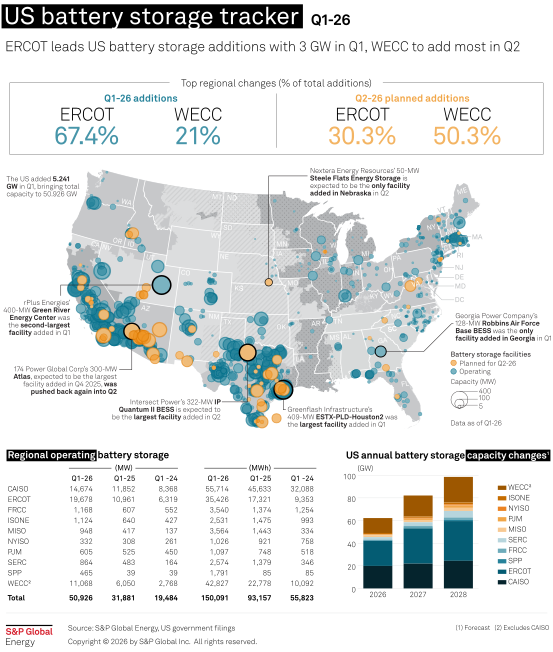
US utility-scale battery storage capacity surpassed 50 gigawatts in the first quarter, with the Electric Reliability Council of Texas leading in both capacity and quarterly additions, adding 67.4% of the 4.445 GW installed across the country.
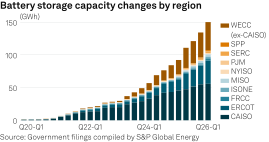
The US capacity increased by 11.5% quarter over quarter and jumped 60% from a year ago to total 50.926 GW by the end of Q1, according to an S&P Global Energy compilation of various government filings. The data includes facilities that either began commercial operation or were synchronized to the grid.
"Passing 50 GW of installed capacity is a big milestone," said Annie Gutierrez, S&P Global Energy CERA senior research analyst. "For reference, grid-facing solar deployment hit 50 GW around 2021, and had tripled that by the end of 2025. The battery storage market is on track for yet another record year."
Of an expected 6.031 GW to be added in Q1, only about 74% of the planned projects came online during the quarter, with much of the shortfall from four facilities with over 1 GW of capacity that had completion dates pushed back, according to the data.
Q2 outlook
If all 6.589 GW of planned second-quarter additions are added to the grid, the US total would surpass 57.5 GW of battery storage capacity, which would be an increase of 13% from Q1, according to the data.
Most of the planned Q2 additions are focused on the Western Electricity Coordinating Council region at 50%, followed by the ERCOT footprint with 30% and the California Independent System Operator with 12%. Outside of those regions, an additional 485 megawatts is slated to come online.
The top five largest projects planned to be completed in Q2 are:
- Intersect Power's 322-MW IP Quantum II BESS in Texas
- 174 Power Global Corp.'s 300-MW Atlas in Arizona
- Arevon Energy's 300-MW Nighthawk Energy Storage in California
- Invenergy Renewables' 275-MW Hashknife Energy Center in Arizona
- Aypa Power Development's 250-MW Pediment BESS in Arizona
The 174 Power Global Corp.'s Atlas facility was previously slated to come online in fourth-quarter 2025, but was pushed back to Q1 and now Q2, according to the data. Likewise, Arevon Energy's Nighthawk Energy Storage project was pushed back from Q1 completion.
In addition, Georgia Power Co.'s 265-MW McGrau Ford Phase 1 BESS in Georgia and Southern California Edison Co.'s 225-MW SCE Anode Springville BESS in California were previously slated to come online in Q1 as some of the largest facilities, but have been pushed back to the third quarter.
"It's common to see these sorts of delays at the beginning of the year, but given the construction status of the three western projects ... I'd expect to see those projects come online in 2026," Gutierrez said.
Gutierrez also expects to see more battery projects start to crop up in the Southeast over the next few years, given Georgia Power's and other southern utilities' interest in procuring battery storage.
Q1 additions
Of the 4.445 GW added in Q1, ERCOT added 2.996 GW, followed by WECC with 935 MW or 21% of US additions, according to the data. Outside of those two regions, an additional 513 MW came online in Q1.
By the end of Q1, ERCOT capacity totaled 19.678 GW, or 38.6% of total US capacity, followed by CAISO with 14.674 GW, or 28.8%, and WECC, excluding CAISO, with 11.068 GW, or 21.7%, according to the data. Within WECC, Utah added the most capacity in Q1 at 400 MW, followed by Arizona with 235 MW, Colorado with 200 MW and New Mexico with 100 MW.
"ERCOT continues to lead the charge on battery deployment," Gutierrez said. "Even though California had a slow start in Q1, there is still significant capacity under construction (near 3 GW) with online dates in 2026."
The top five largest projects that came online in Q1 were:
- Greenflash Infrastructure's 409-MW ESTX-PLD-Houston2 in Texas
- rPlus Energies' 400-MW Green River Energy Center in Utah
- Intersect Power's 322-MW IP Quantum BESS in Texas
- Ørsted North America's 251-MW Old 300 Storage Center in Texas
- Clenera's 235-MW Roadrunner Battery Storage in Arizona
Greenflash Infrastructure's ESTX-PLD-Houston2 project is now the third largest battery storage facility operating in the US, while rPlus Energies' Green River Energy Center project is now the fourth largest, according to the data. Greenflash Infrastructure and rPlus Energies did not respond to requests for comment.
Intersect Power's IP Quantum BESS is now the ninth largest project in operation in the US, while Ørsted North America's Old 300 Storage Center is the 25th largest and Clenera's Roadrunner Battery Storage is the 31st largest, according to the data.
AES Clean Energy Development's 500-MW 50LW 8me, which came online in December, is the largest facility in operation in the US.
Company, state rankings
NextEra Energy Resources, which added 300 MW in Q1, remained the company with the most operating battery storage capacity in the US at 5.679 GW, according to the data. ENGIE North America was in second place with 3.662 GW, adding 411 MW in Q1. Remaining in third place, AES Clean Energy Development has 1.978 GW of capacity, unchanged quarter over quarter.
Rounding out the top five were Plus Power with 1.394 and Enel Green Power North America with 1.253 GW, both unchanged from Q4.
NextEra Energy Resources and ENGIE North America are expected to install a combined 279 MW in Q2, according to the data. AES Clean Energy Development, Plus Power and Enel Green Power North America do not have any projects slated to come online in Q2.
At the state level, Texas continues to lead the US in utility-scale battery storage capacity with 19.678 GW, followed by California with 15.455 GW, Arizona with 5.175 GW, Nevada with 1.704 GW and Florida with 1.174 GW, according to the data. New Mexico, which has 1.138 GW, is the only other state with more than 1 GW. There are 18 states that have between 100 MW and 1 GW, four states between 50 MW and 100 MW, while 14 states have less than 50 MW, leaving eight states with no battery storage capacity.
