Electric Power
November 19, 2026
Brazil expansion of solar panels raises energy costs and risks: distributors
Editor:
HIGHLIGHTS
Small-scale solar capacity surges to 20% of capacity
Solar intermittency increases operational challenges
Subsidies cost the system $3 billion yearly
The fast expansion of small-scale electric generation through solar panels in Brazil has been increasing costs and bringing the system near collapse, according to Brazilian electric energy distributors.
Generation capacity from small-scale units soared from 5 GW in 2020 to over 55 GW in 2026, reaching the equivalent of 20% of the Brazilian generation capacity, according to a study released by the Brazilian Electric Energy Distribution Association, or Abradee.
Since much of distributed generation comes from solar panels in households and commercial buildings, the source's intermittence causes instability to the electric system.
"Every day, the electric system has to deal with a sudden cut of over 40 GW of electricity generation in the evening, precisely when consumption starts to rise," Abradee's director of regulation, Ricardo Brandão, told Platts on Nov. 19. Platts is part of S&P Global Energy.
To compensate for this intermittency, the system operator resorts to other energy sources, such as hydro and thermal plants, the latter facing higher fuel costs. Hiring thermal plants to provide capacity when needed also results in higher system costs.
Moreover, the sudden shift in the generation mix demands more from the grid, nullifying the benefits from generating near consumption centers, the association said.
System's stability
In parallel, the excess of distributed generation has also been increasing curtailments in centrally controlled plants, according to the association. Curtailments of wind and solar generation have reached a combined 20.5% of potential generation in the first 10 days of November, after having reached 24% in October, according to the National System Operator, or ONS.
The excess of small-scale distributed generation units makes curtailments at least 44% higher than necessary, according to the study.
"The increase in distributed generator causes the operator to have less control over the amount of energy generator," Brandão said.
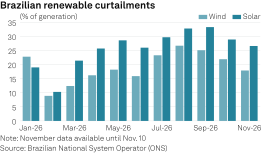
Besides, solar power oversupply has created challenges in operating the system and maintaining its stability. Twice in 2026, the ONS has implemented an emergency plan to cut generation from a wider range of sources during excess of solar generation and lower consumption – usually on Sundays. The plan is considered the last step before localized energy supply interruptions, but continued private investments in solar panels are making this problem harder to solve.
"The emergency plan usually allows cutting 1-2 GW in generation, but capacity keeps growing every year," Brandão added.
The Brazilian Energy Research Bureau expects small-scale distributed generation capacity to reach 72.5 GW by 2030.
Subsidies
To address the problem, the association urges adopting hourly electricity rates for energy consumers, especially those using distributed generation.
The Brazilian government has proposed implementing hourly tariffs for low-tension consumers, but the proposal is still under discussion and pending regulatory approval.
"Hourly energy rates would be a first step to balance consumption and generation throughout the day," Brandão said.
Distributed generation generally refers to electricity generation facilities installed by consumers, with excess output fed into the power grid. When the technology was emerging, the Brazilian government granted subsidies aiming to incentivize electric capacity near consumption centers.
These subsidies are mostly rate discounts for use of the distribution grid and have been gradually removed since 2023. However, the remaining subsidies are estimated at around 18 billion reais ($3 billion) in 2026, according to the National Electric Energy Agency, or (Aneel).
In addition to hourly tariffs, the association demands that the costs of using the grid be applied to newly generated distribution units and that smart measures and other equipment be adopted to increase the sector's predictability.
