Maritime & Shipping, Crude Oil, Wet Freight
November 20, 2026
Shipowners split on new orders as tanker strength faces test from delivery wave
By Mia Pei
Editor:
HIGHLIGHTS
Owners debate ordering amid price surge
2028-29 deliveries threaten rate drop
Long-term charters attract investment
Shipowners are divided over whether to commit more capital to new vessels at current prices, as a wave of deliveries later this decade could coincide with an easing of the trade disruptions that have supported freight rates, executives said during Hong Kong Maritime Week 2026.
"I do not see how it makes sense to order ships at these prices unless it is part of your fleet renewal plans," Pankaj Khanna, CEO of Heidmar Maritime Holdings, told the Capital Link Hong Kong Maritime Forum on Nov. 17.
An owner replacing a handful of vessels in a fleet of 100 could order through the cycle, Khanna said. An owner buying ships at current prices to earn freight on the open market faced a different calculation.
A newbuild VLCC price stood at about $145 million in October, up from $90 million in 2021, according to S&P Global Energy CERA's tanker fleet supply short-term outlook released Oct. 28. CERA noted that tanker ordering slowed in the third quarter amid high prices, limited yard availability and the size of the existing orderbook.
Khanna saw greater risk from deliveries in 2028-29 than from those in 2027, particularly if disruptions affecting the Red Sea, the Middle East and Russia-Ukraine trade eased around the same time.
CERA sees supply risk intensifying from 2028, with global tanker fleet capacity expanding by 6.7% that year, compared with 4.7% in 2027. Scheduled tanker deliveries are expected to reach 67.47 million deadweight tons in 2028, up from 48.09 million dwt in 2027.
More tankers are also due to enter service over the longer term, with supply pressure concentrated in large crude carriers. VLCC and Suezmax tonnage accounts for about 70.5% of tanker capacity on order, S&P Global Energy data compiled in October showed. Scheduled VLCC deliveries alone are expected to rise to 39.85 million dwt in 2028 from 19.33 million dwt in 2027, according to CERA.
Inefficient trades drive earnings
In tankers, inefficient trade flows have sustained freight earnings even as high oil prices have begun to weigh on demand, INTERTANKO chair Rolf Westfal-Larsen Jr. said at the TradeWinds Shipowners Forum Nov. 18.
"It (high freight earnings) is mostly driven by disruption," Westfal-Larsen said of the strong tanker market. "Demand is slowly coming down."
If those trade disruptions ease, the freight market could turn, Westfal-Larsen said. More tankers are also due to enter service over the longer term, although newer vessels offer owners better fuel efficiency and lower emissions, he said.
Platts, part of S&P Global Energy, assessed the Dirty Tanker Basis Global Index VLCC (non-scrubber-fitted, non-eco) at an average of $1,091,963/day in October, up from $823,285/d in September and $416,840/d in August. The index was last assessed at $810,868/d on Nov. 19, down $2,627/d day over day.
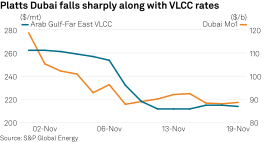
The gap between an investment decision and delivery limits how much owners can read into current earnings, said Sakura Kuma, an executive officer at Mitsui O.S.K. Lines and managing director of MOL (Asia Oceania). Ships entering the fleet today reflect orders placed years earlier, while an owner seeking a yard slot now must assess the market several years ahead, she said at the TradeWinds forum.
Charter cover shapes investment
Other owners still see opportunities when the fleet outlook is favorable and a charterer commits to taking the vessel long term.
"So, I think it is a phenomenal time to invest," SFL CEO Ole B. Hjertaker said at the Capital Link forum, highlighting the balance of supply and demand in individual shipping segments, the availability of long-term charters and limited shipbuilding capacity.
Accumulated earnings give owners room to replace older ships with vessels that consume less fuel and cost less to operate, Li Jiatu, assistant president of China Shipbuilding Consulting Co., said at the Xinde Marine Forum Nov. 17. Li noted an investment strategy of ordering vessels at the group's yards and placing them on long-term operating leases, trading some exposure to rising freight rates for steadier income.
For owners borrowing to order ships, the key consideration is whether they can count on revenue to service the debt when the market weakens, said Christoph Toepfer, founder and CEO of Borealis Maritime Group. "Those who lever up and have security of cash flow, they can be fine."
Lenders are also looking more closely at the charter income behind an order. ICBC Financial Leasing favors long-term employment, tests what a vessel might be worth at the end of the financing period and takes a more cautious approach to loan-to-value ratios, said Simon Sai, vice president of its Asia Pacific department.
Even owners with access to financing face a constraint on how quickly they can add ships, Sai said at the forum. Available yard slots can push delivery to 2030 or beyond, leaving owners ordering today needing to secure employment for a vessel that will enter a different freight market.
