Metals & Mining, Ferrous, Non-Ferrous
June 03, 2026
YEAR OF THE TARIFF: Trump's metals tariffs spur investment, but policy uncertainty limits impact

Editor:
HIGHLIGHTS
50% tariffs boost US project momentum
Policy swings muddy investment outlook
The 50% tariff that the US imposed on steel and aluminum imports in June 2025 has scrambled trade flows, driven up prices and inspired some new investment. This is part two of a three-part series examining the effects one year later. Read parts one and three.
The Trump administration's imposition of a 50% tariff on imports of aluminum and steel has helped build momentum in the US for metals projects, but industry experts say shifting trade policy may be limiting the tariffs' impact on investments.
President Donald Trump doubled the Section 232 tariffs for steel and aluminum in June 2025, raising each to 50%. Trump said the higher charges would boost domestic production and reduce US reliance on foreign imports.
The tariffs, which have remained unchanged aside from the closing of loopholes and the recent lowering of rates for certain industrial equipment, have supported some investment decisions. But the imposition and elimination of other duties have complicated long-term planning and made it difficult to determine how much investment activity has stemmed directly from the levies, analysts told Platts, part of S&P Global Energy.
"Tariffs alone are a meaningful instrument," said Zach Ryan, director of metals and specialty manufacturing at advisory firm Stout. "While Section 232 protections have raised the floor on domestic metals economics, converting that price protection into durable, broad-based private capital investment ... requires a complementary policy architecture."
New US smelter, steel investments in past year
One of the most notable developments in the past year came in January, when Chicago-based Century Aluminum entered into a joint agreement with the UAE' Emirates Global Aluminum to construct the first new US primary aluminum smelter in the last 45 years. EGA initially announced the Oklahoma smelter project in May 2025.
Century also credited the tariffs in an August 2025 decision to restart idled capacity at its South Carolina smelter by 50,000 metric tons/year, a 7.5% increase in production.
The aluminum tariffs pushed the Platts-assessed Midwest Premium to more than four times its pre-tariff level, increasing 297.6% from the beginning of 2025 to the start of 2026.
The White House pointed to the new smelter as a recent example of a US-based investment.
"President Trump's historic agenda to reinvigorate America's steel and aluminum industries with a multi-faceted agenda of tariffs, deregulation, tax cuts and energy abundance has already yielded billions in investments into domestic production," spokesperson Kush Desai said in a May 29 statement to Platts.
In the steel sector, US-based steelmaker Cleveland-Cliffs signed a memorandum of understanding in October 2025 with South Korean steelmaker POSCO to expand POSCO's US customer base. POSCO in December 2025 took a 20% equity stake in Hyundai Steel's new $5.8 billion electric arc furnace mill in Louisiana as part of a business cooperation deal announced earlier that year.
The tariffs have also driven prices for the Platts-assessed TSI US HRC EXW Indiana USD/ST, which increased 34.8% year-over-year from the start of 2025 to 2026.
"What these transactions signal, in aggregate, is a reorientation of global metals capital flows toward the United States," Ryan said.
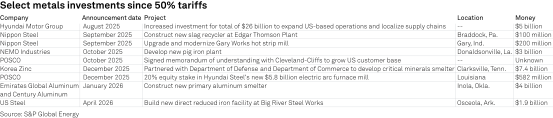
The 50% levies are only one factor in recent metals investment announcements, analysts told Platts.
"The tariffs have not driven the level of new US metals investment that some predicted because new tariffs alone do not offset the broader barriers to investment," said Josh Zive, senior principal at Bracewell.
EGA's new aluminum smelter was driven in part by the US-UAE trade deal, which included investment commitments from the UAE and a $500 million US Energy Department grant, George Heppel, a BMO commodities analyst, told Platts.
Some analysts even see the EGA-Century joint venture as a setback. Century had been conducting a strategic review of an idled smelter in Kentucky before forming the joint venture with EGA, and in February announced it would sell the property to a data center developer.
But reshoring manufacturing has not fully materialized from the tariffs, Clark Packard, a trade policy research fellow at the Cato Institute, told Platts.
"Taking a step back, we lost something like 70,000 manufacturing jobs in 2025," he said. "It's just simply a function of the fact that the US lives in a globally integrated economy."
Policy swings bring uncertainty
Trump's varying tariffs and policies, and an ongoing review of the United States-Mexico-Canada Agreement, havemuddied the outlook for metals investments.
"Broader uncertainty around US trade policy, including USMCA renegotiation, overlapping tariff regimes and the risk of retaliation, has made some investors more hesitant because they cannot confidently model costs, market access or supply-chain decisions over the life of a major project," Zive said.
Section 232 tariffs have intersected with other tariffs implemented over the last year, causing confusion around the stacking of various rates. There have also been changes to content requirements and exemptions that have made navigating the import market complicated, Heppel told Platts.
"Investors are likely understandably cautious about using Section 232 tariffs as the basis for a long-term investment when there is a chance they could be changed or repealed either by this administration or the next," he said.
It will take more than just tariffs to boost the metals investment sector, experts said, pointing to tools such as long-term offtake contracts, price stabilization mechanisms, credible price floors, federal procurement commitments and effective rules of origin.
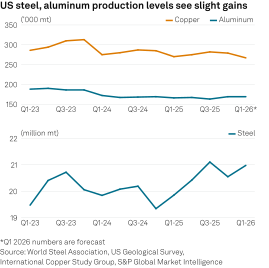
Industry leaders acknowledged that stability is needed for long-term investments, and noted the possibility that levies and pro-manufacturing policies could be repealed by future administrations.
"The clients need stability in order to make good on the promises of investment. Otherwise, everything falls apart," Lourenco Goncalves, chair of the American Iron and Steel Institute and CEO of steel producer Cleveland-Cliffs, said May 12 at the institute's general meeting.
Tariffs alone will not reopen aluminum smelters, Charles Johnson, president and CEO of the Aluminum Association, told Platts.
"We think that we're going to have to have a hard look at American energy policy in order to make smelters viable in the US again," Johnson said. "And even if we start building them today, it'll be six to eight years before they're running."
Steel plant construction is also a multiyear process, but AISI President and CEO Kevin Dempsey said tariffs are prompting investments. Dempsey said he expects to see more if the tariffs stay in place.
"I think there's strong optimism that there's a healthy market in the US and growing demand, so this is going to be a good place to invest," he said.
