Metals & Mining, Non-Ferrous
June 04, 2026
YEAR OF THE TARIFF: US aluminum end-users endure major tariff headwinds

Editor:
HIGHLIGHTS
Tariffs spark construction slowdown, inflation
Auto sector shifts to steel components
Packagers seek substitutes, focus on efficiency
The 50% tariff that the US imposed on steel and aluminum imports in June 2025 has scrambled trade flows, driven up prices and inspired some new investment. This is the final part of a series examining the effects one year later. Part one is here, and part two is here.
After a year of 50% US aluminum tariffs, major domestic end-users have faced significant cost pressures, leading to major operational changes and, in some cases, shifts away from aluminum.
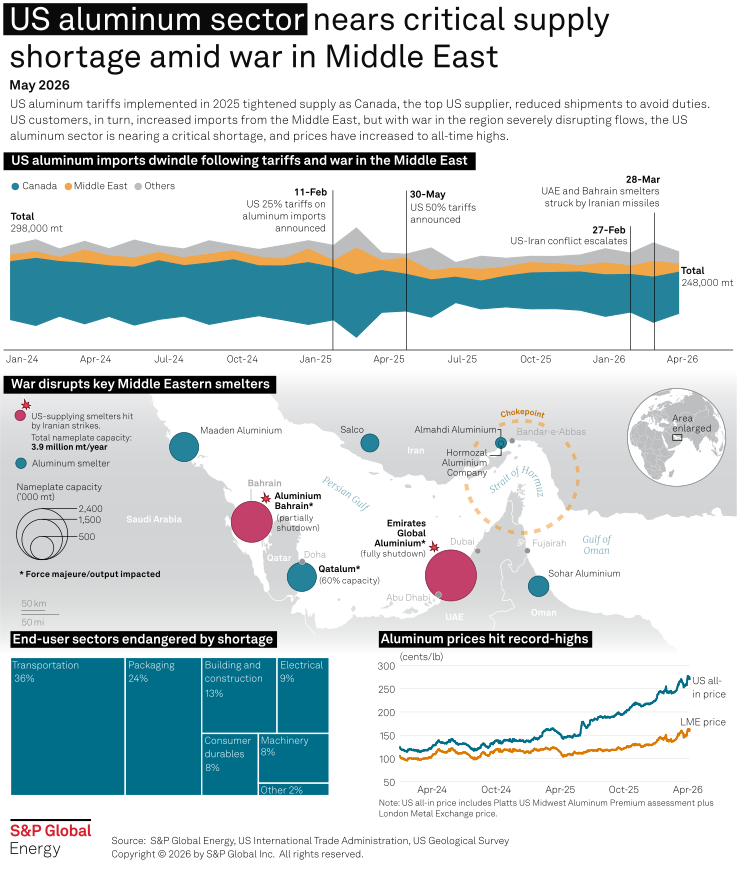
The duties implemented on June 4 pushed US primary aluminum prices to record-shattering highs. Import volumes from the top US supplier, Canada, have also thinned, leaving US markets grappling with supply tightness that is expected to be exacerbated by war-related disruptions to Middle Eastern aluminum producers.
Domestic aluminum demand held steady in 2025, but top consumers in the transportation, construction and packaging sectors are expected to reduce aluminum consumption or endure economic challenges amid surging costs.
"We're reporting an end-of-year [2025] demand number that's positive and a little less than a percentage point," Charles Johnson, president and CEO of the Aluminum Association trade group, told Platts, part of S&P Global Energy. "Not an incredibly strong year, but still a positive year after a good bit of disruption and uncertainty."
North American aluminum demand rose by 0.8% in 2025, according to the Washington, DC-based Aluminum Association.
The largest aluminum consumers in the US for the year were the transportation, packaging and construction sectors, accounting for 36%, 24% and 13% of domestic aluminum consumption, respectively, according to US Geological Survey data.
Demand headwinds
Sky-high aluminum prices are driving some consumers to delay purchases.
Platts assessed the spot 99.7% P1020 US Aluminum Transaction Premium at 117 cents/pound plus London Metal Exchange cash, delivered Midwest, net 30-day payment terms, on June 2.
The assessment, known as the Midwest Premium, is up 116.7% from 54 cents on June 3, 2025.
"There is industrywide inflation, while also making it less likely that certain projects will move forward because it is now less likely that those projects are financially viable," said Anirban Basu, chief economist for the Associated Builders and Contractors trade group. "What these tariffs have done is lay in a stagflationary component onto the industry."
Basu emphasized that the appetite for construction projects is strong, but tariffs, along with high interest rates, are holding back activity.
"There are a lot of people who want to move forward with office projects, hotel projects, warehouse distribution centers, et cetera," Basu said.
Experts said that data center construction has been a notable bright spot for the industry, though it accounted for a small portion of US construction activity.
"Data centers made up 6.8% of US private nonresidential construction spending in March," said Macrina Wilkins, director of market insights at the Associated General Contractors of America, another builders' trade group.
"Data center construction spending has increased by double digits reliably for many months, while almost no other category has seen any positive growth in the last few months," Wilkins told Platts.
Meanwhile, high prices may drive some small-scale beermakers out of canning entirely.
"We are seeing people changing their business model and focus less on distribution and more on the draft and hospitality aspects of their business," said Bart Watson, president and CEO of the Brewers Association. "For a small brewer, it begs the question of, 'should we be selling in cans at all?'"
The Brewers Association is a trade group that represents small and independent craft brewers in the US.
Substitution takes hold
Experts noted that despite relatively positive results in 2025 for US automakers, record-high aluminum prices still exerted notable pressure.
"There's about 500 to 800 pounds of aluminum in a vehicle, more for electric vehicles," said Gerrit Reepmeyer, a partner in the automotive and industrial practice at global consulting firm AlixPartners. "In terms of aluminum prices from 2024 to now, that's a [cost] increase of over $1,000 per vehicle, which is pretty significant. How they're going to react depends on how long the situation will last."
Industry leaders have noted a growing shift away from aluminum to mitigate input cost headwinds.
"We are seeing that the combination of reduced fuel economy and emissions standards and the higher cost of aluminum means automakers are using less aluminum components and using more steel," Stephanie Brinley, principal automotive analyst for S&P Global Mobility, told Platts.
Brinley also noted the struggles US automakers have faced due to the shutdown of the major Novelis aluminum plant in Oswego, New York, following fires in late 2025. The plant is expected to restart operations by June.
"The US auto industry is as healthy as it can be, given everything," Brinley added. "Margins are down, but the major players aren't going anywhere. Using less aluminum has been a strategy."
Some US beer producers are considering using more glass bottles instead of cans, due to the surging aluminum prices.
"We've seen a 30% increase in can prices, and that continues to climb," Watson said. "It's been a real pain point ... we're seeing some people lean into bottles when they have the option."
Aluminum tariffs have also affected multinational breweries.
Molson Coors Beverage Co., the second-largest brewer in the US, has estimated a minimum headwind of $125 million for 2026.
"Our guidance does assume an elevated Midwest premium, which would impact our pretax income growth by about 9 to 10 percentage points," CFO Tracey Joubert said April 30 during a quarterly call.
Eating costs to shelter consumers
Some consumer goods companies have chosen to absorb the higher costs.
"Our industry, by and large, doesn't like to hike [consumer] prices," said Tom Madrecki, senior vice president of supply chain resiliency at the Consumer Brands Association trade group. "We're a low-margin, affordability-focused sector, so nobody wants to increase consumer costs."
The Consumer Brands Association in Washington, DC, represents companies across the consumer-packaged goods sector, including PepsiCo Inc. and The Procter & Gamble Co.
Madrecki emphasized that companies that are heavily reliant on aluminum for beverage or aerosol cans have no real way to avoid hefty tariff costs due to the US' reliance on imported aluminum.
"Everything is done to really try to constrain those [price] increases," Madrecki said. "That typically looks like efficiency creation in terms of supply chain modernization, and the efforts around data and new technology and other ways of trying to hold that back."
The tariff headwinds could also tilt the scales in favor of foreign competitors.
"We may actually get a structural tariff disadvantage if input costs continue to rise because of an aluminum tariff, whereas a finished product from overseas may be at a relative advantage depending on the dynamics afoot," Madrecki said.
