Metals & Mining, Ferrous
June 02, 2026
YEAR OF THE TARIFF: Steel tariff boosts US industry, raises costs for end-users

Editor:
HIGHLIGHTS
Steel tariff boosts US production, prices
Input costs rise 10%-13% for manufacturers
Manufacturing jobs remain flat after tariff
The 50% tariff that the US imposed on steel and aluminum imports in June 2025 has scrambled trade flows, driven up prices and inspired some new investment. This is part one of a three-part series examining the effects one year later. Read parts two and three.
When US President Donald Trump imposed a 50% tariff on imports of steel and aluminum in June 2025, officials said the new duties would revitalize the nation's industrial base by leveling the playing field for domestic producers that were undercut by inexpensive imports.
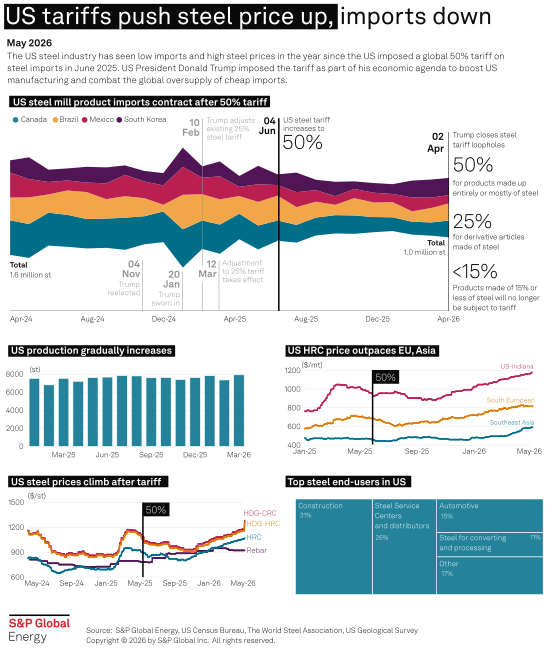
One year later, US steel producers have reaped the benefits of the tariff. Steel imports have plummeted, allowing domestic prices to outpace global prices. US production and capacity utilization have gradually increased as imports declined, despite largely unchanged demand.
But the promised manufacturing boom has yet to materialize for steel consumers. The tariffs have driven up input costs for some downstream sectors, cutting into their profit margins.
"Production is rising, and the industry is in a stronger position than 18 months ago," Tiago Vespoli, a senior research analyst at consulting firm Wood Mackenzie, told Platts. "But the output response has been gradual, reflecting the realities of building new capacity, and the broader manufacturing sector has yet to show a jobs uplift that can be tied directly to the steel tariff."
Platts is part of S&P Global Energy.
Higher costs for steel end-users
The US Bureau of Labor Statistics' producer price index for iron and steel increased 10.4% between April 2025 and April 2026, and the steel mill products index rose 13.3%. Both are major inputs for the construction sector and automotive sectors, which accounted for 46% of net steel shipments in 2025, according to the US Geological Survey.
Until Trump's tariff took effect, the industry's input costs had remained relatively flat since 2023, according to Zack Fritz, an economist for the trade group Associated Builders and Contractors.
"Higher input prices mean higher construction costs, and that means fewer projects pencil out and proceed," Fritz told Platts. "I think that's been a contributor to the fact that nonresidential construction spending has been in a state of decline for some time now."
Nonresidential construction spending in the US peaked at $791 billion in December 2023, according to Census Bureau data. In March, spending was reported to be $729.3 billion, down 2.1% from March 2025.
The decline is largely due to the end of the large projects incentivized by a pair of Biden-era laws, the bipartisan infrastructure act and the CHIPS and Science Act, which pumped money into the construction sector. But higher input costs have also been a factor.
The increased input costs have left some downstream sectors, including automotive and metals fabrication, to negotiate within their supply chains as they face tighter margins.
Platts assessed the TSI US EXW Indiana price for hot rolled coils of steel at $1,201.50/metric ton on May 26, up 31% since Trump imposed the tariff on steel and 58% since Trump took office.
The US price for hot rolled coil is more than double the Southeast Asia price of $571/mt, assessed May 26.
"The cost recovery within the supply chain to account for the tariffs is something that many suppliers are very focused on," Ann Marie Uetz, an automotive supply chain attorney with Foley & Lardner, told Platts. "It's really negotiations with their customers, all the way up to the [original equipment manufacturers], for that cost recovery for tariffs."
A series of charts shows US steel imports falling and prices rising after a 50% tariff was imposed in June 2025.
Limited capex from end-users
The domestic steel industry is in the middle of a $50 billion capital spending wave, Vespoli said, adding that Nucor Corp. alone has several projects ramping up, including a new melt shop in Arizona, a rebar micro mill in North Carolina, and galvanizing lines at its Indiana and South Carolina sites.
End-users have been slower to make new commitments. The most significant announcement since the tariffs took effect is Toyota Motor's $2 billion investment in a new vehicle assembly line at its Texas manufacturing complex.
Among heavy machinery manufacturers, Caterpillar is planning a $725 million expansion of an engine production facility in Indiana and Volvo Construction Equipment is increasing excavator production in Pennsylvania. However, the machinery and equipment sector accounted for only 3% of steel consumption in 2024, according to the US Geological Survey.
Additional policies beyond the 50% tariff will be needed to spur growth in downstream steel sectors, American Iron and Steel Institute President Kevin Dempsey told Platts.
Environmental regulations and permitting policies "are going to be really important for a lot of downstream industries," Dempsey said. "And, you know, nothing happens, especially in government, as quickly as you would like, but I think things are moving in the right direction."
Job numbers unchanged
Employment for the general US manufacturing sector has remained mostly flat at 12.6 million workers through early 2026, while the ISM manufacturing employment index suggests that many subsectors are contracting rather than expanding, according to Vespoli.
The steel industry has added a few hundred new jobs in the past year as steel producers increased capacity, but employment in iron and steel mills and ferroalloy manufacturing has remained largely unchanged.
The sector employed 84,300 workers in March, slightly down from 84,500 workers in March 2025, according to the most recent data available from the Bureau of Labor Statistics. Total employees reached 85,100 in January before marginally falling.
However, the tariff's impact on domestic manufacturing is not primarily in employment numbers, but rather in input costs, sourcing decisions and trade flows, according to Marc Gilbert, global lead at Boston Consulting Group's Center for Geopolitics.
And a recent revision to the tariffs framework has imposed similar duties on steel-derivative products, including machinery and automotive components.
"For manufacturers exposed to tariffed materials, the questions of whether to shift sourcing, redesign products or relocate manufacturing capacity to the US require a long-term view and confidence on the return in invested capital," Gilbert said.
