Metals & Mining Theme, Non-Ferrous, Ferrous
August 21, 2025
FACTBOX: US tariffs roil global metals markets

HIGHLIGHTS
Trump 50% tariffs on copper lead to tumbling US copper prices
Tariffs on steel, aluminum expanded to include derivative products
Duties on Canada, Brazil boosted as US extends negotiations with China
US President Donald Trump's tariff actions in the first three weeks of August, including 50% tariffs on copper and expanded steel and aluminum tariffs, have sent another round of volatility across global metals markets.
The 50% US tariffs on copper imports, which took effect on Aug. 1, were far less broad than markets expected due to the exclusion of raw copper materials from the duties. The move led to plummeting US copper price premiums.
Trump's expansion of 50% tariffs on steel and aluminum imports to include over 400 derivative products was praised by the US domestic metals sectors as a major win against countries attempting to avoid tariff loopholes.
Trump also raised duties on Canada and Brazil to a cumulative total of 35% and 50%, respectively.
The rise in tariffs on Canada will likely have a muted effect on metals markets, as USMCA-compliant goods have been exempted. Virtually all metals are covered under the USMCA trade agreement.
Critically, US tariffs on Brazil excluded pig iron, a key input for steel producers. Brazil accounted for 73% of US pig iron imports under HS code 7201 in 2024, according to S&P Global Market Intelligence's Global Trade Analytics Suite. Brazilian iron will face 10% baseline tariffs rather than a 50% rate.
However, other important metals, such as graphite, manganese, cobalt, and lithium, will be subject to the heightened duty rate.
Trump's country-specific duties went into effect on Aug. 7, further raising barriers between the US and international markets.
Trump extended China's tariff deadline through Nov. 10. US tariffs on China will remain at 30% rather than 64% as negotiations between the two nations continue.
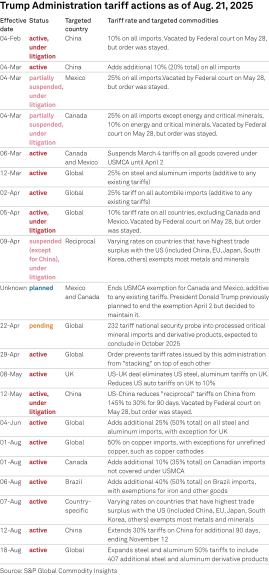
Trump issued an order on April 29 stating that his new series of tariff actions would not stack on top of each other.
In addition, Trump has ordered Section 232 national security investigations into critical minerals.
The US aluminum industry has emphasized that it does not have nearly enough smelter capacity to meet domestic demand. Tariffs on important supply, especially from Canada, have blocked access to affordable metal critical to the US industry.
The US steel sector, on the other hand, is confident it can meet domestic demand on its own amid tariffs, although specialty items may face hurdles, experts told Platts.
Latest trade negotiations
- The US will reduce its reciprocal tariffs for imports to 15% under "a massive deal" with Japan, Trump said on July 22, adding that the country would continue working on another deal to form a joint venture in Alaska for LNG.
- The US reached a trade deal with South Korea, setting a 15% tariff on all South Korean imports to the US, and zero tariffs for US imports into South Korea, Trump said on July 30.
- Joining Canada and China, Brazil has taken the first step toward launching a formal World Trade Organization (WTO) dispute settlement case challenging new US tariffs placed on its exports—totaling as much as 50% for many goods—and saw overtures of support from China, Brazil's largest trade partner.
- China has agreed to extend the suspension of 24% additional tariffs on US goods for 90 days, starting on Aug. 12. China will, however, continue to impose 10% tariffs on US goods.
- The EU and US have confirmed their intention to cooperate on "ring-fencing their respective domestic markets from overcapacity" regarding steel, aluminum and their derivatives in an Aug. 21 deal.
Prices
- Platts, part of S&P Global Energy, assessed the spot 99.7% P1020 US Aluminum Transaction Premium at 71.70 cents/lb plus LME cash, delivered Midwest on Aug. 20, up 207.1% since the start of 2025.
- Platts assessed the daily TSI US hot-rolled coil index at $820/st on an ex-works Indiana basis on Aug. 20, up 18.8% since the start of 2025.
- Platts assessed SS400 HRC of 3 mm thickness at $476/mt FOB China on Aug. 21, up 1.6% since the start of 2025.
- Platts assessed domestic HRC prices in Northern Europe at Eur570/mt ex-works Ruhr on Aug. 20, up 1.8% since the start of 2025.
Trade flows
- US aluminum imports fell 25.6% on the year in June, according to Global Trade Analytics Suite data. Aluminum giant Alcoa said in a July 16 earnings call it had redirected 100,000 mt of Canadian production away from US customers during Q2 in response to tariffs.
- With the US as a top aluminum importer, US aluminum tariffs are set to cause a major shift in global aluminum flows.
- Russia has offered to supply as much as 2.1 million mt of aluminum to the US.
- The US tariffs on all steel imports may cause a significant slowdown in global steel trade and accelerate more localized trade, according to market experts.
- Market expectations of copper tariffs led to a surge of refined copper flows into the US. With refined copper now unexpectedly exempt, the US stock build-up could end up being re-exported by traders, potentially weighing on Asian and European copper prices in the months ahead.
