Refined Products, Crude Oil, Diesel-Gasoil, Jet Fuel, Gasoline
October 21, 2026
South Korea rejects calls for higher diesel exports, but refiners work to meet global demand
HIGHLIGHTS
Export volumes remain capped at 2025 levels
Refiners receive strong demand for more spot cargoes
Seoul uses MOPS for domestic price cap policy
The South Korean government is holding firm on ensuring adequate domestic supplies of clean oil products by capping exports at 2025 levels, rejecting the refining sector's proposal to increase overseas sales, although local refiners remain committed to meeting strong global demand as much as possible, according to the trade ministry and industry sources.
South Korea — Asia's top supplier and net exporter of transportation fuels and middle distillates — has met its contractual supply obligations to term customers across the Asia-Pacific region so far this year. The government and refiners' trading teams have worked together to secure sufficient feedstock crude through supply diversification and alternative logistical strategies, product managers at major refiners in Seosan, Ulsan and Seoul told Platts, part of S&P Global Energy, during market discussions over Oct. 19-21.
However, demand for additional spot supplies of clean oil products from South Korean refiners has surged, particularly for diesel, with the Asian crack spread for the essential middle distillate reaching record highs in the second half of 2026, according to the product managers and the Ministry of Trade, Industry and Resources.
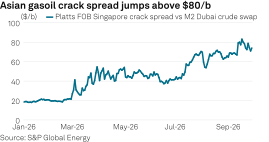
The second-month Singapore gasoil swap crack against Dubai crude swaps reached a record $83.02/barrel on Sept. 16. It averaged $72.97/b in September, compared with $64.71/b in August and the 2025 average of $18.16/b, Platts data showed. The crack spread was last assessed at $66.91/b on Oct. 20.
Seoul recently rejected refiners' requests to ease export controls, emphasizing that maintaining stable domestic supplies and preventing sharp increases in pump prices remained its priorities, MOTIR said in a statement Oct. 19.
The government imposed restrictions on exports of gasoline, diesel and jet fuel/kerosene on March 13 amid concerns over supply disruptions following the US-Israel war with Iran and the effective closure of the Strait of Hormuz.
Under the measures, refiners cannot export more of the controlled products in any month than they did in the corresponding month of 2025. They must also maintain monthly domestic supplies at more than 90% of the same month's sales volume a year earlier, according to MOTIR.
"Amid lingering instability in the international supply of diesel and geopolitical risks, securing a stable [domestic] supply of diesel remains the top priority," a MOTIR official said, citing the fuel's importance to domestic industry and household livelihoods.
Still, the ceiling is not entirely inflexible. The government may approve exports exceeding 100% of year-earlier volumes after consulting refiners, provided market and domestic inventory conditions permit, MOTIR said.
Strong margins, limited flexibility
The restrictions constrain refiners' ability to fully capitalize on exceptionally strong regional margins. Reduced Chinese fuel exports, geopolitical disruptions and Ukrainian strikes on Russian refineries have tightened diesel availability, prompting buyers across Asia, Oceania, Europe and the US West Coast to seek additional spot supplies from South Korea, the product managers said.
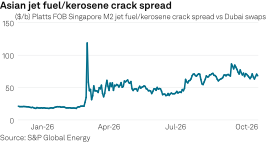
Apart from gasoil/diesel, Platts assessed the FOB Singapore second-month jet fuel/kerosene crack spread against Dubai swaps at an average of $49.17/b so far in 2026, more than double the 2025 average of $17.32/b.
South Korea nevertheless remains well-positioned to meet its term commitments. Refiners have secured steady supplies of light sweet US crude, heavy sour Canadian barrels, Latin American grades and staple Middle Eastern sour crude.
South Korea has about 3.4 million barrels/day of refining capacity, compared with domestic oil demand of roughly 2.3 million b/d, leaving substantial capacity available for exports after domestic requirements are met.
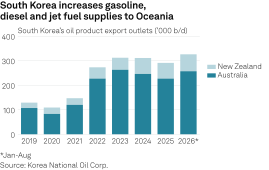
South Korean shipments of refined products to Australia rose 18% year over year to 62.03 million barrels over January-August, while exports to New Zealand increased 11% to 16.7 million barrels, the latest data from state-run Korea National Oil Corp. showed Sept. 25. Clean product shipments to Europe reached a record 5.73 million barrels in August.
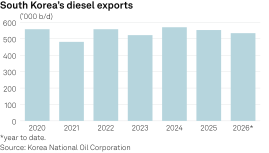
Diesel exports fell 3.4% year over year to 129.82 million barrels in the first eight months of the year.
Among recent spot market activities, GS Caltex offered 300,000 barrels of jet A-1 fuel for loading over Nov. 6-10.
Stable domestic retail prices
The export controls are intended to help ensure adequate domestic supplies and support the government's fuel price ceiling, introduced on March 13 to limit increases in domestic gasoline, diesel and kerosene prices, MOTIR said.
Maximum prices are calculated using average domestic supply costs, changes in Mean of Platts Singapore assessments and applicable taxes. The government will compensate refiners for losses incurred under the program after it ends and will lift the price ceiling and export restrictions once international oil markets stabilize, MOTIR added.
Together with fuel tax reductions, the measures helped bring average retail diesel prices down to 1,843 won/liter ($1.28/liter) in the second week of October, down 8.1% from 2,006 won/liter five months earlier, according to MOTIR. Gasoline prices fell 7.7% to 1,857 won/liter over the same period.
