Crude Oil, Maritime & Shipping, Refined Products, Diesel-Gasoil, Gasoline
August 13, 2026
South Korea turns to longer sour crude routes as Red Sea risks rise
HIGHLIGHTS
Government, refiners activate Suez Canal route option
Delivery time increases by three to four weeks
Strong distillate cracks offset higher costs
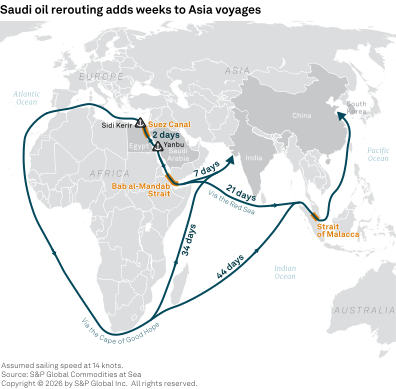
South Korea plans to bring in some of its term Arab Light crude imports by securing longer delivery routes through the Suez Canal and around the Cape of Good Hope, as major local refiners prioritize safety over speed and cost amid growing concerns over ship attacks in the Red Sea's Bab al-Mandab Strait, according to the Trade Ministry, S&P Global Commodities at Sea data, and industry sources over Aug. 10-13.
South Korea, Asia's third-largest crude importer, has taken advantage of the Bab al-Mandab passage to import medium-sour crude loaded at Yanbu Port over the past several months. However, contingency measures are needed due to increased safety risks for tankers navigating through the Red Sea, the Ministry of Trade, Industry and Resources said in a policy briefing report Aug. 10.
The South Korean government and the refining and shipping industries are activating a real-time information-sharing system, discussing alternative routes for transshipment and diversion through the Suez Canal and the SUMED pipeline, MOTIR said.
CAS data showed one VLCC lifted Saudi oil from Sidi Kerir, the Egyptian port on the Mediterranean Sea connected with SUMED, on Aug. 3 for a voyage to South Korea, while another five were fixed for the same route with loading dates later in August and early September.
Those tankers are due to carry more than 12 million barrels of crude, about 70% of the total volume on the emerging Sidi Kerir-Asia trade in the period, according to CAS loading and fixture data as of Aug. 13.
Maritime traffic via the Bab al-Mandab has fallen by around a quarter since Yemen-based Houthi militants started to attack ships in the Red Sea in late July.
Several VLCCs operated by South Korean shipping major Sinokor Merchant Marine Co. have been fixed to deliver medium-sour crude loaded at Yanbu Port to the Far East via the Suez Canal, the Mediterranean Sea and the Cape of Good Hope, Korea Shipowners' Association said in its August monthly key industry issue report.
Saudi Aramco declined to officially comment on the matter Aug. 13.
Although the alternative shipping route would add three to four weeks in delivery time, it is best to choose safety over speed, feedstock managers at two major South Korean refiners based in Ulsan and Seoul told Platts, part of S&P Global Energy, over market engagement and discussion sessions over Aug. 10-13.
South Korea has already managed to secure crude oil equivalent to 110% of the year-ago period for August, while the supplies for September have also been secured with no significant shortfalls, MOTIR said.
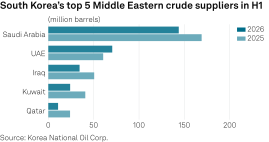
In the first half of 2026, South Korea brought in 143.8 million barrels of Saudi crude, equivalent to 85% of the H1 2025 shipment level, latest data from state-run Korea National Oil Corp. issued July 28 showed.
Refining, logistical economics
Apart from the lengthy extra voyage distance and time, the additional cost of taking the longer alternative route would be quite significant, though attractive Asian middle distillate crack spreads and Middle Eastern crude official selling prices would help cover the shipping cost burden, according to the feedstock managers at Ulsan and Seoul-based refiners, as well as a sour crude trading manager at a major South Korean refiner's trading office based in Singapore.
One VLCC was chartered Aug. 5 for a voyage from Yanbu via Suez and Cape to South Korea at $20.2 million, or $74.8/metric ton, and another was chartered at $20.25 million, according to CAS fixture data, while a third was fixed Aug. 6 for the Sidi Kerir-South Korea trade via Cape at $18.55 million.
Platts assessed the Yanbu-Far East VLCC rate at $64/mt for the Bab al-Mandab route on Aug. 5 and $66.21/mt on Aug. 6.
East Asian refiners are willing to lift as much Arab Light crude as possible since August and September OSPs are attractive after the Dubai forward curve structure flipped to contango for several days in June and July, according to the feedstock managers in Ulsan and Seoul, as well as traders in Singapore.
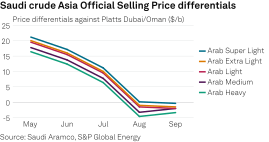
Saudi Aramco has lowered the September OSP differential for its flagship Arab Light crude for Asia-bound cargoes by 50 cents/b month over month to a discount of $2/b to the Oman/Dubai average, according to a company notice seen by Platts Aug. 6.
Furthermore, robust Asian middle distillate crack spreads bode well for South Korea, the world's top jet fuel supplier and Asia's biggest gasoil/diesel and gasoline exporter, according to product marketing managers at two major South Korean refiners based in Yeosu and Ulsan.
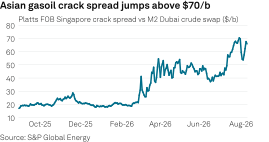
Platts assessed the second-month Singapore gasoil swap crack against Dubai crude swaps at an average of $57.1/b so far in the third quarter, up from the Q2 average of $45.4/b and Q1 average of $25.85/b. Platts assessed the crack spread at $65.9/b on Aug. 12.
