Crude Oil, Maritime & Shipping
July 16, 2026 · Updated July 17, 2026
South Korean, Japanese refiners to keep Red Sea route for Saudi crude
HIGHLIGHTS
To utilize route even if US-Iran war ends
Move part of efforts to diversify delivery options
South Korean and Japanese refiners plan to utilize the Red Sea maritime passage to procure light and medium sour Saudi crude even if the US-Iran war ends and Persian Gulf shipping flows normalize, according to several industry sources and the South Korean government over July 1-16.
A total of 13 South Korea-bound tankers have safely transited the Red Sea to deliver Arab Light crude since the start of the war, with the latest VLCC exiting the Bab al-Mandab Strait on July 12, the Ministry of Oceans and Fisheries, or the MOF, said in its media briefing report on July 13.
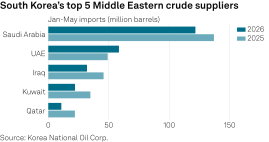
Even if the US-Iran war ends, the South Korean refining industry plans to diversify its Middle Eastern crude delivery options by lifting at least 6 million barrels per month of Arab Light crude from the port of Yanbu in the Red Sea, feedstock managers at three major refiners based in Ulsan and Yeosu told Platts, part of S&P Global Energy, in July.
The MOF said July 13 that it will continue to support the safety of vessels on the Yanbu-South Korea route by providing 24-hour real-time monitoring, as well as by operating a real-time communication channel between the ministry, shipping companies and vessels.
Meanwhile, Prime Minister Han Seong-sook asked officials to conduct thorough checks of crude oil and naphtha supply as well as import flows, while pursuing diversification of supply chains and maritime routes, the Office for Government Policy Coordination said in a statement on July 15.
South Korea secured nearly 90% of its monthly crude oil requirements in May, and shipments to Asia's third-largest crude buyer for July-August are likely to exceed those for the same period a year earlier, the Ministry of Trade, Industry and Resources said in a policy briefing on July 13.
As for September procurement, 76% of the month's crude requirement has been secured so far, and the remaining volume will likely be filled within the next two weeks, according to a July 14 policy briefing from the Ministry of Trade, Industry and Resources.
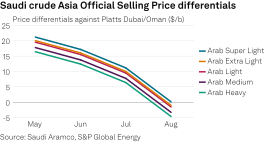
Arab Super Light for Japan
Japan's Taiyo Oil, a major Asian buyer of Arab Super Light crude, will continue to buy the grade, which typically loads from the Red Sea port of Yanbu, as its shipments have not been affected by the US-Iran war, a feedstock inventory and trading manager at the refiner told Platts on July 13.
The company did not respond to a request for official comment on the matter.
Japan's crude oil imports fell to a record monthly low of 853,329 b/d in April, but Asia's fourth-largest crude buyer managed to bring in 900,000 barrels of Arab Super Light from Saudi Arabia that month, data from Japan's Ministry of Economy, Trade and Industry issued June 30 showed.
Additionally, feedstock managers at two other Japanese refiners told Platts over July 13-15 that refiners in the country might aim to use the Red Sea route to bring in 2 million-5 million barrels/month of Arab Light crude, rather than relying almost entirely on the Persian Gulf-Strait of Hormuz passage.
Saudi Aramco declined to officially comment on the matter on July 17.
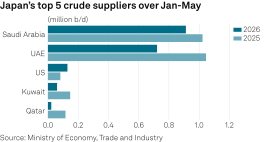
Japan's crude imports in May rose 73% month over month to 1.48 million b/d, the latest METI data showed.
Platts assessed the spread between cash Dubai and the same-month Dubai crude swap at minus $4.13/b on July 2, the lowest level since minus $4.28/b on May 12, 2020. Platts assessed the spread at minus $1.14/b on July 16.
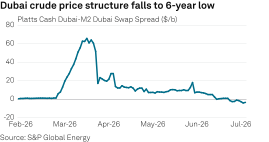
The spread -- widely known as the Dubai M1-M3 market structure -- is a key component of the monthly official selling price calculations used by some Middle Eastern producers.