Crude Oil
July 14, 2026
South Korea’s July-Aug crude procurement set for full recovery, but vigilance remains
Editor:
HIGHLIGHTS
July-Aug fixtures estimated to top year-ago deliveries
Seoul plans real-time monitoring, industry communication
Refiners meet oil products term supply commitments
South Korea's monthly crude oil procurement is poised to fully recover in July and August, although the government and the private refining sector are expected to remain vigilant for any new logistical disruptions in the Persian Gulf, the Trade Ministry and industry sources said over July 13-14.
South Korea secured nearly 90% of its monthly crude oil requirements in May, and shipments by Asia's third-largest crude buyer for July–August are estimated to exceed those of the same period a year earlier, the Ministry of Trade, Industry and Resources said in a policy briefing on July 13.
However, Vice Trade Minister Moon Shin-hak held an emergency meeting on July 13 to address refiners' crude oil procurement after reports that tensions in the Middle East have escalated again, MOTIR said.
The US-Iran tensions may have escalated again, but the near-term impact on South Korea's domestic crude supply is expected to be small, MOTIR said.
"Amid renewed tensions in the Middle East, the government will urgently review crude oil supply and demand conditions," the ministry said. "The government will closely communicate with the refining and shipping industries to prepare for potential crisis scenarios."
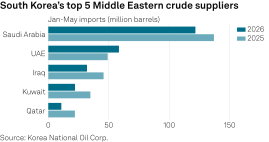
Given the possibility that current tensions could persist for an extended period, the government will establish a real-time communication system with industry, closely monitor conditions in the Middle East and supply conditions, and explore alternative volume procurement options in parallel as part of crisis preparedness, according to MOTIR.
As for alternative options, South Korea has been Asia's largest importer of US crude for many years. Meanwhile, some volumes of Arab Light, along with various light and medium sour Abu Dhabi grades, have bypassed the Strait of Hormuz and been delivered to South Korea over the past couple of months, three feedstock managers at refiners based in Ulsan and Seosan told Platts, part of S&P Global Energy, during market discussion and engagement sessions over June 25-July 13.
Platts assessed the spread between cash Dubai and the same-month Dubai swap at minus $4.13/b on July 2, the lowest level since minus $4.28/b on May 12, 2020. Platts last assessed the spread at minus $1.21/b on July 13.
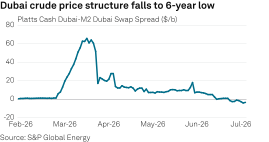
The spread -- widely known as the Dubai M1-M3 market structure -- is a key component of the monthly official selling price calculations used by Middle Eastern producers.
Oil products for Asia-Pacific customers
South Korea is Asia's largest supplier of clean oil products, so many Asia-Pacific term customers for gasoline, jet fuel, and diesel have taken comfort in the feedstock procurement status of major South Korean refiners over the past couple of months, the refinery feedstock managers based in Ulsan and Seoul said.
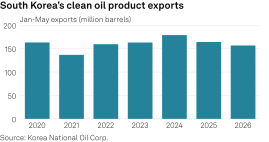
Despite crude oil logistical disruptions in the Persian Gulf since March, four major South Korean refiners, including SK Innovation and S-Oil, have maintained steady runs and fulfilled their term contractual supply obligations for gasoline, diesel, and jet fuel to all customers across the Asia-Pacific so far this year, middle distillate marketing managers at the four refiners told Platts throughout May, June and July 1-13.
"Spot sales may have declined, but term contractual commitments have been fully met...there was no force majeure at all," a product marketing manager at a major South Korean refiner based in Ulsan said.
South Korea exported 156.6 million barrels of gasoline, diesel and jet fuel combined in the first five months of 2026, down 4.54% from 146.04 million barrels a year earlier, the latest data from state-run Korea National Oil Corp. released June 26 showed.
In recent South Korean oil product trading activity, GS Caltex offered two 300,000-barrel stems of gasoline for loading over Aug. 20-24 and Aug. 27-31, respectively, from Yeosu port. The offer closed on July 10, but the tender results could not be ascertained.
