Refined Products, Diesel-Gasoil, Gasoline, Jet Fuel
January 23, 2026
South Korean refiners target 400 mil barrels of clean oil products exports to Asia-Pacific region in 2026
HIGHLIGHTS
Planned supply slightly lower than 2025 exports
Refiners face weak margins, low prices in early 2026
Participants renew most of 2026 term supply contracts
Jet fuel sales to US rise 13.3% YOY in Jan-Nov 2025
South Korean refiners plan to collectively supply about 400 million barrels of clean oil products in 2026, ensuring roughly steady deliveries year over year to key customers across Asia, Oceania and North America, despite weaker refining margins and a low oil price environment early in the year.
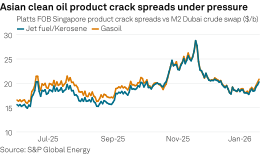
Asian oil products' crack spreads and domestic refining margins have been pulling back since November 2025 amid high US refinery utilization rates, while low outright clean product benchmark prices are hurting export values, according to the state-run Korea National Oil Corp.'s data analysis and a Trade Ministry industry report seen by Platts, part of S&P Global Energy, over Jan. 19-23.
Asia's top clean oil products exporter and the world's largest jet fuel supplier is committed to providing customers and consumers across the Asia-Pacific region with a steady supply of gasoline, jet fuel/kerosene and gasoil throughout 2026, totaling about 400 million-410 million barrels, according to a Platts survey of 11 product managers and marketing executives at five major refiners and downstream companies, including S-Oil and Hanwha TotalEnergies.
The Platts survey was conducted over Jan. 14-23. While most participants declined to be named, they told Platts they could be identified as refinery product managers and sales traders based in Ulsan, Seoul, Yeosu and Singapore.
The 2026 supply target is slightly lower than 2025 exports of 412 million barrels, but above South Korea's average shipment of about 385 million barrels/year since 2020, the KNOC data showed.
China's exports of clean oil products in 2026 are expected to be largely unchanged from 2025. South Korea has mostly renewed its term supply contracts with regular customers across Asia, Oceania and the Americas without significant changes, product marketers at three refiners based in Ulsan and Seoul, as well as those based in Singapore trading desks, told Platts.
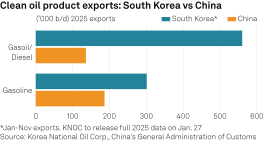
South Korea exported 560,164 b/d of gasoil/diesel in the first 11 months and China sold 136,108 b/d of the middle distillate product in 2025, data from the KNOC and China's General Administration of Customs showed.
Margins, demand, supply
Refinery utilization rates in the US have recently exceeded 95%, partly helped by increased access to cheaper Venezuelan crude. This has intensified competition and has put pressure on Asian products' crack spreads and refining margins, analysts at Seoul-based Korea Petroleum Association and products sales traders at two South Korean refiners' trading offices in Singapore told Platts.
Platts assessed the second-month Singapore gasoil swap crack against Dubai crude swaps at an average of $19.10/b so far in the first quarter, down from $21.60/b in fourth-quarter 2025.
South Korea's domestic average complex refining margin dropped 70 cents/b to $11.50/b in the third week of January and gasoline margins dropped $2/b week over week to $10.70/b, the KNOC data showed.
In addition, the country's total exports reached a record $709.70 billion in 2025, but petroleum products exports declined to $45.50 billion due mainly to the decrease in oil prices, which led to lower unit export prices, according to industry briefing reports from the Ministry of Trade, Industry and Energy and the Korea Customs Service seen by Platts on Jan. 4 and Jan. 22, respectively.
Still, global tourism events like the soccer World Cup in June in Canada, Mexico and the US, as well as a recovery in Asia's high-tech and semiconductor industries, are expected to support jet fuel and diesel demand, product marketers and traders based in Seoul, Ulsan and Singapore said.
South Korea's jet fuel sales to the US reached 38.4 million barrels in the first 11 months of 2025, up 13.3% from 33.9 million barrels a year earlier, the KNOC data showed.
In terms of global supply, Russia's middle distillate and gasoline exports are expected to be limited due to international sanctions, while China is poised to maintain tight control over exports, product marketers at two major South Korean refiners and traders based in Singapore said.
China has likely issued 27 million metric tons of oil products export quotas in its first 2026 allocation, including 19 million mt for clean oil products. This matches the first batch of allocation for 2025, showing no significant policy shift for 2026, Platts has reported.
