Refined Products, Crude Oil, Diesel-Gasoil, Jet Fuel, Gasoline
October 05, 2026
South Korea sustains ample APAC clean product exports on stable feedstock supply
HIGHLIGHTS
Refiners fully secure Oct. crude needs: MOTIR
Diesel exports to Australia jump 18% YTD
Aug clean oil product exports to Europe reach record high
Gasoil crack spreads hit record $83/barrel
South Korea's refining industry expects stable crude procurement through year-end, supported by government measures, enabling major refiners to sustain clean oil product exports to Asia-Pacific customers and help cover essential fuel shortfalls across the region, according to refinery sources, Korea Petroleum Association, and the trade ministry over Sept.29-Oct 5.
South Korea, Asia's top clean oil products supplier and net exporter, has fully secured its feedstock crude needs for October, while crude oil arrivals for the rest of the fourth quarter are expected to reach at least 90% of the previous year's monthly import levels, according to feedstock managers at major refiners based in Ulsan, Seoul and Yeosu, as well as the Ministry of Trade, Industry and Resources in its industry briefing presentation slide for October.
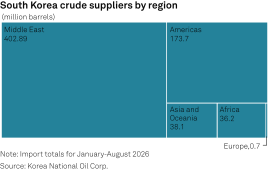
Through rigorous diversification efforts, plenty of light sweet US crude, as well as heavy sour Canadian and various Latin American grades, are poised to regularly arrive, while 1.1 million b/d of staple Middle Eastern sour crudes have also been secured for the rest of the year, a MOTIR official told Platts, part of S&P Global Energy on Sept. 30.
Backed up by stability in feedstock procurement and inflows, South Korean refiners can focus on fulfilling term-contract commitments for gasoline, diesel and jet fuel to Asia-Oceania customers, while also supplying spot cargoes to regional markets facing acute shortages, middle distillate product managers at major refiners based in Ulsan and Seoul, as well as marketing managers at two South Korean refiners' trading offices based in Singapore told Platts over market discussion sessions over Oct. 1-5.
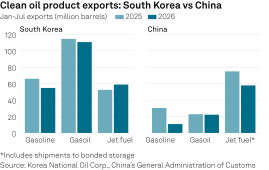
With about 3.4 million barrels/day of refining capacity and domestic oil demand of around 2.3 million b/d, South Korea has about 1 million b/d of surplus refining capacity available for exports, according to data from state-run Korea National Oil Corp. and KPA.
As the global imbalance between clean oil products supply and demand has intensified, South Korea's refining industry has been helping to address diesel supply shortages in various economic partner countries, responding to requests from countries such as Australia and New Zealand, KPA said in its industry report Oct. 2.
In the first eight months, South Korea exported 62.03 million barrels of refined oil products, mostly diesel and gasoline, to Australia, up 18% from the same period a year earlier, the latest data from state-run Korea National Oil Corp. issued Sept. 25 showed.
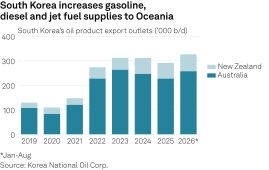
Shipments of essential fuels and oil products over January-August to New Zealand also rose 11% year over year to 16.7 million barrels, KNOC data showed.
Among recent spot market deals concluded in the Asian market, South Korea's second-biggest refiner GS Caltex sold 300,000 barrels of 50 parts per million sulfur gasoil for loading over Oct. 23-27 at a discount of about $1.50/b to the loading-month average of Mean of Platts Singapore 10 parts per million sulfur gasoil assessments, FOB.
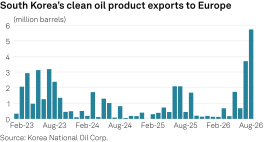
Apart from the regular Asia-Pacific outlets, South Korea sold a record-high 5.73 million barrels of clean oil products, including gasoline, gasoil and jet fuel, to Europe in August, KNOC data showed.
Robust crack, lower Chinese exports
South Korean refiners could find additional opportunities to supply Asia-Pacific markets as steep cuts in Chinese exports tighten regional availability and support exceptionally strong middle distillate margins, the Singapore-based middle distillate marketers and the Seoul-based product manager said.
Market participants expect China's October exports to fall to about 2 million mt, sharply below the previous estimate of 3.85 million mt and estimated September shipments of 4.36 million mt, Platts reported previously.
The pullback has left regional buyers seeking alternative gasoline, diesel and jet fuel supplies. Australia could be particularly affected after a 35,000-mt ultra low sulfur diesel cargo and a similar-sized jet fuel shipment from China, both scheduled for mid-October loading, were withdrawn from shipping fixtures, according to a Singapore-based shipping source.
Tighter Chinese supply has strengthened regional refining margins. Platts assessed the second-month Singapore gasoil swap crack against Dubai crude swaps at a record high of $83.02/b on Sept. 16. The crack spread has averaged $72.97/b in September, up from $64.71/b in August, $56.14/b in July and the 2025 average of $18.16/b.
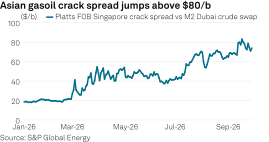
The elevated cracks offer South Korean refiners a strong incentive to maximize exports once domestic supply requirements and term commitments have been met, the Seoul-based refinery product manager told Platts.
With crude procurement stabilizing and China's export suspension potentially extending into November, South Korean refiners are well positioned to offer incremental spot cargoes to Australia, New Zealand and other Asian markets facing supply shortfalls, according to the Singapore-based middle distillate marketers and KPA.
Nevertheless, overseas sales will remain subject to government measures requiring refiners to prioritize domestic fuel security, with the export volumes capped at 2025 shipment levels.
