Crude Oil, Maritime & Shipping
September 28, 2026
South Korea fully secures August crude needs with US, Mediterranean, Oceania supplies
HIGHLIGHTS
US crude imports surge 50% YOY
Government freight rebates support diversification
Middle East share drops to 62% from 70%
South Korea has nearly met its monthly crude requirements in August through aggressive US crude purchases and regular cargoes from the Mediterranean and Oceania, while government freight rebates for non-Middle Eastern crude were poised to further accelerate refiners' diversification efforts, according to Korea National Oil Corp. data and industry sources over Sept. 25-28.
South Korea — Asia's third-largest crude buyer — imported 91.34 million barrels of crude in August, nearly matching the 93.35 million barrels secured a year earlier, according to the latest data from state-run KNOC issued Sept. 25.
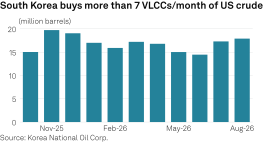
US crude imports climbed 50% year over year to 17.93 million barrels in August, making the US South Korea's largest supplier for the month. Shipments were also 3.6% higher than in July, despite US crude commanding strong premiums in the Asian spot market, KNOC data showed.
The steady availability of WTI Midland and other US Gulf Coast grades has made US crude a dependable alternative for South Korean refiners seeking to reduce exposure to Middle Eastern supply disruptions, feedstock managers at two major South Korean refineries in Ulsan and Seoul told Platts, part of S&P Global Energy, during market discussions Sept. 25-28.
Ample US production and regular export programs have allowed refiners to secure plentiful WTI Midland cargoes on a regular basis, while the government's freight cost support has helped offset the light sweet US grade's high spot premiums and the longer voyage to Northeast Asia, the feedstock managers based in Ulsan and Seoul, as well as two traders at a South Korean refiner's trading office based in Singapore told Platts Sept. 28.
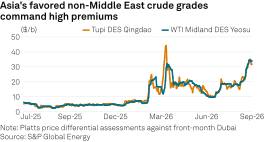
Platts assessed WTI Midland DES Yeosu basis at a premium of $34.6/barrel to front-month Dubai on Sept. 18, marking a record-high price differential for the light, sweet US crude delivery to the Far East. The premium was last assessed at $31.8/b Sept. 25.
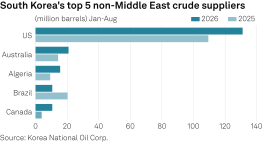
South Korea is poised to maintain its status as Asia's top US crude buyer in 2026. Imports from the US totaled 131.09 million barrels in January-August, up 19.9% from 109.38 million barrels in the same period last year, KNOC data showed.
Other non-Middle Eastern supplies also increased in August and during the first eight months.
Mexican crude arrivals increased sharply in August to 2.98 million barrels, up 227% from a year earlier, while imports from Algeria rose to 2.48 million barrels from zero a year earlier, and Kazakhstan supplied 2.07 million barrels of CPC Blend crude last month, almost double July's 1.05 million barrels, KNOC data showed.
Australian ultra-light and heavy sweet crude shipments over January-August rose 46.4% year over year to 20.93 million barrels, while Algerian Saharan Blend crude imports over the same period climbed 68.2% to 15.65 million barrels, KNOC data showed.
The growing mix of US, Mediterranean, Latin American, and Oceania grades gives refiners additional flexibility in managing crude quality and shipping risks, the Singapore-based traders and two refinery feedstock managers in Ulsan and Seoul said.
Staple Middle Eastern grades
Despite the diversification push, South Korea's refining industry still requires medium and heavy sour Middle Eastern grades as staple feedstocks, the feedstock manager in Ulsan said.
The country's refineries were largely configured to process a broad range of Middle Eastern crude grades, and replacing those barrels entirely with light sweet grades from the Americas would not be possible, he added.
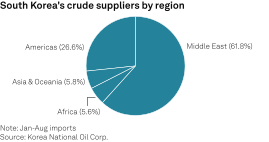
Middle Eastern supplies accounted for about 62% of South Korea's crude imports in January-August, down from nearly 70% in 2025, KNOC data showed. The lower share reflects stronger purchases from the Americas, Oceania and Africa, but Middle Eastern crude remains the foundation of the country's import portfolio, the Ulsan- and Seoul-based feedstock managers told Platts Sept. 28.
Refiners have taken full advantage of Middle Eastern supply routes that avoid the Strait of Hormuz. Imports from the UAE increased 11.4% year over year to 101.56 million barrels in January-August, while Oman shipments surged 313.3% to 16.40 million barrels over the same period, KNOC data showed.
Abu Dhabi grades shipped from Fujairah and Oman Export Blend from Mina Al Fahal provide medium-sour alternatives with direct Indian Ocean access, reducing exposure to Hormuz transit risks, Platts reported previously.
South Korea's top 10 crude suppliers in August (Unit: '000 barrels)
| Supplier | August 2026 | August 2025 | Change (YOY) | July 2026 | Change (MOM) |
| Saudi Arabia | 21,669 | 34,938 | -38.0% | 30,709 | -29.4% |
| US | 17,926 | 11,953 | 50.0% | 17,296 | 3.6% |
| UAE | 16,761 | 18,556 | -9.7% | 14,277 | 17.4% |
| Kuwait | 7,580 | 9,815 | -22.8% | 3,997 | 89.6% |
| Oman | 4,000 | 0 | -22.8% | 5,040 | -20.6% |
| Iraq | 3,826 | 11,105 | -65.5% | 0 | n/a |
| Australia | 3,616 | 0 | n/a | 3,239 | 11.6% |
| Mexico | 2,982 | 912 | 227.0% | 2,950 | 1.1% |
| Algeria | 2,480 | 0 | n/a | 1,841 | 34.7% |
| Kazakhstan | 2,074 | 0 | n/a | 1,051 | 97.3% |
| Total | 91,335 | 93,351 | -2.2% | 93,180 | -2.0% |
| Supplier | Jan-Aug 2026 | Jan-Aug 2025 | % Change |
| Saudi Arabia | 196,215 | 232,481 | -15.6% |
| US | 131,094 | 109,376 | 19.9% |
| UAE | 101,556 | 91,160 | 11.4% |
| Iraq | 38,344 | 70,550 | -45.6% |
| Kuwait | 35,708 | 57,215 | -37.6% |
| Australia | 20,925 | 14,292 | 46.4% |
| Oman | 16,404 | 3,969 | 313.3% |
| Algeria | 15,648 | 9,302 | 68.2% |
| Brazil | 15,551 | 20,273 | -23.3% |
| Qatar | 14,672 | 30,551 | -52.0% |
| Total* | 651,633 | 685,714 | -5.0% |
*Includes other suppliers
Source: Korea National Oil Corp.
