Crude Oil, Maritime & Shipping, Wet Freight
September 08, 2026
APPEC: Canada expands west coast crude exports to meet Asian demand
HIGHLIGHTS
TMX pipeline shifts Canadian crude to Asia
China receives 374 cargoes since May 2024
VLCC capacity targets 2032-2034 launch
Expanding Canada's west coast crude oil export capability is about diversifying global supply outlets and building a durable and dependable heavy sour crude supply option for Asia, a Trans Mountain executive said at APPEC 2026 in Singapore on Sept. 8.
The export capability has expanded dramatically over the past few decades, thanks to the Trans Mountain Expansion, or TMX, pipeline launched in May 2024, which presented a structural change in where Canadian supply can land, Trans Mountain's CEO Mark Maki said during a panel discussion at APPEC hosted by S&P Global Energy over Sept. 7-10 in Singapore.
Canadian crude had previously been routed predominantly toward the US market, but TMX made it possible for tankers to increasingly point to Northeast Asia, Maki said.
According to his presentation slides during the panel discussion, China took the bulk of Asia-bound shipments from the Westbridge marine terminal, totaling 374 Aframax cargoes, from May 2024 to July 2026. South Korea ranked second with 33 cargoes, India came in with four cargoes, and Japan recorded three cargoes.
Those shares reinforce the "diversify to Asia" strategy as not just aspirational, but already visible in how cargoes are being allocated across the region, Maki said.
Refining margin analysts and refinery logistics managers from Japan, Thailand and South Korea told Platts, part of S&P Global Energy, on the sidelines of the conference that tanker flow disruptions in the Persian Gulf this year significantly increased the urgency to secure alternative heavy sour crude grades.
China's private mega refiner Zhejiang Petroleum & Chemical has been the country's largest buyer of heavy crudes from Canada. The refiner was estimated to have purchased about 178,000 b/d of Canadian crudes, including Cold Lake, AWB and Pacific Dilbit, in the first eight months of the year, according to Platts data.
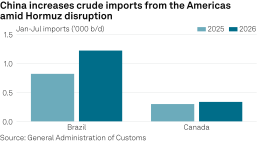
It was up by about 35.9% from the volume of 131,000 b/d imported by the company in 2025, Platts data showed.
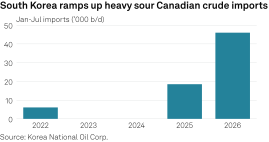
Meanwhile, South Korea aims to raise imports of Canadian crude to as much as 16 million barrels in 2026, a more than threefold increase from 4.88 million barrels in 2025, and will also explore increasing volumes further to 20 million barrels/year.
Elsewhere, Japan's top refiner ENEOS received a rare Canadian crude cargo on Aug. 12, according to S&P Global Commodities at Sea. The ship Freedom Glory departed Vancouver on July 19 with 559,070 barrels of Western Canadian Heavy sour crude and arrived at ENEOS's Kiire terminal in southwestern Japan on Aug. 12. ENEOS did not disclose the specific crude grade or final cargo volume.
Further capacity expansion
Trans Mountain's next phase of west coast pipeline buildout is designed to unlock an additional 1 million b/d of export capacity, shifting the project from an "access" upgrade to a more scalable seaborne export platform, according to Maki.
The aim is to give Canadian producers and shippers more flexibility to match heavy crude volumes to buyer demand across Asia, rather than operating within tighter constraints that can limit cargo size and shipment frequency, he said.
The proposed west coast expansion includes plans to accommodate VLCC loading for heavy crude into Asia, not just Aframax cargoes, which have been the practical norm for shipments so far, according to Maki.
That matters because VLCC lift economics can improve the delivered cost per barrel on long-haul routes, allowing refiners and trading desks to assemble larger cargo programs and maintain more stable supply schedules, Maki said.
Maki added that this capacity and vessel-size upgrade is targeted for commissioning and in-service in the 2032-2034 window, giving the Canadian supply chain time to align logistics and contracts with Asia's refining and trading needs.
In the meantime, it also reinforces Canada's diversification strategy by making Canadian heavy crude more consistently "mappable" into Asian procurement plans -- especially useful when alternative trade flows, including those linked to the Persian Gulf, face disruptions, he said.
Spot price in Asia
In the Asian market, the price of Cold Lake for December delivery rose to a premium of around $3-$4/b to ICE Brent Futures on a DES Shandong basis as of Sept. 7, up from flat about two days ago, according to two refinery sources in Dongying in Shandong, home to the country's independent refineries.
Meanwhile, Platts assessed Cold Lake at an average premium of $1.48/b against Dubai, CFR South Korea, to date in the second half of 2026, compared to H1's average of a 5-cent/b discount.
