Natural Gas, Metals & Mining, LNG, Agriculture, Non-Ferrous, Meat
July 07, 2026
COMMODITY TRACKER: 5 charts to watch this week

By Staff
Editor:
EU LNG imports declined for a third consecutive month in June amid disruptions in the Persian Gulf, while Japan's aluminum premiums reached their highest quarterly level in a decade. The Platts Dirty Tanker Index retreat from June highs, European glycerine price parity and North Asian pork belly record lows are also in focus.
1. EU LNG imports fall amid Persian Gulf disruptions
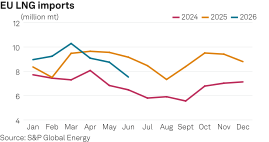
What's happening? EU LNG imports fell 18% year over year to about 7.5 million metric tons in June 2026, marking the third consecutive month of decline, according to S&P Global Energy CERA data. The persistent loss of production from the Persian Gulf following the Iran war has strained Europe's gas sourcing, with about 20% of global LNG exports disrupted due to lower maritime traffic through the Strait of Hormuz. The Platts JKM benchmark for Northeast Asia has exceeded the Platts DES Northwest Europe LNG benchmark by an average of $2.16/million British thermal units since late March, up from a $0.93/MMBtu premium at the start of 2026, reflecting intensified cross-basin competition for available volumes. Platts is part of S&P Global Energy.
What's next? Despite a late June deal between the US and Iran to halt fighting and resume flows through Hormuz, recent exchanges of fire have heightened uncertainty about the agreement's durability. CERA analysts project EU and UK LNG imports to rise 13.9% in Q3 2026 compared to Q3 2025, reaching about 27.9 million mt. However, lagging imports have impacted Europe's winter storage campaign, with EU storage sites only 48.9% full as of June 29, compared to 58.6% in 2025 and 77.1% in 2024, according to Gas Infrastructure Europe data.
2. Japan aluminum premiums hit decade high on supply concerns
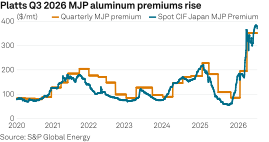
What's happening? Platts assessed Japan's Q3 imported primary aluminum premium at $395/mt plus London Metal Exchange cash, CIF main Japanese ports on July 6, rising 11.9%-12.9% from $350-$353/mt in Q2. These are the highest quarterly premiums in a decade, last exceeded in Q3 2014 at $404/mt. The assessment was based on 10 trades totaling a minimum of 15,500 mt/month, concluded July 3-6. Port stocks at the main Japanese ports fell to 238,000 mt in May, down 4.60% month over month and about 28% year over year, the lowest since February 2012. Japanese demand remained stable year over year with no significant improvement.
What's next? Market participants expect premiums to ease in Q4 as Middle Eastern production normalizes. Al Taweelah smelter production is being restored faster than anticipated, though hot metal production could take up to one year to return to pre-disruption levels, Emirates Global Aluminium said July 2. The timeline for restoring full Middle Eastern export volumes remains uncertain. Japanese buyers continue to prefer Good Western-origin material, limiting the impact of additional regional supply from sources including Xinfa's electrolytic aluminum project, PT Kalimantan Aluminum Industry and increased Indian exports.
3. Dirty tanker index retreats from June highs
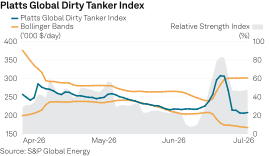
What's happening? The Platts Dirty Tanker Index stood near $208,000/day on July 2, below its short-term moving average of $234,000/d and long-term moving average of $244,000/d, indicating a technically heavy market. The index rose from low-$200,000s/d in early-to-mid June to more than $307,000/d by June 23, with the relative strength index pushing above 80 around June 22-24, signaling overbought conditions. By late June and early July, it cooled back toward the high-40s. The index pushed above the upper Bollinger band in late June, briefly crossing the $300,000/d threshold, indicating the move exceeded normal trading conditions. By June 26, it had repositioned closer to the $200,000/d mark, where it has traded since.
What's next? Market participants expect Q3 performance to depend on effective fleet availability and ton-miles rather than headline ship supply. If Persian Gulf tensions continue easing, rerouting assumptions shorten, insurance friction reduces and ships return smoothly into the spot pool, effective supply could improve quickly. Normalization of ship traffic via the Strait of Hormuz may release pent-up demand for delayed or deferred cargoes. However, a durable rally needs support beyond Persian Gulf-to-China VLCC strength, requiring Suezmax strength on West Africa-to-Europe routes and Aframax strength in the Mediterranean, Black Sea, North Sea, Baltic, Caribbean and US Gulf. The Red Sea remains a separator, with Cape of Good Hope rerouting the working assumption.
4. North Asian pork belly prices hit record low
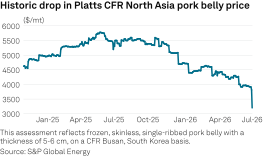
What's happening? North Asian pork belly prices reached a record low on July 1, with Platts assessing the CFR North Asia pork belly price at $3,200/mt for August-September loading to Busan. This represents an 18.4% decline month over month and about 40% decrease year over year. Market participants across North Asia have shown minimal buying interest for weeks, citing high inventory levels and large inflows of Spanish pork bellies. Since Japan implemented a blanket ban on Spanish pork due to African swine flu, products are moving to South Korea more quickly, leading to lower offer prices, according to South Korean importers.
What's next? Despite low Spanish pork offer prices, buying interest is expected to remain subdued, according to importers. While falling prices would typically prompt regular buyers to purchase, current market conditions and high inventories mean buyers are unlikely to step forward simply because prices have dropped. South Korean importers anticipate bearish sentiment to persist in the coming months, as ample belly stocks continue to pressure domestic spot prices. The market outlook remains weak with no immediate signs of recovery in demand or inventory reduction.
5. European glycerine grades reach price parity
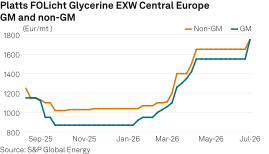
What's happening? European glycerine markets saw genetically modified and non-GM grades reach price parity for the first time since August 2025, as supply constraints during scheduled maintenance eliminated the traditional price differential. Platts assessed both EXW Central Europe non-GM glycerine and GM glycerine at Eur1,750/mt on July 1. A Germany-based supplier said small volumes currently available were scheduled long ago from buffer tanks or warehouses, with no new material for purchase.
What's next? Market participants expect the spread to widen once production resumes in early August and import flows restart. Cheaper GM material from Latin America and non-GM supplies from Southeast Asia are anticipated to restore traditional price differentials. A France-based trader said that when producers restart around early August, they will need to catch up with delays on open contracts first. The market also awaits processing of non-GM material from the rapeseed crop once operations resume.
Reporting and analysis by Matt Hoisch, Yuxi Du, Marina Ledakis, Nikolaos Aidinis Antonopoulos, Rubashiny Veeramohan, Uzma Gulbahar.
