LNG, Natural Gas
July 01, 2026
EU LNG imports fall 18% YOY in June amid sustained wartime strains: CERA

By Matt Hoisch
Editor:
HIGHLIGHTS
Third consecutive YOY drop in monthly figures
EU Jan-June LNG imports flat compared to 2025 at 53.7 million mt
US has supplied 59% of EU LNG so far in 2026
LNG imports into the EU fell year over year for the third consecutive month in June, according to data from S&P Global Energy CERA, as the persistent loss of production from the Persian Gulf continued to weigh on global trade and strain Europe's gas sourcing.
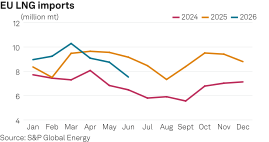
The EU imported about 7.5 million metric tons of the fuel (equivalent to about 10.4 billion cubic meters of natural gas) in June, down about 18% year over year, CERA data showed.
The June downturn marks a sharp increase in the year-over-year shortfall in monthly EU imports that has emerged since the outbreak of the Iran war. Persian Gulf LNG exports that had already cleared the Strait of Hormuz shortly before the war began helped ensure that March imports outpaced those seen the prior year. Since then, however, the EU's monthly intake of LNG has lagged 2025 volumes.
April 2026 imports were some 620,000 mt lower than those in April 2025, and May 2026 trade was 810,000 mt lower than May 2025, according to the latest CERA data.
Despite the recent declines, however, elevated trade early in the year enabled total EU LNG imports so far across 2026 to come in roughly even with those across the first six months of 2025, at 53.7 million mt.
JKM-NWE spread
The widening monthly deficit emerging in the recent data underscores Europe's vulnerability to disruptions in the global LNG market.
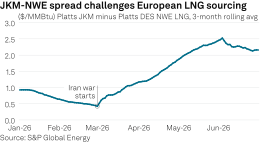
Even though CERA figures show the EU only sourced about 8.2% of its LNG imports from the Persian Gulf in 2025 -- all from Qatar -- the sustained loss of about 20% of global LNG exports with the lower maritime traffic through the Strait of Hormuz ratcheted up cross-basin competition for the remaining volumes.
The Platts JKM benchmark for LNG delivered into Northeast Asia has exceeded the Platts DES Northwest Europe LNG benchmark by an average of $2.16/million British thermal unit since late March. By comparison, at the start of 2026, the Asia benchmark averaged a premium of just $0.93/MMBtu to the European marker across the same span.
The deal late last month between the US and Iran to halt fighting and allow flows through Hormuz to resume has fuelled expectations of more ample trade in the months to come. CERA analysts recently projected EU and UK LNG imports across Q3 2026 to rise 13.9% compared to Q3 2025 and reach some 27.9 million mt.
Recent exchanges of fire between the US and Iran, however, have also heightened uncertainty around the durability of bilateral deal and possible trade resurgence.
Growing storage struggles
Lagging LNG imports have also contributed to a similarly lagging European campaign to stock gas ahead of winter.
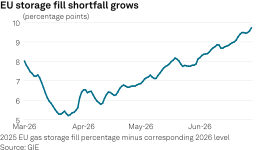
Storage sites across the EU were only 48.9% full as of June 29, according to the latest data compiled by Gas Infrastructure Europe. At the same time in 2025 and 2024, stocks were filled to 58.6% and 77.1%, respectively.
Moreover, the storage fill deficit has grown in recent months, GIE figures show. The EU-wide fill is now some 9.7 percentage points behind the corresponding 2025 level, compared to just 5.2 percentage points in late March.
Top suppliers
Halfway through 2026, the US remains the EU's dominant LNG supplier, shipping it some 31.6 million mt, or 59% of the EU's imports of the super chilled fuel so far this year, according to CERA data. By the same point in 2025, the US had met about 55% of the EU's year-to-date LNG imports.
Russia has held strong as the EU's second-largest LNG supplier across the first six months of the year, despite the banning of imports under both spot and short-term deals in recent months. Russian exports made up about 18% of the EU's year-to-date LNG supply, or 9.8 million mt, CERA figures show. This is up from the same period last year, when Russia supplied some 15% of the EU's LNG.
With Qatar largely out of the international market for the bulk of the year so far, Nigeria has emerged as the EU's third-largest supplier, shipping it 3.2 million mt of LNG in 2026, or about 6% of the EU's imports since January, according to CERA. Nigeria met a similar share of the EU's LNG needs throughout the first half of 2025.
