Natural Gas, Electric Power
June 30, 2026
Europe's gas, power markets brace for heat, supply risks and ETS overhaul in Q3
Editor:
HIGHLIGHTS
Gas eyes Middle East LNG return; storage struggles
Power faces heat risk as nuclear curtailments loom
Brussels to reveal key EU ETS reforms July 15
Soaring temperatures across Europe are poised to reshape gas, power and carbon markets in the third quarter, with meteorologists warning that the 2026 El Niño phenomenon is set to be considerably more intense than in previous years.
The timing could hardly be more precarious. Europe's natural gas situation remains fragile due to lingering Middle East tensions, while domestic storage inventories are languishing well below seasonal norms, a combination that analysts say creates a risk for substantial upside pressure on both gas and electricity prices.
Even a moderately warmer summer would likely push gas and power prices higher, fuelled by surging cooling demand and heightened risks of nuclear plant curtailments during extreme heat, all while the European Commission prepares to unveil sweeping reforms to the bloc's flagship carbon market on July 15.
"Markets have already begun pricing in these risks," analysts at BNP Paribas noted in a recent research note. "The TTF curve has started pricing the coming months -- August and September -- at a premium to the front, while November and December contracts are trading at a discount."
Middle East LNG uncertainty
Halfway through 2026, geopolitical shifts remain a key uncertainty for the European gas sector as market watchers assess the durability of the recent US-Iran agreement to halt the fighting that has rattled global markets for much of the year.
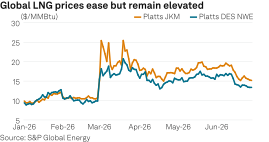
Vessel traffic through the Strait of Hormuz has begun to pick up, and European price benchmarks have subsided from the recent highs seen in the early weeks of the war. However, gas markets have yet to make the sort of recovery back down to pre-war levels that oil markets have.
A major indicator to monitor will be the return of Qatari and Emirati LNG supplies to the global market as both producers ramp up exports.
"Any backtracking on the current peace agreement, or further technical delays to plant restoration, would likely have a significant impact on late-summer and early-winter price dynamics," said Dominic Simmons, senior principal gas analyst for S&P Global Energy CERA.
The return of flows from the Persian Gulf would help to loosen a global LNG market whose recent tightness has pushed Europe into steeper competition for scarcer cargoes with buyers in Asia.
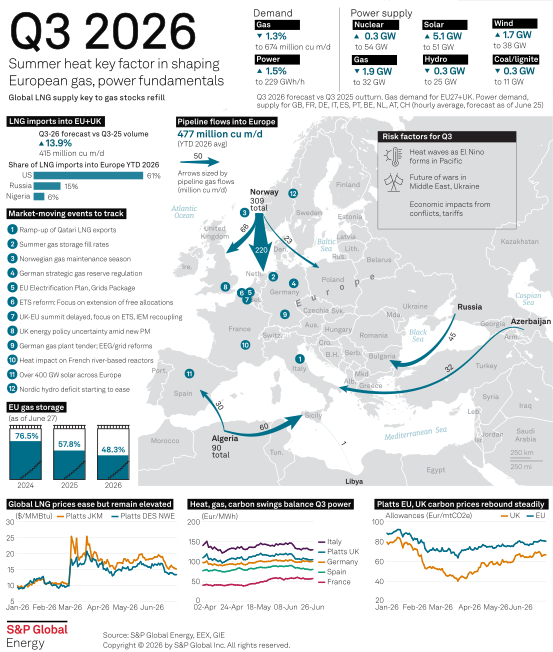
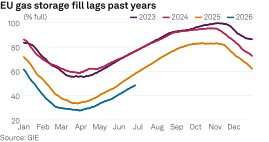
Europe's struggles to attract LNG imports have contributed to the continent's difficulties filling gas storage sites ahead of next winter. EU gas storage was filled to 48.3% as of June 27, according to data compiled by Gas Infrastructure Europe. At the same time in 2025 and 2024, stocks were filled to 57.8% and 76.5%, respectively.
Forward prices have proved another hurdle to Europe's storage build. Summer gas prices have consistently outpaced winter ones, tempering the incentive for market players to store gas in warmer months to sell for a profit in colder ones.
"With the fill deficit widening versus both last year and the five-year average, conditions remain tight," Simmons said. "Concerns around fill rates are intensifying as the market moves into mid-summer."
CERA analysts project European storage to hit 74% full by the end of Q3 2026, which would be on pace for a 78% fill by the end of October.
On the demand side, CERA analysts forecast EU and UK gas needs to dip by 1.3% year over year for the quarter, to 674 million cubic meters/day. One driver comes from the power side, where higher gas prices are expected to incentivize greater gas-to-coal switching where possible.
Upside risk for power
European power prices enter Q3 at slightly elevated levels, with French summer prices bearing the biggest heat wave risk due to the current market discount.
Gas-dependent markets like Italy, Great Britain and Germany are highest, with German Q3 going into delivery at Eur100/MWh compared to Eur129/MWh in Italy, while France is at less than half the Italian price.
Overall, rising solar capacity and a sluggish economy have kept a lid on Q2 price pressures amid episodes of negative prices this spring.
"Late June was an early test of how summer heat waves can impact European power prices and fundamentals. Considering the record temperatures, the impacts on French nuclear and other factors have not been as severe as feared, reflected in a relatively muted response from forward Q3 prices," said Glenn Rickson, head of near-term power analytics at CERA.
"But there are still risks, particularly for markets such as Belgium, which is undergoing its first summer without nuclear and has seen record intraday prices."
In addition to higher cooling demand, restrictions for nuclear and even some gas plant pose the biggest heat risk.
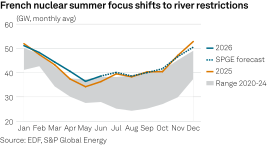
The record-breaking French heat wave saw three reactors halted for environmental reasons in late June.
Despite reduced reactor availability, CERA analysts only expect a minor dent to French nuclear output, forecasting the highest Q3 average since 2019.
Across southern Europe, heat waves have become a common feature over recent summers, with rising solar capacity somewhat reducing the impact, most visible in Iberia.
Hydro levels in the Nordics have recovered after a massive deficit this spring, easing pressure for southern Norway.
Demand in Q3 is forecast to increase 1.5% year on year, according to CERA.
"Abnormally high temperatures -- as observed in late June and forecast for early July -- could see a rise in air conditioning. Low wind commonly coincides with spells of high temperatures and has the potential to exacerbate heat wave conditions," said Kerry Thacker-Smith, senior power analyst at CERA, noting a combined 34 GW swing in lower wind and higher demand in the last week of June across the major five European markets.
In supply, new solar capacity is set to balance demand gains and lower gas and coal generation, assuming average weather conditions.
Nuclear is set to top the mix despite Belgium's first summer without reactors online.
In policy, focus will be on the UK where a new prime minister is incoming, while Germany aims to get final approval for major reforms to pave the way for the first gas plant tender in September, as well as the green energy law to steer the expansion of solar and wind.
ETS overhaul looms
The European carbon market is at a critical juncture, with the European Commission poised to unveil sweeping reforms to the EU Emissions Trading System on July 15, changes that could reshape the bloc's flagship climate policy for years to come.
The highly anticipated review will examine fundamental pillars of the carbon market architecture, from the phase-out trajectory of free allowances allocated to energy-intensive industries to the mechanisms governing supply and demand, as well as potential expansions into new sectors.
Early indications suggest the Commission will introduce multiple adjustments to the EU ETS framework, including recalibrating the Market Stability Reserve by applying an annual fixed reduction rate of 4% to both absorption and release thresholds, while extending free allocations contingent on industrial investment commitments.
The reforms will arrive after months of extraordinary volatility that have tested the market's resilience. European carbon allowances had clawed their way back to just above Eur80/mtCO2e by late June, recovering from a bruising selloff earlier in the year when Europe's climate ambitions collided with industrial policy concerns.
The political turbulence was not confined to Brussels. In the UK, carbon prices opened the third quarter on a bearish note despite recent strength, as Prime Minister Keir Starmer's resignation forced the postponement of the July 22 EU-UK bilateral summit -- a key meeting where alignment between the UK and EU emissions trading systems was set to be discussed.